
A 40-Something Fat Guy, Learning Life Lessons in an MMA Ring 

Most guys of my age and my physical “stature” likely spend their sunny Sunday afternoons on a golf course. Or sitting in a baseball park or at a movie theater. Maybe they just spend the afternoon on the couch, recovering from a long week and preparing for a longer one.

Instead, I spent my last Sunday at a civic center in Central New Jersey. I was there to cheer on my daughter, competing in her first “Challenge of Champions,” a regional grappling and kickboxing tournament sponsored by Tiger Schulmann’s MMA. My mini-me has been training with Tiger Schulmann’s for two years now. On Sunday, she earned a silver in grappling for 9-10-year old girls, and a gold for kickboxing.
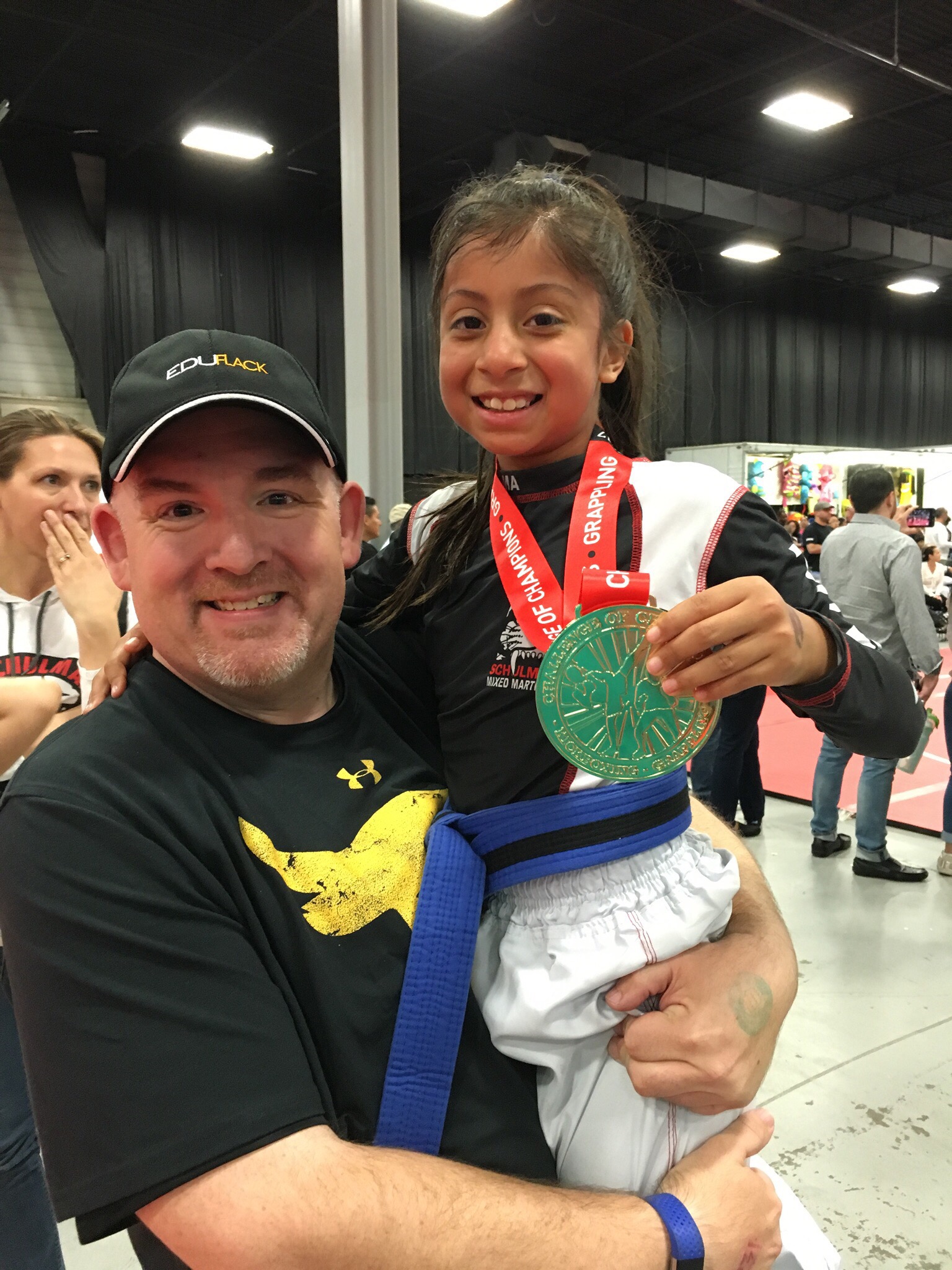
But I was also there for me. I’ve been training a few months longer than my daughter. As a result, I spent my Sunday strapping on my gear to kickbox against the old, fat, and unskilled bracket (those over 40, more than 200 pounds, and with white, blue, or yellow belts). Unlike my daughter, I left with no celebratory hardware. Instead, I walked away from my bouts with two fractured ribs, bones broken 30 seconds into my first fight, and that remained broken throughout my entire second bout.

 
Which begs the question, why in the world is a guy like me spending his Sunday getting kicked and punched to the point of breaking? Why do I spend much of my free time sparring with men half my age and with (at least) twice the skills and athletic prowess? Why do I suffer from broken toes, fractured tibia, and more bruises than I care to count, and respond by thinking of how I can do better and how I can avoid suffering the same injuries in the future? I should be pedaling a stationary bike or strolling around the neighborhood. Instead, I worry about the quickness of my left cross and the strength of my roundkicks.

Why?

I do it because it forces me to do something that doesn’t come easy to me. Not everything should come naturally. Not everything is covered by our personal skill sets or lives in our personal wheel houses. When we are challenged to break those comfort zones, we learn who we truly are as individuals.

I do it because it eliminates the word quit from my vocabulary. Parents know how often kids want to stop doing something because it might be a little challenging. If I’m not traveling for work, then I’m on the mat training. I don’t come up with excuses to skip, and my kids (both of whom train) similarly can’t offer excuses. 

I do it to be healthier. Yes, kickboxing is an incredible workout. I’m a man who once weighed more than 400 pounds. Today, I am in the best physical shape of my life. I’m stronger. I have far greater physical stamina. More importantly, I am healthier so my kids see the importance of a healthy lifestyle and staying physically active. If dad (and mom) can do it, then the kiddos can definitely do it.

I do it to clear my mind. It may sound silly, but the hour on the mat is the one hour in a given day when I don’t think about work or family or finances or any of the other thousand and one things that weigh on me most days. I need to focus on the task at hand. If my mind drifts to a work issue, I’ll take a blow to the body (or worse, to the head). So I need to stay focused on me and my opponent. All of those professionals who embrace the philosophy of “deep thinking” or who bemoan the impact of multi-tasking fully understand the benefit.

I do it because it is a pure meritocracy. No one cares what one does for a living. It doesn’t matter how much money one earns, how big one’s house is, or what car one drives. What matters is commitment, focus, and skill. It’s about the color belt around one’s waist and the number of days one trains. As a result, my community is one that we strive for in the 21st century. It is male and female. It is black, white, brown, and yellow. It is Christian and Jewish, Muslim and atheist. It is young and old. At the end of training, we are all just brothers and sisters, working toward similar goals.

And I do it because it provides a sense of family. It may sound incredibly corny, but our little Princeton school does indeed become a family. I care for many of the other kids there as I do for my own, watching them train and develop. We have a tight group of families that train, with both parents and all kids working. It provides a sense of belonging that it harder and harder to find these days. We help each other through training issues, through work issues, through family issues, and through personal issues. And we do it because we choose to, not because of a sense of obligation.

I have no grand aspirations. I recognize that Dana White is never going to come knocking on my door, because he has been looking for someone just like me to join the UFC. I know that, no matter how much time I put in, my skills will never be great. Sure, I know they will improve over time, and I want them to improve, but few will ever look at me and use the words “skilled fighter” without adding a “not a” before it. I’ll continue to work through the bumps and bruises and breaks, using them as motivation instead of reason for surrender.

I do so because it makes me a better, more complete individual and because it makes us a stronger, more capable family. I’m reminded of that when I see a group of people cheering their hearts out for my daughter as she took home the gold. I’m reminded of that when I see those members of my Tiger family who waited until the very last fights of our friends were fought late on Sunday evening. And I’m reminded of that when I see the resiliency, commitment, and respect my young children demonstrate on a daily basis because of it all.

At the end of the day, I am a writer, a father, an advocate, an agitator, a strategist, an innovator, and a fighter. And through all of the ups and downs all of those identifiers bring me in both my personal and professional lives, I wouldn’t want it any other way.

(Eduflack is a high blue belt training at Tiger Schulmann’s MMA in Princeton, NJ. A version of this piece also appeared on LinkedIn Pulse.)

Can We Check Our Impulse to Condemn?

It should come as no surprise, but we aren’t the most open-minded, slow-to-judgment crowd in education policy. We haven’t been for generations, and we certainly aren’t now. And that’s a crying shame.

The embodiment of this in 2017 is the Pavlovian response by many to condemn everything and anything that may be proposed by EdSec Betsy DeVos almost as quickly as she unveils it. While dear ol’ Eduflack gets that there may be a great deal of policy disagreements in the coming years, are we really willing to say there isn’t a single issue where there may be some common ground for a discussion? Is there not a single idea that may be put forward that is at least worth a productive discussion?

We examine this topic on this week’s #TrumpED program on the BAM! Radio Network. My hope is that we can soon all just take a collective breath and actually consider before condemning. But the realist in me realizing my hopes are often unfulfilled.

Regardless, give it a listen.

A Textbook Case of Bad Crisis PR

Before Eduflack focused his attentions completely on education policy and school improvement, I used to spend my days in crisis communications. I counseled Fortune 500 companies, national non-profits, and name-brand politicians on how to navigate potentially crippling PR issues that they did, or that were done to them. And I was pretty good at it.

So in watching the Kathy Griffin PR fiasco unfold this week, I was aghast with how poorly she was advised (or how poorly she did what she was advised to do). Over at LinkedIn Pulse, dear ol’ Eduflack offers some analysis of how Griffin went wrong, and what she should have done.

The big takeways? Take responsibility for one’s actions. Don’t look to blame other people, Don’t make it a racial issue when you are a privileged white person. Don’t make it a gender issue when it has nothing to do with gender politics. And don’t forget to say you are sorry while promising to do better.

Give it a read. Remember the advice. Hopefully, you’ll never need it.

Is Budget an Education Strategy?

Last week, the Trump White House released its education budget. Most of its content was no real surprise, as it mirrored the skinny budget the Administration offered earlier this year. But as the education community continues to wait for a clear blueprint on how the Administration intends to make public education great again, the budget substitutes as strategy. We now read what we want to read out of the numbers, whether it be true or not.

On the latest episode of #TrumpED on the BAM! Radio Network, we explore how budget just can’t substitute for strategy, and how EdSec Betsy DeVos could go a long way focusing on the latter, rather than defending the former. Give it a listen.

Some PR Advice for the EdSec

It’s been four months since the start of the Trump Administration. Three months since EdSec Betsy DeVos’ confirmation hearing. Yet most are still waiting for DeVos to take control of the ED bully pulpit like her predecessors did. And waiting. And waiting.

Over at the Fordham Institute’s Flypaper blog, Michael Petrilli offers some advice from PR pros on how DeVos could, or should, up her comms game. There are some valuable thoughts there. Then there are some insights offered by yours truly. You may be right, Eduflack may be cray-cray. But I do think it would be a master stroke to have DeVos ask Randi Weingarten if she can address the full AFT at its summer gathering. 

Give the full article a read. You won’t be disappointed.

Home Schoolers Don’t Want to Be a “Choice”

Earlier this week, EdSec Betsy DeVos continued to tease the details of the big school choice plan that is likely to come from the Trump Administration. The next day, the President’s budget reflects that same commitment to dramatically expanding access (and dollars for) public charter schools and vouchers for private education.

In all of the discussion, though, an interesting voice has spoken out asking NOT to be included in the expanded school choice plan. That voice? The homeschool community. As Eduflack explains in the most recent edition of #TrumpED on BAM! Radio Network, the reasons for this make a great deal of sense. With federal dollars comes federal oversight and regulations.  And while the homeschool community may largely trust President Trump and his administration on the topic, there are no guarantees that a future President or EdSec will hold the same level of respect for homeschoolers.

Give it a listen. I promise it is an interesting examination of an equally interesting topic.

Learning to Learn Better: The Interview

Dear ol’ Eduflack has been spending a great deal of time recently focused on the subject of cognitive science. Dating back to my time helping lead the National Reading Panel, I’ve been fascinated with learning about how people learn. And I’ve been even more fascinated by those that, despite the incredible growth in cognitive learning research in recent years, continue to believe that learning is an art, with little room for hard science.

So when I heard about the new book, Learn Better: Mastering the Skills for Success in Life, Business, and Schools, or How to Become an Expert in Just About Anything, I was sold. The book itself is terrific, weaving a tight narrative of instruction, storytelling, and inspiration. And it applies to concepts of learning, and learning better, in areas many of us may never have thought of.

That’s why I just had to reach out to Ulrich Boser, the author of this terrific book, to get some answers to the questions I was begging to ask. Most know Boser as a senior fellow at the Center for American Progress. My first interactions with him date back to when he was an editor at US News & World Report. As author of Learn Better, Boser has made an important contribution to the discussion of how we improve learning and how we ensure our educators, our institutions, and our learners are prepared for what the future of learning might bring.

Huge thanks to Boser for indulging me and stepping up on the five most important questions his book left me with. 

EDUFLACK: What was the most surprising story on learning you heard as part of your research? 

BOSER: For me at least, the story of Roger Craig was definitely the most surprising. To explain, Roger Craig thought that he might have an edge at Jeopardy after reading about an approach to learning known as spacing. The idea behind spacing is pretty simple. Since we all forget, learning should be spread out—or spaced—in order increase the amount of learning.  

So Craig began to study Jeopardy! trivia using a spaced approach, and with the help of a bit of software, he would revisit every weird Jeopardy detail in a highly distributed—or spaced—way.

Armed with this bit of the science of learning, Craig dominated Jeopardy. He first appeared on the game show in the fall of 2010 and eventually set a record for the most amount of money won in a single game.

Craig’s success at the game show tells two bigger stories, I think. First, learning often leaves as soon as it arrives, and to account for this fact, people should revisit whatever they’ve learned at regular intervals.

Second, people can use the science of learning to develop much richer skills. 

EDUFLACK: Learn Better seems to champion competency-based education, the ability of a student to both learn and be able to do/demonstrate. Is that a fair assessment?

BOSER: Absolutely. Indeed, I find the debate over competency-based education a little narrow minded, to be honest. More specifically, does anyone really argue that we should not measure competency? To me at least, it seems obvious that if students learn something, they should be able to–you know– do it.

In my mind, the more important question is: How do we measure competency? What programs and policies do we need to figure out if students can really demonstrate their learning?

From my conversations with researchers, it seems that robust learning is the ability to think in a certain field. So if someone wants to be a competent engineer, they should be able to think like a engineer. If someone wants to be a competent a car mechanic, they need to think like a car mechanic.

This isn’t as complicated as it seems, and according to a growing number of experts, this sort of thinking—and learning—often comes down to analogies. In other words, we can learn a lot by seeing the relationships within a field, by seeing how things fit together.

For me, the problem is that our education system is not aligned with the research. Standards, curriculum, tests, they often push in different directions on the issue of competency, and we need better tests and instructional tools to promote—and measure— analogical thinking within an area of expertise. 

EDUFLACK: In recent years, there has been a drumbeat that every student can and should benefit from a liberal arts college education. But as you emphasize finding value in one’s learning, is “all can benefit” the approach we should be looking to?

BOSER: I think a liberal arts education is deeply important. To engage in the world, we need a broad base of knowledge, from knowing Mozart to understanding the Battle of Mogadishu. What’s more, a liberal arts-oriented education can help us learn new things. Background knowledge helps learning, and the most reliable indicator of what you can learn is what you know.

At the same, we expect way too much of schools. In K-12 at least, schools are supposed to teach everything from reading to coding, social skills to citizenship, tuba to Picasso, plus win an occasional sports championship. That’s simply too much, and it keeps schools from focusing on effective teaching and learning. 

EDUFLACK: The thesis of Learn Better seems to place a great deal of responsibility on the learner to own his or her own education. What should teachers today be doing, or doing differently, to ensure better learning in their classrooms?

BOSER: Great question. First, I’d point out that students need to learn responsibility in the same way that they learn geometry or Spanish, and we need to give young people more opportunities to develop ownership skills in meaningful ways.

This can be difficult, to be sure. I have little kids, and as we are rushing out the door each morning—a mess of untied shoes and missing water bottles—it’s hard to imagine giving my kids any more responsibility. But giving kids some ownership is crucial. It gives them an opportunity to practice responsibility.

Second, we have to realize that people need to find their own meaning. This is key to learning, and people have to find their own meaning in a subject in order to be driven to learn that subject.

This means that just sprinkling some pop culture facts on a topic isn’t going to make it interesting. Alas, just mentioning the Kardashians during math class isn’t going to promote any robust forms of motivation.

Instead, educators should encourage students to find their own value in a topic, to figure out how the students might uncover their own relevance in a field of expertise.

Chris Hulleman at the University of Virginia puts this idea well. Motivation “is about making that connection between what people are learning and what’s going on in their lives,” he told me. “Value is the mechanism. For people, the question is, ‘Can I see why this is valuable to me?’” 

EDUFLACK: In talking about the need to shift from rote memorization to deeper thinking, I read it as a need to move learners from being generalists — or jacks of all trades — to being specialists or expert in those things that really drive them. Are we headed toward such a future?

BOSER: Yes, and in many ways, this future is already here. After all, the history of the modern world is the history of specialization, and our economy runs on people developing pretty narrow areas of expertise.

Adam Smith wrote about the power of specialization centuries ago in his book Wealth of Nations, and at its core, it’s about dividing up labor. What’s more, technology is putting a version of this trend into hyperspeed by automating more and more tasks, which requires more and more specialization.

That said, we don’t always need to become experts. Mastery isn’t always necessary. But we should stay away from rote learning. It’s simply not effective.

Let’s take changing a tire on a car, for instance. I don’t need to become expert in the skill of tire changing. My tires don’t break down that often. But I do want to go beyond a rote understanding of tire changing.

Because if I have a rote understanding, I will not be able to change a tire on any other car besides my current car. That doesn’t help me that much, especially if my friend’s car has a flat tire or if I get a new car.  

So when it comes to changing a tire, I would want to learn how to change a tire well enough that I understand some of the basic principles (like lift) and enough of the mechanics (like unscrewing bolts) that I can change the tires on different cars.

To answer your question, then, we want people to specialize–and learn some topics very well. But some generalization remains necessary, at least if you don’t want to be stranded by the side of the road with a flat tire.

Off the Pace on ED Hiring

Eight years ago, Eduflack wrote on the appointments the then new Obama Administration had made. With almost all of the senior, Senate-confirmable appointments made by then EdSec Arne Duncan, we saw a great deal of ED leaders coming with backgrounds including the Gates Foundation and New Schools Venture Fund, but almost none that came with experience working on educational issues at the state level.

Oh, the good ol’ days!

Here we are in May of 2017, and we are still waiting to see what experiences and backgrounds the senior ranks of EdSec Betsy DeVos’ Education Department will bring. One would like to believe that she will have strong representation of those with experiences at the state and local level. One can assume that the state of Michigan, as well as the American Federation for Children, Great Lakes Education Project, and other efforts DeVos has personally involved herself in. But that’s what it is, a belief. It is a guess. It is a hope (or for others, a fear).

It’s not a matter of waiting for those positions to be confirmed by a cantankerous Senate. No, it is still an issue of actual nominations being put forward.

No word on who will serve as Under Secretary, with a responsibility of overseeing most higher education work, including student loans. No word on who will serve as Deputy  Secretary, essentially running ED day to day. No word on who will run Elementary and Secondary Education, overseeing ESSA implementation and all that comes with it. No word on who will run the Office of Innovation and Improvement, with the likely portfolio of implementing DeVos’ school choice effort. Not even word on who will run the Office of Communications and Outreach, ensuring a consistent message and a community of supporters to move whatever agenda is ultimately put forward forward.
EdSec DeVos has an opportunity to really move some things. Setting aside budget politics for a second, the Trump agenda allows for significant action on issues like career and technical education, adult education, and early childhood. The school choice proposal is on par — both financially and inspirationally — with Duncan’s Race to the Top Efforts or Rod Paige’s NCLB agenda. But to take advantage of it, DeVos needs leaders who can help shepherd parts of a cohesive policy agenda. She needs individuals who can build coalitions and recruit advocates. She needs visionaries who can help states and localities think outside the box. And yes, she needs rabble rousers who can constantly push against the defenders of the status quo.

Until we see who is in those positions, we truly have no idea what the potential impact of a DeVos agenda may be. Washington, DC is often where good ideas go to die. Whether it be because of Hill inaction, lobbyist pressures, grassroots uprisings, implementation challenges, or unforced errors, change in education is a hard nut to crack. Time will tell if Team DeVos will get to enjoy the meat, or will continue to tap away at the often unpenatrable shell.

Just Say No to Political Pottymouths

If you haven’t noticed yet (and it is near impossible not to notice), the 2016 elections have led us into a 2017 political discourse where the name of the game is vulgarity. The language that was once used in political backrooms is now being used front and center in public meetings, speeches, and in social media. Things most people wouldn’t say to their mothers are now being said before cheering crowds of thousands.

Over on Medium, I look at the rise of cuss words as substitute for political voice. As with any name calling, it fills the space because we simply can’t think of anything substantive to put in its place.

As dear ol’ Eduflack writes: “it is fascinating that a generation of parents who regularly preach to their kids, ‘use your words,’ to express their frustrations now throw in the towel when it comes to doing the same themselves.”

Give the full piece a read. You won’t f*%!in’ believe it!