Gender Lines on the … Alphabet?

Most parents have been warned of the dangers of “gender-specific” toys and what that means nowadays. It’s perfectly acceptable for little girls to play with soldiers or guns (as long as parents aren’t anti-violence, etc.) and it is equally acceptable for little boys to play with dolls and tea sets.

Just the other day, a friend of Eduflack shared a photo on Facebook of her five-year old son receiving an American Boy doll for his birthday. The child just couldn’t have been grinning any bigger than he was from scoring his dream present.

We say that there are no gender-specific colors either. It is perfectly fine for girls to prefer drab colors, just as it is for boys to own pinks and purples. (And I can proudly say that Eduflack has a significant number of pink, purple, and pastel articles of clothing, but owns almost nothing black, except for my kickboxing gear.)

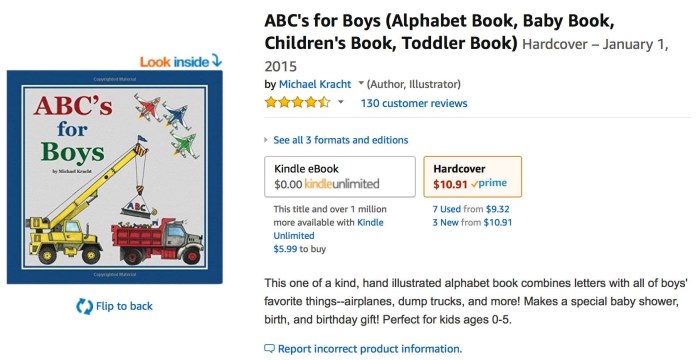
One would hope we’ve gotten past the whole gender appropriate discussion when it comes to equipping our children with the attire, toys, and such one needs these days. But then Amazon has to go and ruin everything. For you see, in 2017, there is one set of ABCs for boys, and another set for girls.

IMG_3009.JPG

IMG_3008.JPG

Seriously? We are more than halfway through 2017 and we still think boys learn the ABCs from airplanes and dump trucks while girls only garner it through lessons of butterflies and castles?

Setting aside, for a second, that folks are paying $10 a piece for an ABC book. Setting aside, for a moment, that twice as many people saw the need to review the boys’ ABCs than the girls’. Setting aside, for a bit, that it took two additional years to finally wrap up the ABCs that were appropriate for the “fairer” gender. Was all of this really necessary? Is there now a demand for a gender-fluid ABCs?

I miss the good ol’ days when it was all about making sure a child could read at grade level by the end of the third grade. It didn’t matter if they were reading words from a Babysitters Club book or the Hardy Boys.

Sigh. Double sigh. Sigh in both pink and camo.


Choosing the Kardashians Over GoT

We’ve reached the point in our society when we want every micro-action we take to have deep socio-political meaning. As Eduflack writes at LinkedIn Pulse, sometimes we need to accept that television viewing is just entertainment, and shouldn’t be seen as anything more.

We are just as guilty of this in the education space, assuming we know what makes someone tick because of their opinions on an issue such as testing, standards, choice, or teachers unions. And we then ascribe that “tick” to everything they do, from raising their kids to voting.

As I write for Pulse:

In the past decade, I’ve watched more episodes of Keeping Up With the Kardashians than I have segments of 60 Minutes. After reading five newspapers – The Washington Post, The New York Times, USA Today, The Wall Street Journal, and the New York Post – each morning, there just isn’t much more I’m going to get from television news magazines.

I’ve yet to make it through an entire Rachel Maddow show, but I’ve watched plenty of RuPaul’s Drag Race. And plenty of UFC Fight Night on Fox. In short, I’m the Neilsen Ratings’ worst demographic nightmare.

Why is this important? At a time when we should be looking for commonalities and ways to bring people together, we are using more and more – including our media consumption – as ways to divide and ascribe potentially mistaken personas.

Give it a read. And if you are up for it, come catch an episode of the Kardashians or a UFC match with me. It’ll be entertaining, I promise.

Does the Media Really Need a Listening Tour?

Since the November election, mainstream media outlets have made pilgrimages to “flyover” states to better understand those millions of people who voted for Trump. Using the book Hillbilly Elegy as their Frommer’s Guide to Red America, reporters have returned with tales of low incomes, opioid abuse, American flags, and Bible verses. They’ve written how those who voted for Trump will be most negatively impacted by his policy recommendations. And they’ve questioned how such voters can remain so loyal to such a President.

In its dogged pursuit of a President, the media has, both indirectly and directly, called into question the intelligence and motives of the voters who elected him. As a result, those same voters gravitate to the media outlets they are most comfortable with. Maddow or Hannity? New York Times or New York Post? NPR or Rush? HuffPo or Breitbart?

From Eduflack’s latest on LinkedIn Plus, Do Media Really Need a “Listen to America” Tour?


A “Chicken Little” Political Resistance 

The Resistance is based on a negative frame, standing up against all that it sees as wrong and immoral. But it does so without putting forward a positive vision or an alternate plan. And it does so by insulting those individuals who voted the other way, attacking the very intelligence and morality of the average red voter. The Resistance is a protest movement. It makes no bones about that. But If those issues it pounds away on don’t come to fruition, it appears as much ado about nothing to those not in the protest. It is merely a group of true believers providing comfort to other true believers.

From Eduflack’s latest US News & World Report commentary, The Sky Isn’t Falling

Chasing Social Media Squirrels 

The public can attack President Trump for Twitter behavior that is beneath the office, but it shouldn’t ignore that while we let an entire media cycle get dominated by a Tweet about a morning show host on a cable network, the Trump Administration put into place new regulations regarding the profiles of people who can enter the United States from certain countries and what they are allowed to bring with them when they enter our borders. And we might want to question what really deserves our limited, ADHD attentions.

From Eduflack’s latest on President Trump and the public responses to his social media activities 

Celebrating West Virginia’s Country Roads

On this day in 1863, the great state of West Virginia was formally admitted into the Union. While Eduflack may consider himself a Jersey boy, it is hard to forget that I am also a proud graduate of West Virginia public schools (Jefferson County Consolidated High School in Shenandoah Junction, West Virginia, to be exact).

And while I left “By God” West Virginia for college, going across state lines to attend Mr. Jefferson’s University of Virginia, I went on to serve my adopted home of West Virginia. For years, I served as an aide to Senator Robert C. Byrd, a tremendous leader who shaped me in many ways. From the history of the Senate to the intricacies of the appropriations process to a thorough respect for the voters, Senator Byrd taught me the foundations that my professional life is built on today. He also inspired me to be the writer that I am today (spurred when he asked me to write him an hour-long speech linking the rhetoric of Aristotle and ancient Greece with the celebration of July 4th).

But I started my career in public service as a staffer to U.S. Senator John D. Rockefeller IV, the then “junior” senator from the Mountain State. Twenty five years ago this summer, to be exact. It was as an intern for Senator Rockefeller that I penned my first congressional floor statement, a statement that Rockefeller read on the Senate floor on June 19, 1992 to commemorate West Virginia’s 129th birthday. It seems appropriate to share that statement today, delivered far better by Senator Rockefeller than Eduflack’s still developing writing deserved.

Mr. President, today I rise to speak to you in honor of the people of the great State of West Virginia in recognition of our State’s 129th birthday.
On the 20th of June in 1863, the State of West Virginia was born.  The product of a crisis between the States, West Virginia earned its place as the 35th State to join the Union, through incredible bravery and initiative.
This spirit of initiative has remained with our fair State since its inception.  The proud people of West Virginia have consistently served this country through the good times and the bad.  We have fought valiantly for our country, we have provided for our families through hardship and prosperity, and we have worked to establish the greatest community, State, and country that we possibly could.
Mountaineer pride is evident still today, throughout the State.  This pride has attracted hundreds of thousands of vacationers to our fair State.  They have fallen in love with our majestic mountains ideal for skiing, our racing white water rivers, and our beautiful national parks.  One only needs to open any local West Virginia newspaper to see the numerous letters written from vacationers commending the State on both its attractions and its people.
THis feeling has led many people to continue to visit the Mountain State and has brought many more to relocate permanently in our fair State for good.  Thanks to the hospitality and kindness of West Virginia’s native residents, our Mountain State quickly becomes home for her new citizens, and remains a place where pride and hard work thrive.
So, on this, the 129th birthday of our State, I ask you, Mr. President, and my other colleagues, to join me in recognizing this important day for West Virginia, and for all her citizens who have made West Virginia a State that I am proud to represent and call home.

The Consequences of Free Speech

“While it isn’t difficult to understand the calls to support that which we believe strongly and attack that from which we recoil, recent activities surrounding the Public Theater and Megyn Kelly teach us one important lesson – free speech does not mean speech free of consequence.”

From Eduflack’s latest essay, “Sorry Social Media Mob, But Free Speech Is Not Free of Consequence,” at LinkedIn Pulse 

A Textbook Case of Bad Crisis PR

Before Eduflack focused his attentions completely on education policy and school improvement, I used to spend my days in crisis communications. I counseled Fortune 500 companies, national non-profits, and name-brand politicians on how to navigate potentially crippling PR issues that they did, or that were done to them. And I was pretty good at it.

So in watching the Kathy Griffin PR fiasco unfold this week, I was aghast with how poorly she was advised (or how poorly she did what she was advised to do). Over at LinkedIn Pulse, dear ol’ Eduflack offers some analysis of how Griffin went wrong, and what she should have done.

The big takeways? Take responsibility for one’s actions. Don’t look to blame other people, Don’t make it a racial issue when you are a privileged white person. Don’t make it a gender issue when it has nothing to do with gender politics. And don’t forget to say you are sorry while promising to do better.

Give it a read. Remember the advice. Hopefully, you’ll never need it.

Learning to Learn Better: The Interview

Dear ol’ Eduflack has been spending a great deal of time recently focused on the subject of cognitive science. Dating back to my time helping lead the National Reading Panel, I’ve been fascinated with learning about how people learn. And I’ve been even more fascinated by those that, despite the incredible growth in cognitive learning research in recent years, continue to believe that learning is an art, with little room for hard science.

So when I heard about the new book, Learn Better: Mastering the Skills for Success in Life, Business, and Schools, or How to Become an Expert in Just About Anything, I was sold. The book itself is terrific, weaving a tight narrative of instruction, storytelling, and inspiration. And it applies to concepts of learning, and learning better, in areas many of us may never have thought of.

That’s why I just had to reach out to Ulrich Boser, the author of this terrific book, to get some answers to the questions I was begging to ask. Most know Boser as a senior fellow at the Center for American Progress. My first interactions with him date back to when he was an editor at US News & World Report. As author of Learn Better, Boser has made an important contribution to the discussion of how we improve learning and how we ensure our educators, our institutions, and our learners are prepared for what the future of learning might bring.

Huge thanks to Boser for indulging me and stepping up on the five most important questions his book left me with. 

EDUFLACK: What was the most surprising story on learning you heard as part of your research? 

BOSER: For me at least, the story of Roger Craig was definitely the most surprising. To explain, Roger Craig thought that he might have an edge at Jeopardy after reading about an approach to learning known as spacing. The idea behind spacing is pretty simple. Since we all forget, learning should be spread out—or spaced—in order increase the amount of learning.  

So Craig began to study Jeopardy! trivia using a spaced approach, and with the help of a bit of software, he would revisit every weird Jeopardy detail in a highly distributed—or spaced—way.

Armed with this bit of the science of learning, Craig dominated Jeopardy. He first appeared on the game show in the fall of 2010 and eventually set a record for the most amount of money won in a single game.

Craig’s success at the game show tells two bigger stories, I think. First, learning often leaves as soon as it arrives, and to account for this fact, people should revisit whatever they’ve learned at regular intervals.

Second, people can use the science of learning to develop much richer skills. 

EDUFLACK: Learn Better seems to champion competency-based education, the ability of a student to both learn and be able to do/demonstrate. Is that a fair assessment?

BOSER: Absolutely. Indeed, I find the debate over competency-based education a little narrow minded, to be honest. More specifically, does anyone really argue that we should not measure competency? To me at least, it seems obvious that if students learn something, they should be able to–you know– do it.

In my mind, the more important question is: How do we measure competency? What programs and policies do we need to figure out if students can really demonstrate their learning?

From my conversations with researchers, it seems that robust learning is the ability to think in a certain field. So if someone wants to be a competent engineer, they should be able to think like a engineer. If someone wants to be a competent a car mechanic, they need to think like a car mechanic.

This isn’t as complicated as it seems, and according to a growing number of experts, this sort of thinking—and learning—often comes down to analogies. In other words, we can learn a lot by seeing the relationships within a field, by seeing how things fit together.

For me, the problem is that our education system is not aligned with the research. Standards, curriculum, tests, they often push in different directions on the issue of competency, and we need better tests and instructional tools to promote—and measure— analogical thinking within an area of expertise. 

EDUFLACK: In recent years, there has been a drumbeat that every student can and should benefit from a liberal arts college education. But as you emphasize finding value in one’s learning, is “all can benefit” the approach we should be looking to?

BOSER: I think a liberal arts education is deeply important. To engage in the world, we need a broad base of knowledge, from knowing Mozart to understanding the Battle of Mogadishu. What’s more, a liberal arts-oriented education can help us learn new things. Background knowledge helps learning, and the most reliable indicator of what you can learn is what you know.

At the same, we expect way too much of schools. In K-12 at least, schools are supposed to teach everything from reading to coding, social skills to citizenship, tuba to Picasso, plus win an occasional sports championship. That’s simply too much, and it keeps schools from focusing on effective teaching and learning. 

EDUFLACK: The thesis of Learn Better seems to place a great deal of responsibility on the learner to own his or her own education. What should teachers today be doing, or doing differently, to ensure better learning in their classrooms?

BOSER: Great question. First, I’d point out that students need to learn responsibility in the same way that they learn geometry or Spanish, and we need to give young people more opportunities to develop ownership skills in meaningful ways.

This can be difficult, to be sure. I have little kids, and as we are rushing out the door each morning—a mess of untied shoes and missing water bottles—it’s hard to imagine giving my kids any more responsibility. But giving kids some ownership is crucial. It gives them an opportunity to practice responsibility.

Second, we have to realize that people need to find their own meaning. This is key to learning, and people have to find their own meaning in a subject in order to be driven to learn that subject.

This means that just sprinkling some pop culture facts on a topic isn’t going to make it interesting. Alas, just mentioning the Kardashians during math class isn’t going to promote any robust forms of motivation.

Instead, educators should encourage students to find their own value in a topic, to figure out how the students might uncover their own relevance in a field of expertise.

Chris Hulleman at the University of Virginia puts this idea well. Motivation “is about making that connection between what people are learning and what’s going on in their lives,” he told me. “Value is the mechanism. For people, the question is, ‘Can I see why this is valuable to me?’” 

EDUFLACK: In talking about the need to shift from rote memorization to deeper thinking, I read it as a need to move learners from being generalists — or jacks of all trades — to being specialists or expert in those things that really drive them. Are we headed toward such a future?

BOSER: Yes, and in many ways, this future is already here. After all, the history of the modern world is the history of specialization, and our economy runs on people developing pretty narrow areas of expertise.

Adam Smith wrote about the power of specialization centuries ago in his book Wealth of Nations, and at its core, it’s about dividing up labor. What’s more, technology is putting a version of this trend into hyperspeed by automating more and more tasks, which requires more and more specialization.

That said, we don’t always need to become experts. Mastery isn’t always necessary. But we should stay away from rote learning. It’s simply not effective.

Let’s take changing a tire on a car, for instance. I don’t need to become expert in the skill of tire changing. My tires don’t break down that often. But I do want to go beyond a rote understanding of tire changing.

Because if I have a rote understanding, I will not be able to change a tire on any other car besides my current car. That doesn’t help me that much, especially if my friend’s car has a flat tire or if I get a new car.  

So when it comes to changing a tire, I would want to learn how to change a tire well enough that I understand some of the basic principles (like lift) and enough of the mechanics (like unscrewing bolts) that I can change the tires on different cars.

To answer your question, then, we want people to specialize–and learn some topics very well. But some generalization remains necessary, at least if you don’t want to be stranded by the side of the road with a flat tire.

Happy Happy!

On this day in history. Seventy years ago, the International Monetary Fund (IMF) was established. Twenty-three years ago, Justin Bieber was hatched, err was born. Twenty two years ago, Yahoo was incorporated. And 10 years ago today, Eduflack was launched.

It’s hard to believe that it has been a decade. In that time, we have had well over a million page visits to this site. We have experienced three different presidents and four different EdSecs. We went from the height of NCLB to the rejection of NCLB to the passage of ESSA to now the start of the rejection of key ESSA provisions. The more things change, the more they stay the same.

When I launched Eduflack in 2007, I did so because I found the writing cathartic. I didn’t expect folks would actually want to read it (no, I’m not being self deprecating). I certainly didn’t expect major news outlets would quote posts (particularly when I hypothesized on potential EdSec candidates in 2008).

This site has evolved over the last decade, but I still try to keep it at that intersection of education communications, policy, politics, and research. Sometimes we lean more one way than the other. But with each post, we try to stay true to our roots.

This blog has led to the establishment and curation of a top education policy Twitter feed, @Eduflack (believe it or not, Twitter wasn’t even a thing when the blog was established). It has led to a regular podcast for BAM! Radio Network, with the current focus on education policy under President Trump (#TrumpED). And it has resulted in essays and commentaries bearing the Eduflack name in Education Week, US News & World Report, and many, many others.

It has even led to an upcoming book, currently late to my publisher, on the need to reform education reform.

And while I hate the term, it has also resulted in an Eduflack “brand,” which hopefully stands for something that is seen as contributing to a meaningful discussion, and not just adding to all of the meaningless white noise in public education.

Big thanks to all of those who read this blog, who encourage me to continue to do this blog, and to those who run into me at conferences and events and simply know me as Eduflack (granted, Riccards can often be too difficult for some to pronounce.)

Thank you all! And happy birthday Eduflack, truly my middle child.


img_3284