
Capturing the Magic

In education, we tend to focus most of our attentions on all that is wrong with our schools. By emphasizing the problems and trumpeting the shortcomings, we thing we can drive greater attention to potential solutions and possible fixes.

In the process, we tend to drive out meaningful conversations with the buzzing white noise of negativity. We simply don’t take the time to celebrate the successes, examine the promising practice, and acknowledge a job well done.

Last week, Eduflack had the opportunity to spend the day at Episcopal Academy, a terrific P-12 independent school in Newtown Square, Pennsylvania. The reason for my visit? To observe and help with the school’s J-Term, an interdisciplinary program that the school’s high schoolers undertake.

The projects were fascinating, demonstrating just the sort of teamwork, collaboration, and integrated, project-based learning that we all seem to seek from a 21st century learning environment. More importantly, learners are engaged in new ways, bringing together what they’ve learned in other academic subjects and applying them in ways that align with the personal interests and passions.

Don’t believe me? Check out some of the items that have come out of this year’s J-Term. Tools like videos that look at:

More of their work can be found on Twitter, with the hashtag #EAJterm. And it is definitely worth checking out.

Some may say that there isn’t much a “public” school can learn from an independent school. They would be wrong. What drives students to learn is universal. Great teaching is universal. And innovative approaches to learning is universal. We may not be able to replicate down to the letter, but we can look to all schools – traditional publics, charters, independents, and parochial – for new and interesting ways to approach teaching and learning.

Many thanks to the teachers and students who let me share in the J-Term experience. (Particularly to those students who reinforced that Instagram is king with today’s students, Twitter is still a major driver, and Vine isn’t the “be all” that some say for the upcoming generation of college students.) And special thanks to Dr. T.J. Locke, the head of Episcopal Academy and a truly inspirational educator and leader. I learned a great deal during my day on campus, and seeing J-Term at work rejuvenated my desire to better focus on the positives and the truly transformative efforts underway in education today.

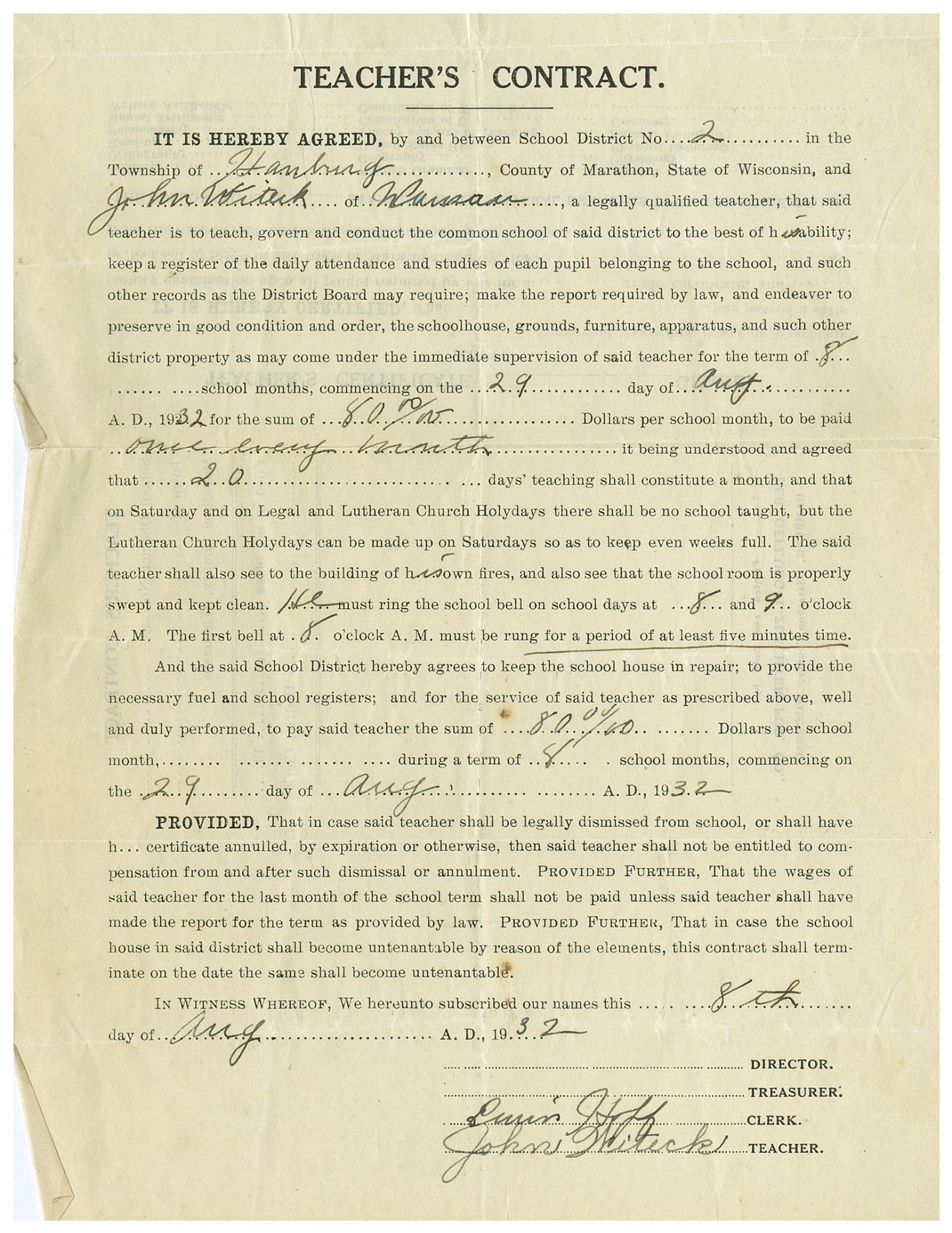
Teacher Contracts, Circa 1932

Over the holiday break, a friend of mine shared this fascinating piece of history. Its a contract between the Township of Hamburg, County of Marathon in Wisconsin with a teacher.

The total contract is one page long. For the 1932-33 school year, the teacher in question received $80 for teaching 20 days per each school month (and the teacher in question was only paid for eight months of a 12-month calendar). Legal and “Lutheran Holydays” are days with no school.

The contract defines a “legally qualified teacher” as one with responsibilities to “teach, govern and conduct the common school of said district to the best of her ability; keep a register of the daily attendance and studies of each pupil belonging to the school, and such other records as the District Board may require; make the report required by law, and endeavor to preserve in good condition and order, the schoolhouse, grounds, furniture, apparatus, and such other district property as may come under the immediate supervision of said teacher.”

Among the added teacher responsibilities? The teacher has to build her own fires. She also has to keep her classroom swept and clean.

Wages could be withheld if the teacher didn’t make the “report for the term as provided by law.” And if the school is determined to be “untenantable by reason of the elements,” the teacher contract is terminated.

No witty comment or snarky remark. Just a document that makes you go, hmmmmm.

WI teacher contract

Ed Reform Through Litigation

In yesterday’s New York Times, Michael Shear offers up a piece on how the Republican majorities on Capitol Hill may be looking to the courts to help win on the issues the GOP has prioritized. In his lede, he cites healthcare, climate change, and immigration as top issues Republicans are looking to.

The Times quotes West Virginia Attorney General Patrick Morrisey, with saying, “Given the state of dysfunction in Congress, in many cases, the courts do represent the last opportunity to get a fair hearing on these issues.”

To counter, U.S. Rep.Gerry Connolly of Virginia counters with, “What they cannot win in the legislative body, they now seek and hope to achieve through judicial activism.”

So why highlight this sort of “policy through lawsuit” philosophy? Because one has to ask if it is the same approach that education reform advocates are shifting towards.

For more than a decade, “reformers” have been working the state legislatures seeking changes to how public education is addressed. Expansion of school choice here. VAM on teacher evaluations there. Adoption of new standards and assessments. Vouchers. We all know the list. Most of the major changes we have seen in education in recent years has been the result of legislative action, where governors and or state legislatures have addressed both policy and appropriation to bring about change.

But 2014 ushered in a new approach to education reform. Both 2013 and 2014 saw major slowdowns (if not downright freezes) on school improvement efforts in state capitals. Reformers (and many of their funders) have grown impatient. So it should be no surprise that the largest education policy development in 2014 — teacher tenure and due process rights via the Vergara decision in California) has become the new playbook. A similar suit has already been filed in New York, with other states anticipating their own versions of Vergara.

Sure, litigation in education is nothing new. Each year, it seems we have a handful of states dealing with court cases over funding and equity. And we’ve had such cases since the Abbott districts were created in New Jersey in 1985 following a court decision in the Garden State.

Reform via legislation is tough work. It requires both a ground game and an air game. It demands strong relationships with governors’ offices and legislatures. It begs for voices beyond the reform community asking for change. And more often than not, based on the past decade, efforts fall short. Compromises are made. Politics comes into play. Reformers are left with partial wins, if that, as the legislative session draws to a close. And even if they do win big, they have to be back the following year to ensure adequate funding for the reforms in question.

Will 2015 be the year the reform model truly changes, with lobbyists and ad campaigns replaced with lawyers and amicus briefs? Is there a perceived higher ROI going to the courts versus working the statehouse hallways? Is it easier to have the courts decree change rather than fight for the dollars for it each and every year?

Time will tell. But if the national GOP has determined it is easier to address sticky policy in the courts rather than in the wells of Congress, surely reform organizations and their funders have been having the same conversations, no? Is Vergara the spark that reforms reform?

It’s All About the States, Bout the States, No Federal

For years now, Eduflack has written about the balance of edu-power between the Federal government and the states. While major statement pieces like NCLB or Race to the Top signal the Feds in the driver’s seat, the real action (or inaction) on school improvement continues to happen at the state level.

And as Congress continues to show less and less interest in funding those big signature pieces, that power will likely continue to shift to the states, with governors and state legislatures determining what is best for their states and their students. The Feds provide the guidance and broad strokes, but it falls to states and locals to decide what to do, how to do it, and ultimately how to determine if it works.

Over at The Hill, my colleague Arthur Levine (former president of Teachers College, Columbia University) has a commentary on this specific topic. In his piece, Levine focuses on how states can and should be beacons for innovation and school improvement. And he looks at places like Tennessee, as well as states like Georgia, Indiana, Michigan, New Jersey, and Ohio (all states that have adopted the Woodrow Wilson Teaching Fellowship program) as examples of the power of state transformation in education.

As Levine writes:

States are already doing much to strengthen education. Simply put, they need the encouragement, policy framework, and flexibility to explore new avenues that will work best for their schools, their students, and their communities.

As the 114th Congress looks to chart the course for the next phase of our shared educational journey, policymakers in Washington must give states the tools they need and the right incentives to help them think outside the box, and then hold them accountable for results.

Give it a read. With a new Congress coming to Washington, and new leadership more in tune with the power of states than the growing power of the Feds, it could be a glimpse into the edu-future.

Excellent Teachers? Focus on Excellent Teacher Ed

Over at Education World this week, I have a piece that looks at some recent Politico analysis following the U.S. Department of Education’s call for equitable distribution of excellent teachers in our public schools. It should come as no surprise, the current data regarding teacher quality is disturbing to say the least.

How do we begin to address the problem? One way is to strengthen our teacher preparation efforts. And that can be done by looking at the lessons learned by a number of programs currently engaged in transforming teacher education to meet the challenges and rise to the opportunities.

Give the piece a read. The reccs on how to address state-based improvement to teacher education is well worth the time.

Teaching the Teachers: Improving Ed Schools

In recent weeks, the topic of teacher education has been picking up steam. After spending years (or decades) focused on how to improve student achievement, many are now starting to see that real improvement can’t happen until we fundamentally address how prospective educators are prepared and supported for their roles as teachers of record.

This week, Education Week’s Stephen Sawchuk offers up a terrific collection of stories examining the issues, including:

States Slow to Close Faltering Teacher Ed. Programs, which looks at how our national quest for improved education and improved educational outcomes hasn’t quite reached those overseeing our ed schools;

Disparate Teacher-Prep Curricula Complicate Accountability Efforts, which demonstrates the continued challenges in demanding effective teacher ed efforts; and

N.Y. College’s Experiences Shows Conflicts Around Ed. School Closures, which shows how all of these policy debates play out, or fail to, in the real world.

All three pieces are worth the read, particularly the examination of Mercy College in Dobbs Ferry, NY. Anyone who has been in higher ed knows that the tale told by Sawchuk there is similar to many others around the nation.

In his States Slow piece, Sawchuk quotes Arthur Levine, president of the Woodrow Wilson Foundation and President Emeritus of Teachers College Columbia University, on the current state of the American ed school. Levine rightly notes: “I haven’t visited a state where the political leaders are enthusiastic about the quality of ed. schools. They have the capacity to do a reauthorization of their existing programs, and they haven’t done it.”

We all seem to be good at pointing out the problems. It’s what we do with the capacity (and power) to improve that is the ultimate measure. This series from Sawchuk may very well serve as the canary in the coal mine, with meaningful “reform” coming to teacher education in the near future.

In Search of STEM Teachers

STEM. STEM. STEM. STEAM. STEM. STEM. STEM. STEM. STEAM. STEM. STEM.

If one spends his or her time in education, it is impossible to avoid the topic of STEM. For a decade now, ever since “21st century skills” jumped the shark, we have been focused on a STEM-literate society. Sometimes, we look to add the arts to STEM, making it STEAM. (Though in one ingenious school district I visited in Wisconsin, they had STEAM, but the A was for agriculture, not the arts.) But we can’t get away from that STEM focus.

Last month, ACT released a survey of its test takers on a range of topics, one of which was STEM. ACT found that nearly half of those looking to take the ACT test demonstrated an interest in STEM subjects. That’s almost a million aspiring college students giving at least a look to the STEM areas.

But that interest in the content isn’t translating into an interest in teaching the content. Surveying those same students, of the nearly 1 million interested in STEM, only 5,500 are thinking about a future where they are teaching a STEM subject.

Over at Education World, I delve a little deeper into this disturbing revelation, looking at both why we need to do a better job or recruiting STEM teachers and how we can do it.

The teacher is the single-most impactful influence on the learning of the child. If we want today’s students to have an interest in STEM and to want to pursue careers in STEM teaching, we need to provide them with well-prepared teachers who make STEM real in their classrooms. We need excellent educators who inspire the next generation of STEM teachers. We need classroom teachers who can inspire an interest in the STEM subjects, encourage high-ability students to consider teaching careers, and show them how best to prepare the next generation of learners.

It’s an important read. Give it a look.

From Better Ed Data Comes Better Teacher Ed

Can we improve teacher education without improving education data and data systems?

Earlier this week, Eduflack wrote on the U.S. Department of Education’s efforts to improve teacher preparation. Now that those draft regs are out, folks are looking for the good, bad, and ugly in what the Feds are looking for from our ed schools.

Over at the Michael and Susan Dell Foundation’s blog, Eduflack has a guest post on how the teacher ed regs really speak to a need to better address the education data we collect and how we collect it.

Specifically, I write:

In these draft regulations, we see a true embrace of data in the teacher preparation process. Data such as employment metrics that look at how long a teacher remains in the classroom, recognizing that our most effective teacher education programs are those that ensure good teachers remain in the classroom for more than five years. Data such surveys that look at educators new to the classroom see their preparation once they become the teacher of record. Data such as employer surveys that can help local teachers colleges better understand if their graduates are prepared for the rigors of the classrooms they are now leading.

And yes, data such as student performance data. These new regulations recognize that student learning outcomes are an important part of determining whether a teacher is prepared for the classroom. Yes, there are many factors that go into student performance beyond what the educator is bringing to the classroom. But there is also no denying that learning is a key component of effective teaching. And there is no ignoring that excellent teachers, those prepared for the rigors of today’s classroom, are the ones who get the most out of their students.

Thanks much to the Dell Foundation for giving me the platform on which to write. The whole piece is definitely worth a read, as is recognizing programs such as Relay School of Education, Urban Teacher Center, and the Woodrow Wilson Foundation for already doing many of the things the proposed regs are dreaming about.

The Path to Improving Teacher Education

Last week, the U.S. Department of Education released its long-anticipated draft regulations regarding teacher education. The regs focus on several key areas, including a state-based approach to improvement, the need for employment metrics (including how long teachers stay in the profession and how their employers rate them), student learning outcomes, and accreditation.

For those looking to better understand exactly what is in the regs, EdWeek’s Stephen Sawchuk has the best primer on the regs, their meanings, and the initial reactions from the education community. You can find the full article here.

Lyndsey Layton at the Washington Post has an excellent write-up of the announcement. So, too, does the New York Times’ Motoko Rich. And if you can get beyond the firewall, Caroline Porter of the Wall Street Journal offers some great analysis as well.

Of course, dear ol’ Eduflack is particularly partial to the analysis Arthur Levine offered to these teacher ed regs. The president of the Woodrow Wilson Foundation and the former president of Teachers College at Columbia University, Levine called the new proposed regs “an important step forward” in a Huffington Post commentary. Levine continued:

All of us involved in teacher education should look for ways to strengthen these regulations and improve the teacher prep process. But let us be clear: we need real action now. Our colleges and universities have waited far too long to transform these programs to meet the needs of both today and tomorrow. We cannot afford to wait as another generation of teachers passes through programs that are lacking. In the states where Woodrow Wilson has worked, we have seen a real hunger — from state leaders, from school districts, and from colleges themselves — to enact the sort of changes needed. We must act together — and swiftly — to change the very fabric of teacher education nationwide. These regulations are the first step toward achieving that.

The regs now move into their “public comment” period. Groups like AACTE, AFT, and NEA have already weighed in with their concerns (or opposition). Other groups like Education Trust, DFER, and Urban Teacher Center have come out strongly in support of the new direction.

Regardless, it is heartening to see a focus on teacher education and the need to improve how we prepare teachers for the classroom. While all might not agree on the specific action steps needed to get us to the intended destination, none can argue that the current model, a model we have been using to prepare teachers for generations, is the most effective and valuable way to prepare 21st century educators for the challenges of the 21st century classroom.

(Full disclosure, Eduflack works with Levine and the Woodrow Wilson Foundation, and has worked with AACTE, AFT, NEA, EdTrust, and UTC.)