Time to Read Dadprovement

I am thrilled to announce that my new book, Dadprovement, is now officially available. This book is a deviation from what I typically write. Instead of opining on the latest and greatest in education policy, It is a far more personal story.

Dadprovement tells of the journey I have gone through to become a father. It details all my wife and I experienced adopting our two children from Guatemala. Such international adoption tales are typically told through the eyes of the mother. Dadprovement is decidedly father-centric.

The second half of the book, though, spotlights the path I have taken to become a more involved father. My shift from careerist, a man focused primarily on my work and sacrificing my family in the name of taking care of them, toward a real dad and husband who rightfully placed my family first and foremost in my life.

Those who have read it are amazed by the story. It officially comes out from Turning Stone Press at the end of the month, available in bookstores around the nation. It is available as a paperback now from Amazon. It is also now available on Kindle here.

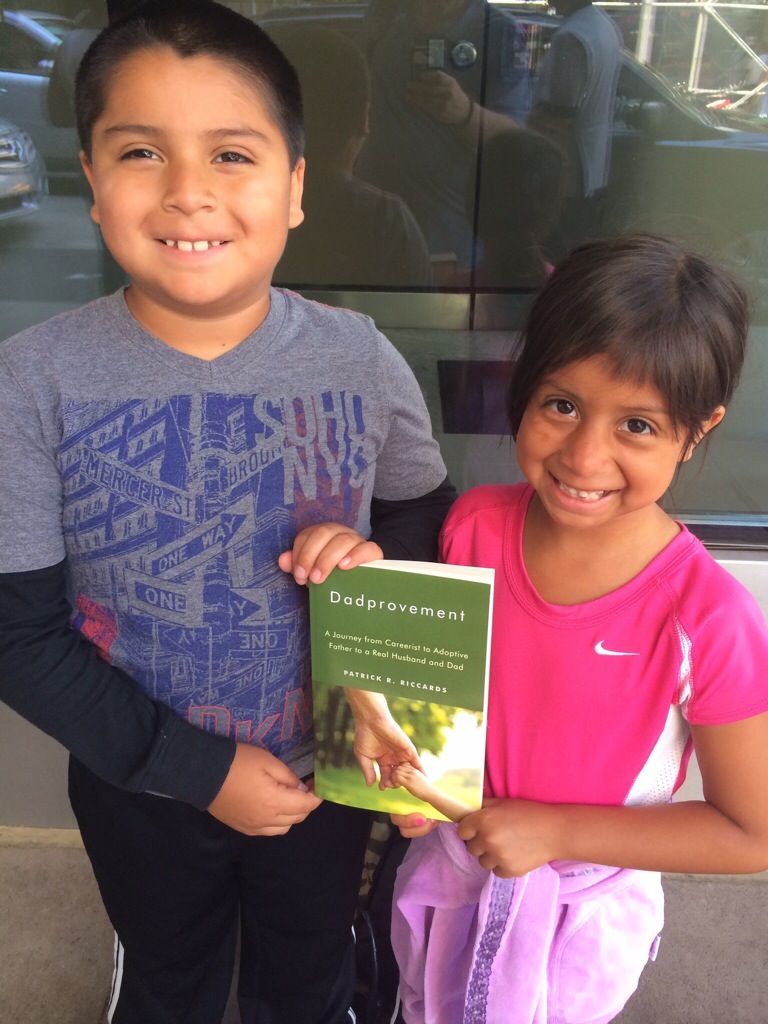
Don’t take my word for it on how terrific a book it is. Just look how happy my kiddos seem with it, finding it in NYC this weekend.

20140713-212639-77199494.jpg

You can also read more about the book and related issues over on the Dadprovement blog, www.dadprovement.com.

The Importance of a Mother’s Education

Over on my Dadprovement blog, I write about a new study that looks at how a mother’s education impacts a child’s education. Definitely offers some real food for thought. The full post follows:


Yes, this blog is primarily about issues related to fatherhood. But it is also about being a better parent and raising a better family. So it was quite interesting to see an article in today’s Washington Post of a new research study that finds that a mother’s education may be the biggest influence on a child’s education.

WaPo reporter Michael Alison Chandler really distilled the findings by offering that “one in eight children in the U.S. … are born to a mother with no high school diploma, compared to one in three whose mothers have a college diploma.”

So how do those groups compare? Chandler reports:

“● 84 percent live in low-income families, compared to 13 percent

● 48 percent have a mother who is not securely employed, compared to 11 percent

● 16 percent read proficiently in the eighth grade, compared to 49 percent

● 40 percent do not graduate on time, compared to 2 percent

● 27 percent are obese, compared to 13 percent”

Some fascinating food for thought, particularly for dads, and parents in general, who think the “do as I say, not as I do” approach to child rearing can get the job done in the long term.


“Our School,” Our Community

When we talk about education and school improvement, we can often forget there are real schools involved in the equation. In our quest for reform, we can slip into thinking in abstraction, thinking about public education as if it were a laboratory and our changes have little, if any, impact on the educators and students who spend the majority of their time in those very buildings.

While some of my reformer friends may say this is an unfair or downright untrue statement, it is rooted in fact. The reform movement, of late, is largely about changing systems and processes. It is about administrative changes and oversights and accountability. The rest can come later, after we change how these schools “operate.”
It is because of this that we need to be reminded of the human factor in our schools, both those that excel and those that struggle. That we highlight that there are no educators or students who seek to fail or not make the grade. That we all want to see success, even if we define it differently or can’t determine how to chart the best path to get there.
That’s why we need to refocus on our schools as a community. Good or bad. Success or no. We are a community, and we are in this together.
This spring, author Sam Chaltain reminds us of this important point in his new book, Our School. Published through Teachers College Press, Our School chronicles the search “for community in the era of choice,” as Chaltain weaves a powerful narrative that looks at the experiences in real schools. He reminds us why so many of us do what we do, and why this work can be much harder than so many people seem to think.
How? The impact of this book is best captured in the words of Sir Ken Robinson, a guy who knows a thing or two about school reform and improvement and who pens Our School‘s foreword.
Our School is an important book. It brings to life, in the most vivid way, many of the issues about American education that in political debates are too often treated as abstractions. In place of the conventional rhetoric about what’s right or wrong in the nation’s schools, Sam Chaltain offers a close-up, beautifully observed account of a year in the life of just two of them. In many respects, these schools couldn’t be more different. Both are in Washington, D.C., physically close to the epicenter of American power, though in most other respects a world away from it. One is a startup charter in new premises, still working to define its identity and to catch its beat. The other is a long-established neighborhood school, filled with the memories of generations, a school where many former pupils now send their own children or grandchildren.
On these pages, Eduflack has often written about the importance of conversing, engaging, and collaborating with those that offer a differing perspective. For many years now, Sam has been one of those folks in my life. Sam and I agree on much, and strongly disagree on some. And while I may not agree with all of the conclusions he offers up in his latest book, I’m damned glad to have taken the time to read it. We all must be reminded that community, far more than policy or oversight, is what is responsible for a school’s ultimate success or failure.

“A Day of Action”

Yesterday, educators across the country participated in “A Day of Action,” a series of events across the country that, according to Valerie Strauss at The Washington Post, “sponsors hope will draw national attention to the problems of corporate-influenced school reform and to build a national movement to change the public education conversation and to increase funding for schools.”

We can set aside the fact that organizers were hoping to accomplish an incredible number of goals from a series of public demonstrations.  And we will forget what Eduflack has written here previously, that too many people are fighting a false battle against the “privatization” of our public schools, when no one is actually looking to flip public schools private.
And I’m even willing to save for another day the important discussion on school funding.  Yes, I agree wholeheartedly that we need to look at our funding models for our public schools, ensuring that all schools are equitably funded.  But we also must look at how we are spending those dollars, and admit that our priorities are off when some of our lowest-performing schools are also those with some of the highest per-pupil expenditures in the nation.
Instead, today Eduflack turns your attention to the guiding “principles” behind “A Day of Action.”  Organizers are absolutely right in needing a call to action, a basis that all participants can latch on to and believe in.  So for this week’s festivities, seven principles were offered in an effort to “reclaim the promise of public education.”
They include:
* Public schools are public institutions.
* Our voices matter.
* Strong public schools create strong communities.
* Assessments should be used to improve instruction.
* Quality teaching must be delivered by committed, respected and supported educators.
* Schools must be welcoming and respectful places for all.
* Our schools must be fully funded for success and equity.
All noble goals.  All well meaning.  And all principles that EVERYONE should be able to get behind.  I recognize the importance of trying to win over hearts and minds.  But these same principles (maybe with an edit to the final one) are principles that any education reformer worth his or her salt could get behind.  
Just think of the following:
* Public schools, including our public charter schools, are public institutions.
* Our voices (not just those of the unions or veteran educators) matter.
* Strong public schools create strong communities.  Just ask those whose lives and neighborhoods have been transformed by an institution like Democracy Prep.
* Assessments should be used to improve instruction, with test scores utilized to ensure our schools, our teachers, and our students are achieving. 
* Quality teaching must be delivered by committed, respected and supported educators. It isn’t what ed school you attended or that you received the proper pedagogy in your prep, it is about what you do in the classroom.
* Schools must be welcoming and respectful places for all.  That includes parents and community members who seek improvement or choice.
* Our schools must be fully funded for success and equity.  That begins by ensuring all public schools, including charters, in the same city are spending the same per pupil.
There is no question we are in need of a day, a week, a month, a year of action to improve our public schools.  And while I still maintain that sides agree on far more than they disagree when it comes to school improvement, can’t we have a real, respectful conversation about the areas of disagreement instead of trying to “own” some basic platitudes on which we all should agree?

Correcting the Teacher

As my daughter was enjoying her kindergarten year, I used to cringe whenever I spent time in her classroom.  She had a caring teacher, walls full of books and other learning materials, and a relatively small class.  So why my reaction?  Each time I was in the room, my eyes were drawn to a large handwritten sign that was the focal point of the wall.  And in the middle of that sign was a significant grammatical error.

So each visit to the K classroom, I wanted to take a red pen and mark up the wall.  The eduwife’s better judgment always won out.  I left the sign alone.  And I never said anything to the teacher, not wanting to embarrass her or create an issue where one doesn’t need to be.
We all make mistakes.  I make them quite frequently (particularly on this blog, where I never read or edit anything I throw up there).  But it begs the question.  What should a parent do when he or she sees a mistake in need of correcting?  Do you call your child’s teacher on it, or do you just let it go?
Over the weekend, a high school friend shared a note that had come home in her child’s class.  The (unedited) note reads:
“We are no longer completing book essays.  Instead, we are completing weekly reader responses.  This is handed out on Mondays and are not due to the following Monday.  I have required that three entries be completed by Friday as a way to monitor their time.  All directions are located on their response log!”
The note went home to all families in the class.  It came from an English teacher.  How many errors can you spot?
So what’s a parent to do?  Do you reach out to the teacher?  Do you keep quiet?  Do you go to the principal? 
Most parents seem to opt for silence.  I’ve heard from some who worry that if they raise the issue, the teacher will take it out on the child (and while I find this hard to believe, it has been known to happen).  But is that the right thing to do, nothing?
If parents are going to work with educators, and do so in a productive and positive way, we need to find a way to have such discussions.  Or we need to be prepared to live with the consequences.

Urban Schools, Disengaged Parents

In recent years, parents have come front and center in the debate regarding what is right (or wrong, depending on your perspective) in our public schools.  As education reformers have focused on educator evaluations and teacher effectiveness, teachers in reform-targeted communities have often turned around to point the finger at parents, citing disengaged and uninvolved parents as a leading contributor to failing schools and achievement gaps.

So why do we have low parental engagement in many urban public schools?  And what can we do to improve parental involvement in schools and with kids who need it the most?
That is the question that the good folks over at BAM Radio have asked this week.  The segment, available here, is hosted by Rae Pica and features Patricia Ackerman, Peter McDermott, Marilyn Rhames, and yours truly.  An interesting topic definitely worth the listen.
(Eduflack is a proud commentator to BAM Radio and its programs.  It is always interesting to do a deep dive into an important issue, particularly when it includes both classroom educators and researchers.)

I Want That School!

There are a couple of companies on TV that run commercials touting how they are different from their many competitors.  You may have seen them for both buying a car and choosing a frozen pizza.  The consumer is standing before a plethora of options, and starts identifying personal preferences.  When all is said and done, there is only one choice left.

What if we have that option with our public schools?  What is we were able to go and identify what we want from a school in a range of categories?  What if we were able to prioritize what issues are most important for us in choosing a public school for our child?
It may not be such a crazy question.  For residents of the Commonwealth of Massachusetts (yeah, go Sox, Beard nation, yada yada) the Boston Globe has launched an online Massachusetts school calculator tool, called DreamSchool Finder.  (I know, not loving the name, but the intent is well meaning.)
At DreamSchool Finder, parents can choose the region of the state, the grade level of the child, and then get to look at five characteristics, giving them each percentages until the 100% mark is hit.  The choices include: Mathematics Growth, English Language Arts Growth, School Climate, College Readiness, School Resources, and Diversity.
So for those parents who care only about the test scores, they can be all about math and ELA growth and college readiness.  Those more concerned with the school culture can emphasize climate and resources.  
It is an interesting concept, and it is one that can significantly empower a parent or caregiver when used appropriately.  For families looking to relocate, it provides a tool for helping better understand which town may be best to lay down roots.  For others, it lets you see what schools might be doing it better, based on your percentages, and help you identify why so you can bring solutions to your own neighborhood school.
And if you had such a tool in a community that believed in complete school choice, it could be the holy grail.
Kudos to boston.com for offering up the resource.  Clearly, there is the need.  We should be working to develop more tools and providing more information so that parents are better informed on what is happening in their schools and better understand how other schools may be better suited to meet their own needs or preferences.

A Teachable Moment on Columbus Day

So Eduflack comes from a proud Italian-Amerian family (at least on my paternal side).  My paternal grandfather, the man I was named after, was born Ponzion Ricciardelli.  He was first generation American.  His family came in through Boston, instead of Ellis Island, and you can still find a slew of Ricciardellis stomping around Beantown.

He changed his name to Patrick Riccards in the 1950s, but the pride in our heritage never changed.  My father’s mother is both a Finelli and a Peron (yes, our family is partly responsible for Evita’s 15 and a half minutes of fame).  And as the genealogy goes, I am also descendent of proud Italians who fought on Garibaldi’s right hand in the liberation of Italy itself.
Over the weekend, my princesa, now in the first grade, began telling me all she learned this week about Christopher Columbus.  Typically, Columbus is another one of those pride points for an Italian-American family.  She told me about the three ships and how he sailed, and how he came to America to “discover a land for you and me.”
Those who know me know that both of my children are adopted from Guatemala.  And they know how proud we are of that, as a family.  Both my kids know they are adopted.  They both know about Guatemala  And they both fight us each week as they have to get up extra early for their weekly Spanish class before school starts.  We want them to be proud of their heritage, both that which they were born into and that into which they were adopted.
So imagine my surprise as I took this lesson as a teachable moment to remind my princesa of where she comes from.  First, I congratulated her for all that she had learned and the poem she had written about Columbus.  I then explained to her how she is descendent of the Mayan civilization, and the advances they achieved and how much they had done well before Columbus ever set foot on North America. 
We talked about what descendent meant, about what the Mayan did, and to remind he of where she came from.  She seemed to get most of it.  Asked a few additional questions, then went back to playing with her horses.
In years past, Columbus Day was always one of those great points of pride.  It is still true.  And while I am one of the last people who would ever be called “politically correct,” I found the need to explain, to make sure my kids shared the same pride about their heritage that I do, and understand that there is often more to the story than they might originally hear.
Heritage in an adopted family can be a tricky thing.  By blood, my kiddos are Guatemalan with Mayan ancestry.  On my paternal side, I have my proud Italian-American family.  On my maternal side, I am German-Irish-Scottish, with the Scots bringing a family tie to William the Bruce (of Braveheart fame) and of an alleged witch who was stoned to death in the village square.
The edu-wife offers up a paternal side of Russian Jews.  On her maternal side, she is descendent of an actual signer of the Declaration of Independence (from the Commonwealth of Virginia) and a pirate of the same era.  
We are the American melting pot.  So on this Columbus Day, I am proud of my heritage and equally proud of where my children come from.  I am proud of the Ricciardellis immigrating through Boston, and of my two kiddos immigrating through Houston as I helped them get sworn in as citizens in the bowels of Bush International Airport as they were seven and 13 months old.
Life is full of teachable moments.  I’m glad I was able to take advantage of this one and hope my kids will be able to share the same moment as they explain where they come from and what makes them who they are today, be it Mayan Guatemalan, Italian Catholic, Russian Jew, and pirate.
 

Teachers and the Morals Clause

Down in Texas, it seems some parents have their knickers in a twist over the latest revelation regarding a Spanish teacher at a Dallas-area magnet school.  The teacher in question is Cristy Nicole Deweese.  Seems she has always wanted to be a Spanish teacher, and she is now living the dream.  And now a local mom is leading a crusade to have her removed from the classroom immediately.

Her sin?  When she was 18 years old and in college, Deweese posed for Playboy magazine.  In fact, she was “Coed of the Month” in the February 2011 edition of the mag.  Now her old photos are being circulated and the moral crusaders have kicked in.  Huffington Post has a good recap of the issue here.
Eduflack appreciates that teachers are held to a higher standard than most, particularly in the public eye.  And as a former school board chairman, I appreciate the morals language that is in most educators’ contracts, allowing the school and the school district to look out for the best interests of the community and the students.
But what, exactly, is Deweese’s fireable sin?  As a legal adult (18 years old) she legally posed for a magazine that is legal (for most) to purchase.  She broke no laws, committed no seeable offense.  And even if we might have a personal objection to a choice she made at the start of her adulthood, it was done years before she ever became a teacher.  
I presume that Deweese attended a college of education in Texas, passed her courses, and earned her degree.  She took all the requisite steps to secure a teaching license.  She even managed to impress veteran educators by securing a teaching job in a local magnet school.  She did everything that one asks of those entering the profession.
In all of the articles written on the subject, no one seems to reflect on what sort of teacher she was.  And since the school hasn’t taken action, I’m going to assume she is a pretty good newbie teacher, good enough that no one is acting too rashly.
I get that some folks, particularly down in the Lone Star State, may have problems with Playboy and the magazine’s industry in general.  But that’s hardly a reason to trash this woman’s career before it even starts.  Sure, there are pictures out there.  But at the end of the day, they aren’t much different than the pictures one sees of coeds on Facebook or Instagram or Flickr.  The world is changing, and folks just share too much of those images to begin with.
What’s next?  The new president of Cinnabon was a Hooter’s waitress to put herself through college.  Should we now boycott our cinnamon buns because she once wore tight orange shorts and a low-cut top when she was slinging wings?  I’m guessing there are photos of that too.
With so much we need to worry about to ensure that our kids are getting the public educations that they both deserve and we all should feel obligated to provide, can’t we start focusing on what is really important?  Can’t we focus on her skills and abilities as a teacher?  Are we really saying that the (legal) things we did or said or captured when we were 18 are now grounds from keeping us from our chosen professions and personal paths once we become more responsible adults?
Let Cristy Nicole teach.  Who knows?  If all this means just a few more boys pick up Spanish language skills, we might be thanking her for it later.
  

Where Are the Parents in Education Nation?

With day one of the 2013 Education Nation Summit in the books, and day two offering up a terrific array of speakers, one has to be impressed.  Throughout yesterday’s program, participants heard from many of the nation’s leading education voices — superintendents, national organization heads, entrepreneurs, innovators, and all-around visionaries.

Spotlights were placed on new initiatives designed to spark new thinking.  There was even a constant reminder of an ongoing student competition, seeking to signal the best of the best in young education innovation.
Today promises tales from the celebrity sector of education, as names such as Tony Bennett (the I Left My Heart in San Francisco singer, not the I Left My Post in Florida state supe) and Goldie Hawn slated to address the audience.
In watching the 1 percent of the education community, if you will, though, Eduflack was left with a lingering question.  Where were the parents?  Where were the voices of those caregivers left to decide which school provides the greatest opportunity for their kids?  Where were the mothers worried about school safety or the fathers concerned about their son dropping out without employment opportunities?  Where were the parents in the academical village?
As a lead up to the two-day summit, NBC now offers two town halls to address some of these stakeholder issues.  Education Nation first offered up a summit with students, which is always an eye-opening and interesting development.  It also provided a town hall for teachers, letting educators discuss many of struggles and concerns they are facing each day in the classroom.
One can argue that these two voices also needed to be front and center during the two-summit itself.  No, I’m not talking the celebrity teacher who is trying to make a name for himself with his latest crusade.  Nor am I talking about the student who is on the cusp of curing cancer before being named homecoming queen and student body president.  I’m talking about those very real voices who can speak to the struggles and the victories that we see in classrooms across the nation.
Those are the voices that should be in there at the New York Public Library.  As those in the know are discussing the impacts and intents of Common Core State Standards, we should also be hearing from parents concerned with the amount of testing their children receive and whether any of those assessments measure if their child is ready for the rigors of college or not.
As the leaders in the field are discussing blended learning, its merits, and how it presents itself, we should also be hearing from parents who wonder how they provide it to their child when they don’t have internet access at home or can’t afford the latest tablet that everyone is gushing about.
Yes, Education Nation plays a valuable role in these ongoing discussions that drive our community.  It is important for the movers and shakers to get together and hear these discussions and understand many of the policy and instructional issues facing our schools.
But it is just as important for voices from the rest of the nation to be heard.  It isn’t enough to say that parents and local school boards and other such actors can watch Education Nation on the Internet.  We need engagement, not just information.  We need a give and take of ideas, not just the consumption of data.
Eduflack doesn’t mean to pick on Education Nation. The same could be said about virtually any education conference or summit these days.  At least Education Nation makes the effort at convening students and educators beforehand as part of the kick-off town halls.
In reality, Education Nation is made up of millions of parents and caregivers and volunteers and educators and other stakeholders who are unable to get into the room.  How do we ensure that their voice is heard during the process?  It is a challenge NBC and its partners are up to, and it is a puzzle that the entire education community should be committed to solving.