Earth Day, #CommonCore, and Environmental Ed

As we celebrate another Earth Day, we are seeing more and more examples of how instruction in the environmental sciences — even for our youngest learners — can be about more than just lecture and the recitation of facts.

As I write for BAM Radio’s EDWords, there are strong ways to connect Common Core and Next Gen Science Standards with environmental science instruction and student interests. The Think Earth Environmental Education Foundation provides us just one example of what is possible.

From BAM Radio’s site:

While many may think that aligning with Common Core and NGSS means a tightly controlled, proscribed curriculum with on room for creativity or tailoring to specific students, we are seeing more and more that that simply isn’t the case. With offerings like Think Earth, we are given a clear view of how our youngest learners can learn subjects like environmental science in ways that just enhance what they are already learning in their science and math classes.

Teaching “to the Common Core” provides an unending number of paths to the creative educator. They have third graders market vacations to the outer reaches of the solar system and they can have first and second graders understand natural resources and conservation in ways that their own parents may not quite appreciate.


For Students’ Sake, Let’s Look to Student Data

Over at Education World, I have a new piece that looks at the important role student research and data can play when gathered and utilized properly. From Data Quality Campaign to ACT to NWEA to Project Tomorrow to ERCA, we can see the value data plays, particularly in understanding student perceptions on key issues, including their college and career aspirations.

As I wrote:

For years, we have grappled with the notion of “assessment literacy,” where educators, families, and policymakers can better learn the importance of data collection and the ability to distinguish a valuable data-gathering tool from a lousy one. At the same time, educators have demanded that any student data collected needs to be used to help the student, and not just as the impetus for punitive action.

Teachers are right. We probably don’t focus on what is helpful to the student nearly as often as we should, particularly when it comes to student data. And that’s a cryin’ shame. The student perception information coming from organizations like Project Tomorrow and NWEA is incredibly important. It provides a glimpse at how what is taught in the classroom aligns with student interests and passions. It helps us better understand the path today’s young learners are on as we encourage them toward college and career success.

I hope you’ll give it a read.


Celebrating #NJSTEMWeek By Celebrating #STEM Teacher Ed

This week is NJ STEM Week. Across the Garden State, educators, policymakers, and the business community have been celebrating STEM (science-technology-engineering-math) and its importance in building a strong economy, stronger society, and stronger citizenry.

Over at Medium, I reflect on some of my own STEM experiences over the years, while highlighting some of the great work the Woodrow Wilson Foundation is doing to recruit, prepare, and support STEM teachers for high-need schools in New Jersey. As I write:

Whether one wants to become a rocket scientist or a poet, there is no denying that children today benefit from a background in the STEM disciplines. The big question is where and how do we find the teachers, particularly in our high schools, to deliver that benefit?

Programs like the Woodrow Wilson Teaching Fellowship are seeking to answer that important question, leading work in five states to help construct a strong pipeline of excellent STEM educators for our nation’s high-need schools. In Georgia, Indiana, Michigan, New Jersey, and Ohio, the Woodrow Wilson Foundation partners with 28 universities to deliver STEM-focused teacher education. In each state, prospective teachers receive the strong academic preparation, valuable K–12 classroom-based clinical experiences, and meaningful mentoring to become the STEM teachers our states, districts, and communities seek.

I hope you’ll give it a read.


Chaos, Coherence, Better #TeacherEd

If we want our children to be critical and creative thinkers, individuals who possess a true love of learning and a deeper ability to demonstrate it, we must ensure they have like-minded educators guiding them through the process. They need teachers who both know and do, instructional leaders who are able to adapt to the individual learner and specific lesson. They demand educators who personify the balance of both inputs and outcomes.

From “Out of ‘Chaos,’ A Call for Improved Teacher Education,” Eduflack’s latest on Medium

Data Literacy and Teacher Ed

When one thinks about the pieces that go into effective teaching and effective teaching education, much comes to mind. Content knowledge. An understanding of effective teaching techniques. Classroom management skills. Teamwork. The ability to wear about a zillion different hats, depending on the situation, the student, and the desired outcome.

Yes, we expect classroom teachers today to be educators and guidance counselors. Nurses and social workers. Juvenile justice surrogates and substitute parents. And now, of course, with such an emphasis on student testing and the use of assessment data in the classroom, we now look to educators to also serve as psychometricians.

Unfortunately, too few teacher preparation programs really do an adequate job in preparing aspiring educators with the knowledge and abilities to both understand the data provided to them by the school district and then put it to use in their classrooms. And even when a teacher is data literate, too often they are given student achievement data too late in the term (or after the term is completed) for them to even attempt to tailor instruction to meet the needs of their particular classes or students.

Step one in the process is understanding what it means to be “data literate.” What do we expect teachers to both know and be able to do with student assessment data? And how do we make sure that today’s classroom educators have the preservice and inservice supports to actually do what so many of us are asking of them?

The Michael and Susan Dell Foundation recently released a series of case studies that look specifically at this topic. In partnership with WestEd, the Dell Foundation examined what teacher preparation programs like those at Western Oregon University, Relay Graduate School of Education, Boston Teacher Residency, and Urban Teachers are doing to key in on the data literacy need. (Full disclosure, Eduflack has worked with Urban Teachers in the past, and just thinks the world of the program they have built.)

Coming out of these case studies, Dell — along with WestEd and the Data Quality Campaign — offered a set of nine skills that 21st century educators must possess to be “data literate” in today’s classrooms. They must:

  1. Define “data” broadly to include standardized test data as well as broader academic, socioeconomic, situational, behavioral and environmental data that affect student performance.
  2. Understand how to identify and apply critical grade-level standards in the context of individual students’ needs.
  3. Prioritize and validate relevant student data as it relates to learning and standards mastery.
  4. Develop high-quality informal and formal assessments in order to collect usable data on students’ progress against those standards.
  5. Administer assessments on an ongoing basis to monitor student understanding.
  6. Develop responsive lesson plans and differentiate instruction based on assessment and other contextual data.
  7. Use data-informed insights to communicate student achievement and needs to students and their families.
  8. Use data appropriately, knowing what conclusions can be drawn from what types of assessments.
  9. Understand that, although data is important, data alone does not define a student. Empathy and relationships matter.

Without question, this is asking an awful lot from teachers, particularly from those who never signed up for such “data-literate” priorities when they themselves first went through their own ed school experiences. But it isn’t too much to ask when one thinks of the students in their classrooms, what we expect of them, and the aspirations they may have for their own futures.

One can question the Common Core and its assessments and still believe in the need for data literacy. One can support the opt-out movement and still believe in data literacy. And one can demand the most stringent of student data safeguards and protections and still believe in data literacy for teachers.

At its core, data literacy is about improved teaching and improved learning. It is about further empowering teachers to do all they can to connect with that student or students who are struggling. It is about getting the most out of the classroom setting, and being able to demonstrate that the most has been achieved.

Testing has always been and will always be a key component of the K-12 learning experience. Regardless of what happens to a particular assessment instrument, assessments in the general sense will always be part of the learning process. It is the responsible thing to do to make sure those assessments are put to good use.

No, we don’t test kids for testing’s sake. We assess so we can improve the instructional process for a given class or child. And we can’t do that — or at least can’t do it well — if educators are not data literate.

Non-Fiction, #CommonCore, and Deep Learning

Not a day can go by without someone criticizing the Common Core State Standards or blaming the Common Core for all that ails our public education system. And while assessments are usually the prime target for Common Core haters, the standards’ emphasis on non-fiction texts have drawn greater scrutiny in recent months.

No, Eduflack isn’t going to (AGAIN) rise the defense of Common Core and all that it stands for. Instead, I’d just like to provide a terrific example of how an exemplary educator can use the expectations under Common Core, mix it with a non-fiction topic, couple it with student collaboration and teamwork, and produce a final learning experience that is a winner for all those involved.

Full disclosure here, I am completely bias. The teacher in question is my daughter’s third grade teacher. Earlier this year, she had students work in pairs to develop “marketing” brochures for each of the planets in our solar system. Students did research and identified key facts. They organized those facts to make a compelling argument. They were then asked to present their findings as if they were travel agents, trying to convince families to visit a particular planet. Bunches and bunches of Common Core standards and expectations, all wrapped up in a project-based science lesson that demanded teamwork and critical thinking.

Here’s the brochure my daughter and her partner came up with. They were tasked with marketing Uranus, and played up the terrific aspects that a cold, ice planet could offer a little kid.

This was one of the most engaging lessons I’ve seen in either of my kids’ classes in recent years. And it is a great example of how the Common Core should be taught and can be taught by a great teacher. It demonstrates that Common Core isn’t about memorizing facts or relying on worksheets or boring children into submission.

No, Common Core can be about real, deep learning. And in the hands of good teachers who are empowered to use it right, Common Core can be a wonderful guidebook for meaningful student learning.


Gaming and the #CommonCore

As the urban legend goes, educators are provided little flexibility when it comes to teaching the Common Core State Standards. Those who don’t quite understand what the standards are assume it comes with a proscribed curriculum, one that teachers must follow to the very letter.

But in classrooms across the country, we see educators empowered with the flexibility to do what makes sense in teaching the Common Core to their students. With learning as the ultimate goal, how one gets there isn’t as important as the final destination.

On Common Core Radio this week, LFA’s Cheryl Scott Williams and I speak with Rebecca Rufo-Tepper of the Institute of Play. In this segment, Dr. Rufo-Tepper discusses how educators are using gaming to help students learn the key tenets of Common Core, and do so successfully.

It’s definitely worth the listen. We are seeing more and more how gaming can be a tremendously effective tool in 21st century teaching. Using it to relay Common Core lessons to students is no different.


Because #STEM Matters

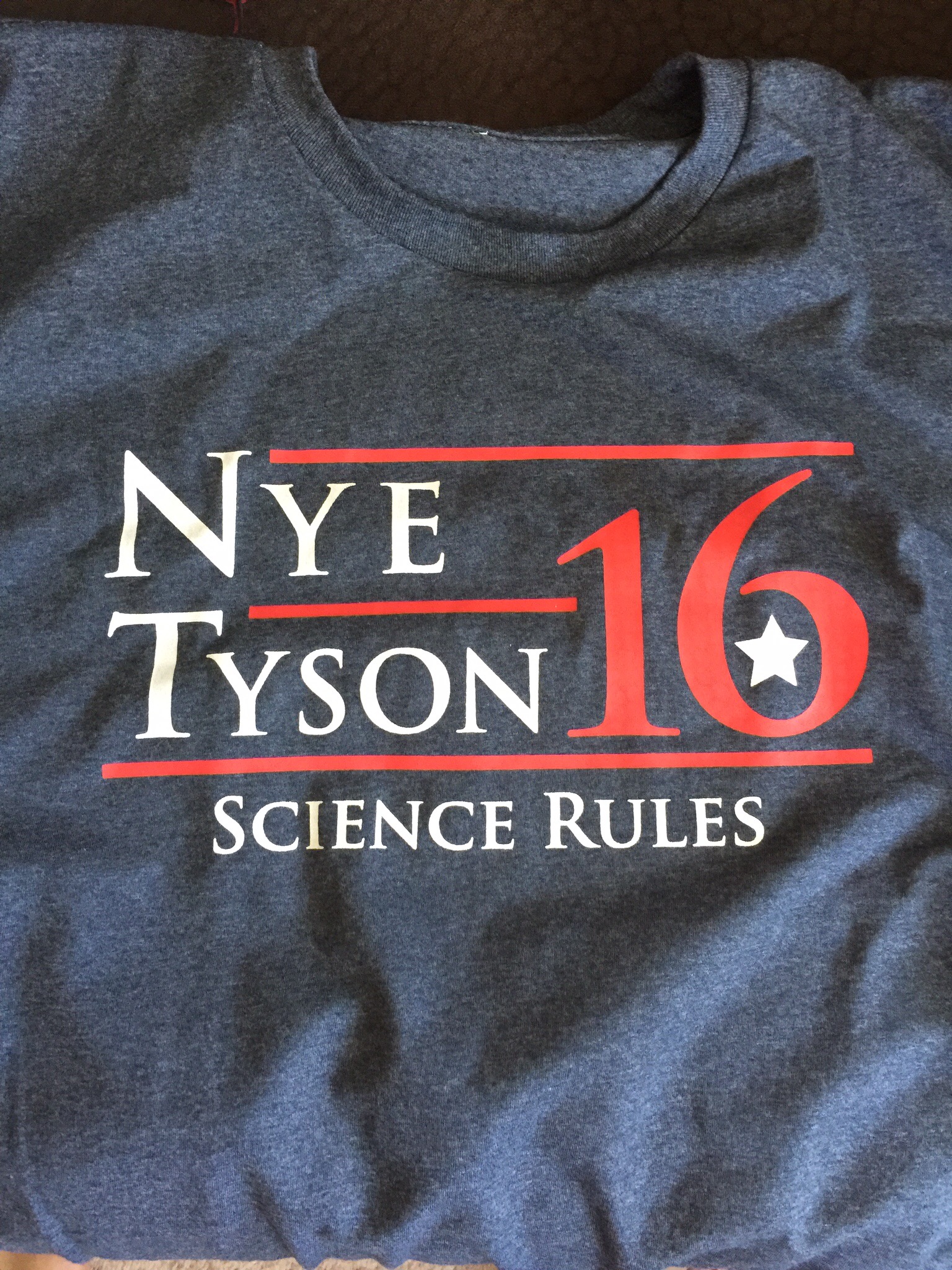
I wore this shirt over the weekend, while I was out running errands. Got lots of confused looks. None seemed to really appreciate it. One asked if Mike Tyson was really running for president. 

Was it too soon? Should I have waited until after we got photos back from Pluto?


A Real STEM-winder

On a fairly regular basis, Eduflack reads some voice on social media lamenting that we are spending far too much time, as an education community, focused on discussions of science, technology, engineering, and math (or STEM) education). What about the humanities? What about passion? What about love? What about what about?

But we can’t overlook the importance of STEM education in our global, digital economy. Even the most romanticized of today’s poets need some STEM skills to remain relevant. One doesn’t need to be a rocket scientist or a surgeon to know that STEM literacy is just as important these days as literacy itself.

Over at US News & World Report, there is a new STEM Index for our reading, review, and reflection. Developed in partnership with Raytheon, the USNWR STEM Index “measures science, technology, engineering and mathematics activity in the United States relative to the year 2000.”

  • Additionally, USNWR offers a wealth of analyses and opinions of what the numbers tell us. Some of the more noteworthy facts include:
  • While the number of STEM bachelor’s degrees earned by Black college students increased 60 percent since 2000, the share actually shrunk compared to the overall number of bachelor’s degrees earned by Black students;
  • STEM degrees earned by white students increased 10 percent, compared to overall bachelor’s degrees;
  • Women still lag behind men in number of STEM degrees earned, exam scores, and general interest in STEM; and
  • White and Asian students and college graduates overwhelmingly outperformed Black, Hispanic, and American Indian students in STEM degrees earned, exam scores, and general interest in STEM.

You can read more about the trends here.

The portfolio of STEM info from USNWR is definitely worth the read. And it is a further reminder of why STEM literacy is so important, whether one wants to be a physicist or a playwright.

Free College, With Caveats

Earlier this month, President Barack Obama announced his plans to provide all “hard working” students with two years of free community college. But such a grand promise comes with a great number of questions, questions that we just aren’t getting a lot of answers to at this point.

Over at Education World, Eduflack opines on some of the many questions that come out of a promise to free college. Impact on dual-enrollment programs and proprietary colleges? Improved quality of community college programs? Impact on Pell? Future of competency-based education? And are we putting the emphasis on the right higher ed items?

As I write at Education World:

Will this be another good idea that only gets tossed aside because it lacks the funding and the changes it calls for are too hard (or too ambiguous) for institutions and policymakers to take on? Or is it just the innovation needed to begin to shake up higher education policy and place greater power and focus on the students, and not just on the institutions?

Give it a read. And please, offer answers if you have any …