Continuing to Challenge the Reading Instruction Status Quo

As some may know, in 2005 Eduflack was part of a team that was asked to put together a book to help parents and teachers better understand scientifically based reading instruction. This came out of my work with the National Reading Panel, which looked at decades worth of research to determine the best ways to teach young children (those in kindergarten through third grade) how to read and how to read at grade level.

A lot has changed since 2005, both in education in general and with regard to literacy and reading instruction specifically. But the guidance SBRR provides hasn’t changed. We still know what works. We still know what is most effective for teaching kids – particularly those from historically disadvantaged backgrounds – to read. We still know if a child isn’t reading at grade level by the end of third grade, learning in the later grades just becomes harder and harder.

But since Why Kids Can’t Read originally came out, we’ve had knock-down, drag-out fights on everything from Race to the Top to teacher evaluations to new ELA standards under the Common Core. While these debates have garnered all the headlines, they haven’t diminished the importance of doing what works when it comes to teaching literacy skills. And they certainly haven’t reduced the importance of parents in the teaching and learning process.

That’s why I am so excited to announce that Why Kids Can’t Read: Continuing to Challenge the Status Quo in Education, from Rowman & LIttlefield, is now available to help teachers and parents navigate this important subject matter. Done in collaboration with my co-editors Reid Lyon and Phyllis Blaunstein, Why Kids Can’t Read offers personal stories from parents and educators on how they have “beaten the odds” when it comes to teaching kids to read. It also provides a deep understanding of what the research says AND how parents and teachers can use the research to ensure each and every classroom is doing what works when it comes to literacy instruction.

Contributing authors include Teresa Ankney, Diane Lyon, Phyllis Blaunstein, Norma Garza, Marion Joseph, Richard Long, Reid Lyon, Sara Porter, Benjamin Sayeski, Bennett Shaywitz, Sally Shaywitz, and yours truly. It also offers a foreword from Carol Hampton Rasco, the president and CEO of Reading Is Fundamental, and a preface from former U.S. Education Secretary Richard Riley.

For those parents with struggling readers at home, it is worth a look. For those seeking a refresher on SBRR, it is work a read. And for those looking for inspiration from parents and educators who are doing extraordinary things, it won’t disappoint.

Of course, I’m biased. As the lead editor, a contributing author, and the father of a struggling reader, this book is quite personal to me. But it should be personal to all of us. We should want every kid reading. We should demand every fourth grade reading at grade level. And we should never make excuses for so many children – particularly kids of color – struggling with reading.

Why Kids Can’t Read is really a story of empowerment, helping parents take an active, positive role in their children’s educational journey. As Bob Chase, a past president of the National Education Association said about the book, “Parents and teachers working together can be an unstoppable force in solving our children’s reading problems. This book will guide all who strive for a nation of readers.”

Couldn’t say it any better myself.

why kids cxant

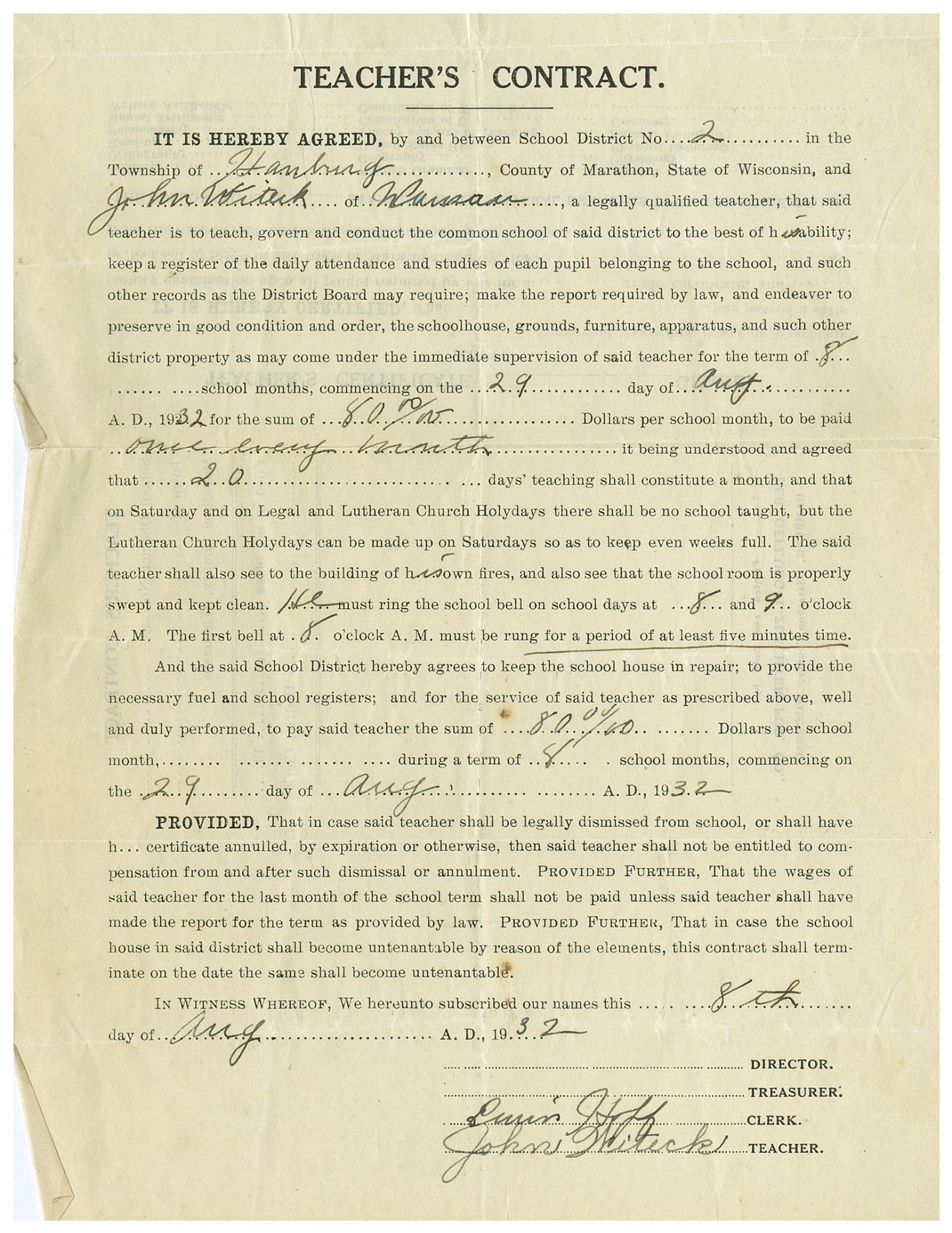
Teacher Contracts, Circa 1932

Over the holiday break, a friend of mine shared this fascinating piece of history. Its a contract between the Township of Hamburg, County of Marathon in Wisconsin with a teacher.

The total contract is one page long. For the 1932-33 school year, the teacher in question received $80 for teaching 20 days per each school month (and the teacher in question was only paid for eight months of a 12-month calendar). Legal and “Lutheran Holydays” are days with no school.

The contract defines a “legally qualified teacher” as one with responsibilities to “teach, govern and conduct the common school of said district to the best of her ability; keep a register of the daily attendance and studies of each pupil belonging to the school, and such other records as the District Board may require; make the report required by law, and endeavor to preserve in good condition and order, the schoolhouse, grounds, furniture, apparatus, and such other district property as may come under the immediate supervision of said teacher.”

Among the added teacher responsibilities? The teacher has to build her own fires. She also has to keep her classroom swept and clean.

Wages could be withheld if the teacher didn’t make the “report for the term as provided by law.” And if the school is determined to be “untenantable by reason of the elements,” the teacher contract is terminated.

No witty comment or snarky remark. Just a document that makes you go, hmmmmm.

WI teacher contract

Ed Reform Through Litigation

In yesterday’s New York Times, Michael Shear offers up a piece on how the Republican majorities on Capitol Hill may be looking to the courts to help win on the issues the GOP has prioritized. In his lede, he cites healthcare, climate change, and immigration as top issues Republicans are looking to.

The Times quotes West Virginia Attorney General Patrick Morrisey, with saying, “Given the state of dysfunction in Congress, in many cases, the courts do represent the last opportunity to get a fair hearing on these issues.”

To counter, U.S. Rep.Gerry Connolly of Virginia counters with, “What they cannot win in the legislative body, they now seek and hope to achieve through judicial activism.”

So why highlight this sort of “policy through lawsuit” philosophy? Because one has to ask if it is the same approach that education reform advocates are shifting towards.

For more than a decade, “reformers” have been working the state legislatures seeking changes to how public education is addressed. Expansion of school choice here. VAM on teacher evaluations there. Adoption of new standards and assessments. Vouchers. We all know the list. Most of the major changes we have seen in education in recent years has been the result of legislative action, where governors and or state legislatures have addressed both policy and appropriation to bring about change.

But 2014 ushered in a new approach to education reform. Both 2013 and 2014 saw major slowdowns (if not downright freezes) on school improvement efforts in state capitals. Reformers (and many of their funders) have grown impatient. So it should be no surprise that the largest education policy development in 2014 — teacher tenure and due process rights via the Vergara decision in California) has become the new playbook. A similar suit has already been filed in New York, with other states anticipating their own versions of Vergara.

Sure, litigation in education is nothing new. Each year, it seems we have a handful of states dealing with court cases over funding and equity. And we’ve had such cases since the Abbott districts were created in New Jersey in 1985 following a court decision in the Garden State.

Reform via legislation is tough work. It requires both a ground game and an air game. It demands strong relationships with governors’ offices and legislatures. It begs for voices beyond the reform community asking for change. And more often than not, based on the past decade, efforts fall short. Compromises are made. Politics comes into play. Reformers are left with partial wins, if that, as the legislative session draws to a close. And even if they do win big, they have to be back the following year to ensure adequate funding for the reforms in question.

Will 2015 be the year the reform model truly changes, with lobbyists and ad campaigns replaced with lawyers and amicus briefs? Is there a perceived higher ROI going to the courts versus working the statehouse hallways? Is it easier to have the courts decree change rather than fight for the dollars for it each and every year?

Time will tell. But if the national GOP has determined it is easier to address sticky policy in the courts rather than in the wells of Congress, surely reform organizations and their funders have been having the same conversations, no? Is Vergara the spark that reforms reform?