Time to Read Dadprovement

I am thrilled to announce that my new book, Dadprovement, is now officially available. This book is a deviation from what I typically write. Instead of opining on the latest and greatest in education policy, It is a far more personal story.

Dadprovement tells of the journey I have gone through to become a father. It details all my wife and I experienced adopting our two children from Guatemala. Such international adoption tales are typically told through the eyes of the mother. Dadprovement is decidedly father-centric.

The second half of the book, though, spotlights the path I have taken to become a more involved father. My shift from careerist, a man focused primarily on my work and sacrificing my family in the name of taking care of them, toward a real dad and husband who rightfully placed my family first and foremost in my life.

Those who have read it are amazed by the story. It officially comes out from Turning Stone Press at the end of the month, available in bookstores around the nation. It is available as a paperback now from Amazon. It is also now available on Kindle here.

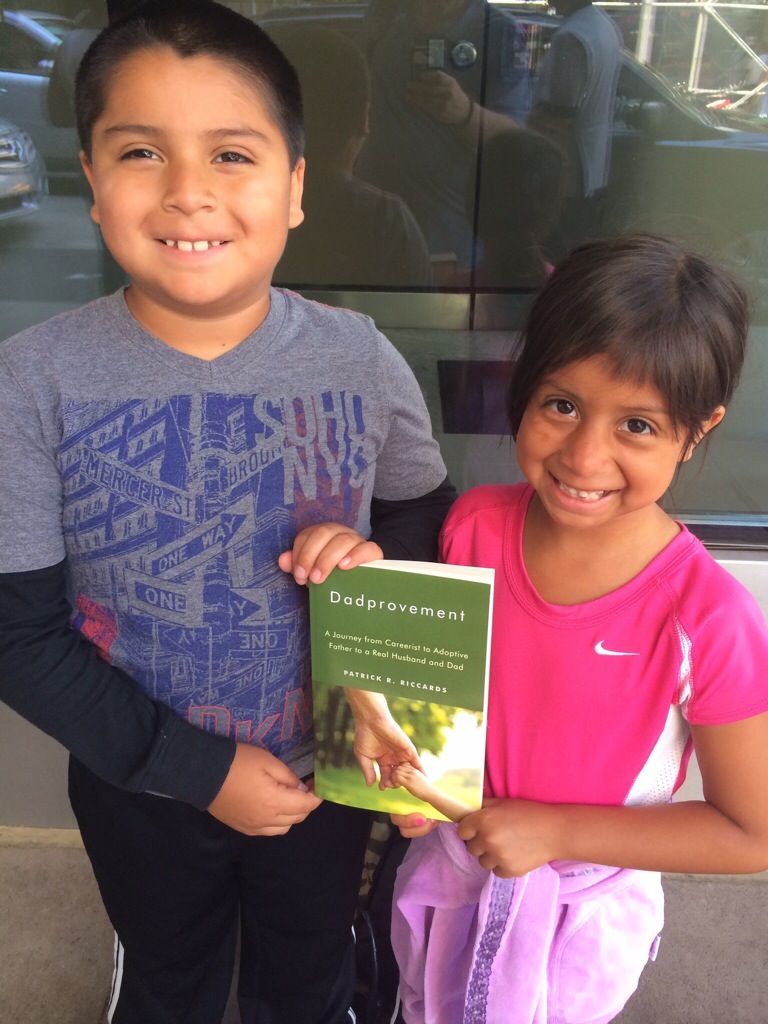
Don’t take my word for it on how terrific a book it is. Just look how happy my kiddos seem with it, finding it in NYC this weekend.

20140713-212639-77199494.jpg

You can also read more about the book and related issues over on the Dadprovement blog, www.dadprovement.com.

AFT Yells, “Game On!”

Some were wondering how AFT, at its annual assembly, would top NEA and its official vote calling for EdSec Arne Duncan’s ouster. Would AFT call for the same? Would they seek heads on pikes?

Well, AFT has responded, and they decided to do so in the most political of ways. First, they announce the formation of “Democrats for Public Education,” a new 527 that will seek to inject addition teacher unionism in political races. While details of the new org are still being worked out, it’ll be co-chaired by former Ohio Gov. Ted Strickland and Dem political consultant Donna Brazile.

It is best seen as a direct counter to Democrats for Education Reform, a group that has grown more and more active in political campaigns. So,me traditional Dems in Los Angeles even tried to block them from using the “Democrats” word, questioning their allegiance to the party.

In welcoming the new group to the fold, DFER ED Joe Williams offered an appropriate Guns n Roses response, “Welcome to the jungle, baby!”

Then over the weekend. AFT also issued an email missive to rally the troops. Under the header of “Are You In?” AFT sent the following:

The promise of America isn’t disappearing by accident. We are being ripped off.

Today, I stood in front of 3,500 AFT members and leaders and asked them to pledge to push back and fight forward. Now I’m asking you.

Our students are suffering. Our families are being squeezed. Our communities are being starved. But it doesn’t have to happen this way.

Will you pledge to stand with us—in our communities, in our workplaces, and at the ballot box?

Our enemy is organized and motivated. They blame teachers for struggling schools. They blame public employees for budget deficits. They blame workers for the broken economy. They sell austerity as the solution while they buy elections, push radical legislation and fund court cases to strip us of our rights.

They use their wealth to build power. Our strength is people-powered. It’s in our members, our leaders and the communities we serve. Despite the vast challenges we face, our ranks continue to grow. Today, our union is 1.6 million members strong.

We work every day to create a better life for our members and the communities we serve. More and more, we’re fighting together to reclaim the promise that’s being stolen from us.

Take the pledge, and join us as we push back and fight forward.

This is the promise we believe in: If you work hard, you have a fair shot to get ahead. Your children can attend a great neighborhood public school, no matter where you live. You can get high-quality healthcare without going broke. Your tax dollars will help build and support a safe community for all of us. You’ll be treated fairly at work, and you’ll get a real raise once in a while. A lifetime of work will earn a retirement with dignity.

While we’re fighting for big things, no action is too small. We need you to do whatever you can. Commit to engage your colleagues in the fight. To build power at the ballot box. To share our work online and in person. To work hand in hand with the communities we serve.

Joe, it seems Randi Weingarten’s retort is “game on.” The big question is whether the new AFT response results in the sort of power they seek come Election Day. Will the new AFT call be a reason for folks to vote in coming elections, or will it be an also ran, as education issues have been for decades. Only time will tell.

The Importance of a Mother’s Education

Over on my Dadprovement blog, I write about a new study that looks at how a mother’s education impacts a child’s education. Definitely offers some real food for thought. The full post follows:


Yes, this blog is primarily about issues related to fatherhood. But it is also about being a better parent and raising a better family. So it was quite interesting to see an article in today’s Washington Post of a new research study that finds that a mother’s education may be the biggest influence on a child’s education.

WaPo reporter Michael Alison Chandler really distilled the findings by offering that “one in eight children in the U.S. … are born to a mother with no high school diploma, compared to one in three whose mothers have a college diploma.”

So how do those groups compare? Chandler reports:

“● 84 percent live in low-income families, compared to 13 percent

● 48 percent have a mother who is not securely employed, compared to 11 percent

● 16 percent read proficiently in the eighth grade, compared to 49 percent

● 40 percent do not graduate on time, compared to 2 percent

● 27 percent are obese, compared to 13 percent”

Some fascinating food for thought, particularly for dads, and parents in general, who think the “do as I say, not as I do” approach to child rearing can get the job done in the long term.


Federal Educator Quality, Take 62 1/2

Today, Arne Duncan and the U.S. Department of Education announced its new “Excellent Educators for All Initiative.” A likely response to much recent data (including that from Ed Trust) that students from historically disadvantaged backgrounds are least likely to have the best teachers leading their classrooms (and likely in partial response to change the subject from the divisive Vergara decision in California, ED is seeking to turn a new page on teacher quality and the equitable distribution of our most effective educators.

In making the announcement, EdSec Duncan said:

All children are entitled to a high-quality education regardless of their race, zip code or family income. It is critically important that we provide teachers and principals the support they need to help students reach their full potential. Despite the excellent work and deep commitment of our nation’s teachers and principals, systemic inequities exist that shortchange students in high-poverty, high-minority schools across our country. We have to do better. Local leaders and educators will develop their own innovative solutions, but we must work together to enhance and invigorate our focus on how to better recruit, support and retain effective teachers and principals for all students, especially the kids who need them most.

Perhaps more interesting, though, was the communique that Team Duncan shared with the nation’s chief state school officers in rolling out the new initiative. Included in the letter:

Over the past several months, the U.S. Department of Education (Department) has conducted outreach to Chief State School Officers, school districts, civil rights groups, teachers, principals, and other stakeholders to explore ways to tackle and resolve the disparities in access to great teachers that we know continue to exist. Through this outreach, we heard that there is no single solution to this problem; we need a broad and systemic focus on supporting and improving teaching and learning, especially in our highest-need schools and for our highest-need students, including students with disabilities and English learners. We heard that the best efforts will not only include recruiting, developing, and retaining great educators with the skills to teach all students, but will also build strong school leaders, create supportive working conditions, and address inequities in resources and supports for teachers.

and

This is not the first time that states, districts, and the federal government have tried to grapple with the complex challenge of ensuring equitable access to excellent educators, but previous efforts have not fully addressed the challenge. Our continued collective failure to ensure that all students have access to great teachers and school leaders is squarely at odds with the commitment we all share to equal educational opportunity. I thank you for your ongoing and tireless work on behalf of America’s schoolchildren, and I look forward to working collaboratively and supporting SEAs and districts as part of a nationwide effort to close this unacceptable opportunity gap.

The new initiative is initially focusing on three key areas: 1) New State Educator Equity Plans; 2) Educator Equity Support Network; and 3) Data Release and State Profiles.

At face value, it all seems well meaning. These are three areas that all those, whether they be “reformers” or defenders of the “status quo” should be able to get behind. Maybe some consensus on the one area — effective teaching — on which we need the greatest collaboration and commitment.

But it does raise one unanswered question. How will this new effort interact and build on the work that has already happened on this topic? How does it build on the existing research? How does it move forward from past ED efforts, like teach.gov? How does it build on the teacher-focused philanthropic efforts led by everyone from Gates to Ford? How does it learn from upstart efforts such as the Woodrow Wilson Teaching Fellows and STEM mid-career programs? How will it bring together colleges of education and alt cert programs in a meaningful way?

How does it learn from all that came before it? Or will it simply be another effort that seeks to reinvent a wheel that already has plenty of road miles on it? Only time will tell …

I’m (Almost) Back

Eduflack is happy to report that I will soon be back in the saddle on this dear ol’ blog shortly. I appreciate all the loyal readers’ patience with me as I wrapped up my book on fatherhood (coming to a bookstore or e-reader near you next month) and wrapped up the second edition as lead editor of Why Kids Can’t Read: Challenging the Status Quo in Education.

Come August, I’ll be back to multiple posts a week here on the important intersections of education, policy, politics, and communications. And if you can’t get enough of Eduflack, check out my Twitter feed and all those articles I find interesting, and hope to blog about one day.

Thanks, as always, for following. Have a great Independence Day weekend!

The Path to “Dadprovement”

Earlier this year, Eduflack had noted that he had completed a new book on fatherhood, and the book would be coming out soon. After initially self-publishing it through Amazon, I’m pleased to announce that Red Wheel Publishing is releasing the book, and is currently planning to do so in August.

Eduflack fans be warned, this is not my typical policy rants or communications critiques. Instead, this is a very personal and emotional story. It talks through all of the triumphs and challenges my wife and I went through in adopting our children from Guatemala, particularly as we raced against the clock that was shutting off the international adoption process for good. It then transitions into a relatively raw story on my own struggles to figure out what fatherhood truly meant and the stumbles and frustrations I required before I truly became a real husband and a real dad to my family.

The book is Dadprovement: A Journey from Careerist to Adoptive Father to Real Husband and Dad. If any Eduflack readers are interested in reading the book, and then blogging about it, please let me know and I can shoot a copy over to you. It is a quick read, and I hope you will learn a little something about what makes dear ol’ Eduflack tick.

As the publisher notes in the initial promotion,  the book provides “Inspiration for any parent wrestling with society’s expectations and acknowledging (and cherishing) what really matters…”

The best part is I am now sharing a publishing imprint with the likes of the Dali Lama and the guy who wrote Chicken Soup for the Soul. I feel like a real boy!

In the coming months, I’ll be ramping up a Dadprovement blog, which will focus on all things fatherhood and the joys and struggles of being a dad. I hope you will add it to your reading list. Check it out!


“Don’t Call Them Dropouts”

Over at GradNation, America’s Promise Alliance is running a blog series on its new report, “Don’t Call Them Dropouts.” The report is an important one, making clear there is no quick-and-dirty explanation as to why so many fail to earn their high school diplomas. More importantly, America’s Promise Alliance has launched a valuable discussion on what the report really means and how we can move its findings and observations into meaningful policy that increases high school graduation rates and pathways to success.

Eduflack was proud that he was asked to contribute to this series, and my post is up this morning. In Driving To a Better Future, I write about how we can better engage students at risk, and how it could have impacted my family.

From today’s GradNation post, in telling the story of my grandfather:

Oh, how times have changed. A high school diploma is now a non-negotiable. My grandfather would not have been able to join the Army without a high school diploma. And the chances that he would be able to buy a house and raise a family where all five of his kids would graduate from high school would be slim. 

I urge you to check out the full post, and spend some time exploring some of the other posts on the GradNation blog. It is well worth the read.


A Little Housekeeping

For those loyal Eduflack readers, you may have noticed that the blog site looks a little different these past few days. In the words of those fun-lovin’ families in the South Park movie, “Blame Canada!”

Seriously, though, for the past seven years this blog has been hosted on a GoDaddy platform. Earlier this month, GoDaddy let us know it was doing away with its blogging platform. So I am currently in the process of trying to move seven years’ worth of posts from the old site to this new Word Press site.

So bear with me. Much appreciated.

“Our School,” Our Community

When we talk about education and school improvement, we can often forget there are real schools involved in the equation. In our quest for reform, we can slip into thinking in abstraction, thinking about public education as if it were a laboratory and our changes have little, if any, impact on the educators and students who spend the majority of their time in those very buildings.

While some of my reformer friends may say this is an unfair or downright untrue statement, it is rooted in fact. The reform movement, of late, is largely about changing systems and processes. It is about administrative changes and oversights and accountability. The rest can come later, after we change how these schools “operate.”
It is because of this that we need to be reminded of the human factor in our schools, both those that excel and those that struggle. That we highlight that there are no educators or students who seek to fail or not make the grade. That we all want to see success, even if we define it differently or can’t determine how to chart the best path to get there.
That’s why we need to refocus on our schools as a community. Good or bad. Success or no. We are a community, and we are in this together.
This spring, author Sam Chaltain reminds us of this important point in his new book, Our School. Published through Teachers College Press, Our School chronicles the search “for community in the era of choice,” as Chaltain weaves a powerful narrative that looks at the experiences in real schools. He reminds us why so many of us do what we do, and why this work can be much harder than so many people seem to think.
How? The impact of this book is best captured in the words of Sir Ken Robinson, a guy who knows a thing or two about school reform and improvement and who pens Our School‘s foreword.
Our School is an important book. It brings to life, in the most vivid way, many of the issues about American education that in political debates are too often treated as abstractions. In place of the conventional rhetoric about what’s right or wrong in the nation’s schools, Sam Chaltain offers a close-up, beautifully observed account of a year in the life of just two of them. In many respects, these schools couldn’t be more different. Both are in Washington, D.C., physically close to the epicenter of American power, though in most other respects a world away from it. One is a startup charter in new premises, still working to define its identity and to catch its beat. The other is a long-established neighborhood school, filled with the memories of generations, a school where many former pupils now send their own children or grandchildren.
On these pages, Eduflack has often written about the importance of conversing, engaging, and collaborating with those that offer a differing perspective. For many years now, Sam has been one of those folks in my life. Sam and I agree on much, and strongly disagree on some. And while I may not agree with all of the conclusions he offers up in his latest book, I’m damned glad to have taken the time to read it. We all must be reminded that community, far more than policy or oversight, is what is responsible for a school’s ultimate success or failure.

“The Power of Introverts”

My name is Eduflack, and I am an introvert. While I am a highly functioning introvert, one who overcomes when need be, I can never shake being an introvert. I even come complete with a horrible stutter, another item I have overcome, but which often comes back when I get particularly worked up.

While I tend to read a great deal of things, I rarely write about them here. Instead, I focus on education politics and policy and communication. But after recently completing Susan Cain’s “Quiet: The Power of Introverts in a World That Can’t Stop Talking,” I feel compelled to write a little.
Those who are not true introverts will never understand the real fear that comes from having to make small talk in an overpopulated room or having to be “on” for a dinner party. Just ask the eduwife, a classic extravert who has had to live with Eduflack for the past 15 years.
“Quiet” captures quite well the introvert experience. And it offers some keen observations for what it is like to be introverted and how best to deal with those of us in the club.
Among Cain’s more compelling nods:
  • Introverts often need solitude in order to be truly productive
  • Forced collaboration, even in the name of teamwork, is rarely valuable
  • Some of the best ideas come while working solo, not in those group brainstorms that folks are often so fond of
  • Some of the most dynamic, entertaining speakers and public engagers are introverts, who “act the part” to do what they care about
  • Having to speak before a crowd of hundreds is far easier than having to make small talk with a half dozen people at a cocktail party
  • Introversion is largely a matter of nature, not nurture
  • Introverts are more sure of themselves, even in the face of groupthink
  • Introverts typically only speak when they have reason to contribute. They don’t talk for talking’s sake.
Equally interesting was Cain’s remark that while introverts appreciate their alone time, they are prone to share far more about themselves via social media than their extroverted friends. 
What does all of this have to do with this blog? Not much, to be honest. But if offers some interesting food for thought as we start the summer months.