
Can You Teach a Superpower?

Last week, dear ol’ Eduflack wrote about the incredible learning experiences the Edu-family is getting from kickboxing. so this week, I’d like to turn the rostrum over to one of my Tiger Schulmann sisters, Amy Vondrak. 

Dr. Vondrak is a professor of English, an instigator of Utopia, and a TSMMA Yellow Belt (which means she outranks me and has physically kicked my butt on the mat.) Dr. Vondrak has captured a powerful perspective to the experience that just has to be shared whole cloth. So here goes …


A few nights ago at Tiger Schulmann’s Princeton, Sensei gave the advanced kickboxing class a scolding. About half the class had been late, which earned us quite a dressing down. The core message of his admonishment was the importance of self-discipline. In fact, the core of almost every one of Sensei’s talks is self-discipline. Now, even though (as he has often told us), “Sensei” means “born before,” I often feel just a bit odd about being the recipient of the wisdom of a man 20 years my junior. But actually, Sensei is right about a lot of things, and discipline is one of them.

During his scolding, I thought about my students, as I often do at martial arts. I’ve taught developmental composition at a community college for 13 years. Sensei teaches martial arts much like I teach writing: he takes complex series of moves and “scaffolds” them, taking them a step at a time. Learning a double-leg take down to side mount to triangle choke takes weeks as we work through each of the component parts of each move. And Sensei often tells us that if we don’t show up to class, on time and consistently, we are not likely to get any better at martial arts. I tell my students the same thing, but most of the time, they don’t listen.

I love my students. They have big dreams and so much potential. By and large, they are smart people who have been failed by an archaic educational system. But much of that potential gets lost because of the one thing they don’t have: self-discipline. They face huge challenges in life. They have jobs and kids and no money and crazy lives, so there are plenty of good reasons why it’s not so easy for them to get their work done and their butts in class. I’m not saying my students are lazy. Self-discipline is not a character trait, it’s a skill, one that they lack just as they lack writing skills. So they fail. Those of you who follow higher ed know that college students fail in great numbers. Then they feel even less able to take their place in the world, they feel even less powerful than they did when they walked into my class. That is not my mission as a teacher. My job is to show them their strength.

Along with Eduflack, I fought in the 42nd Challenge of Champions. I chose to fight up a division, literally fighting above my belt, and spent the late winter and spring trying to get mentally and physically prepared. The physical part was easier than the mental. It’s easier to face burpees than fears. But I did it: I got on the mat and I fought, as did many of my TSMMA Princeton teammates. Now, I’ve been going to the CoC as either a parent or spouse of a competitor for years, and this was my second time competing. Our family is very familiar with the emotional intensity of that day. But for some reason, this CoC showed me something I had not fully seen before: the way in which fighting lets us win our life battles. Of course, I know that martial arts is way more than a workout. Of course I’d been vaguely aware that for all of us on the mat, it’s not just about getting in shape. But this CoC gave me a glimpse into just how much we are fighting our demons, and winning. We may not be superheroes, but fighting makes us feel like when life starts shooting, we’ve got metal bracelets, a cool shield, and some amazing powers. In reality, our amazing superpower is self-discipline.

It is not easy to drag your tired self out to kickboxing on a Thursday night knowing that someone better than you is likely going to punch you in the face – sure, they’ll do it with respect and camraderie, but whatever, they’re still punching you in the face. And at the end of a few rounds of that, those burpees are waiting. But we do it. Again, and again, and again. Why? Discipline. And that discipline gives us tremendous power. We are less afraid of our demons and we are more powerful in our fight against them because our spines are stiffened with strong discipline. Bring it on bad guys, we got this.

My focus as a teacher has long been on content: how to read and write. Of course, I’ve tried for a long time to figure out how to teach grit, or growth mindset, or whatever trendy term is hot this week. But as many of the critics of those buzzwords will say, how do you teach grit? “Grit” always seems to be found in heroic stories of grand characters who beat enormous odds. In contrast, self-discipline is small and boring. Self-discipline is the accumulation of many daily acts, most of which may seem unimportant in the individual, but are massively important in the aggregate. But self-discipline is a skill which can be taught, which can be broken down into its component parts and taught a step at a time with lots of practice. So this summer I am cooking up a semester-long self-discipline project to roll out in the fall.

As a community college teacher, I’m not just trying to help students become better writers. Community college can be transformative, and it’s my job to help students feel empowered to change their lives. What I saw at the CoC was ordinary people fighting their demons with daily discipline, winning, and growing stronger because of it. This is what I want to share with my students as well – be disciplined, not just for your grade, but because your discipline will make you stronger than the world that tries every day to cut you down. Do your work. Fight for your grades. Fight for your degree. Because your fight, your discipline, gives you superpowers.
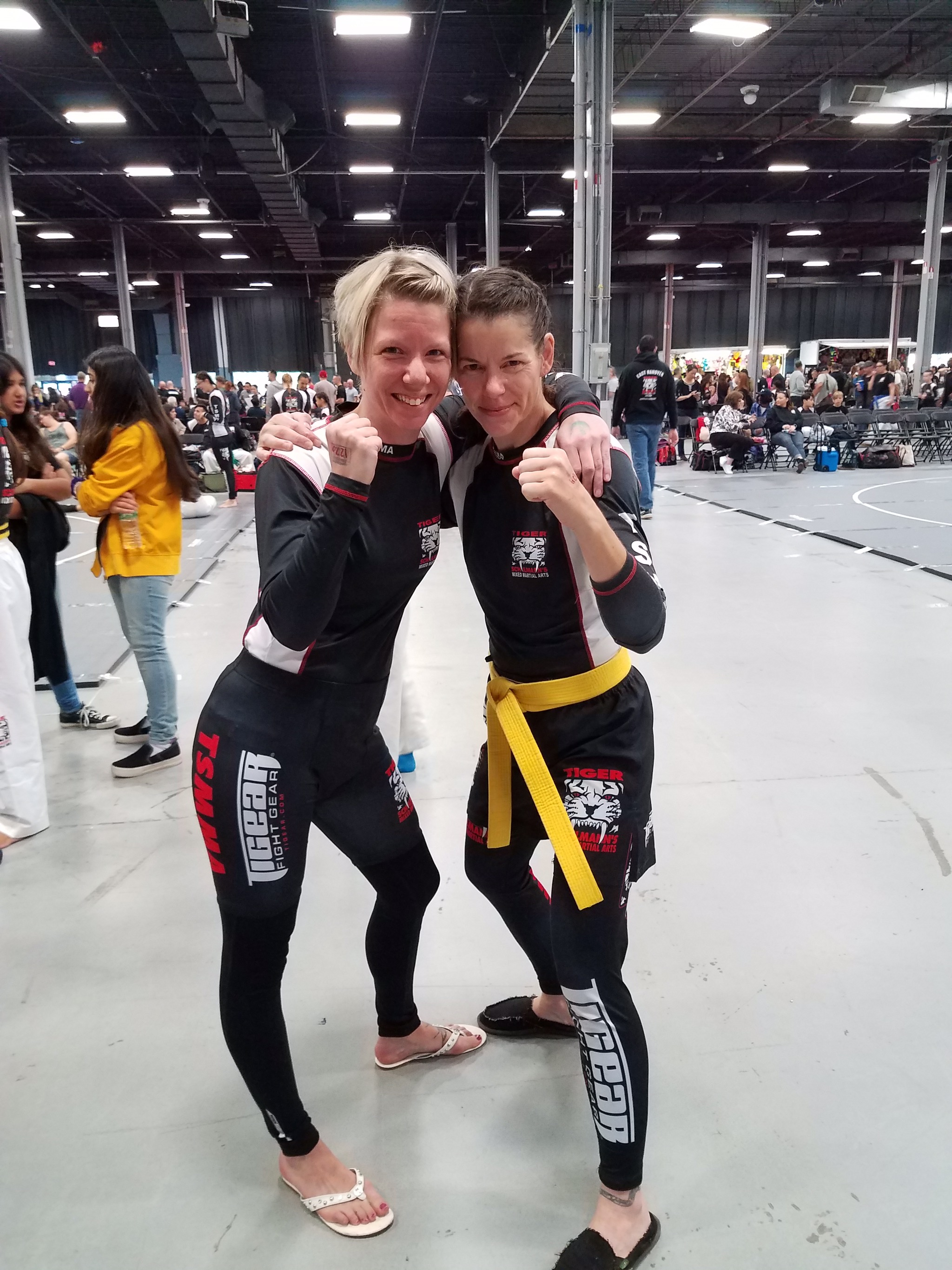

Dr. Amy Vondrak (r) with Megan Barndt.
A 40-Something Fat Guy, Learning Life Lessons in an MMA Ring 

Most guys of my age and my physical “stature” likely spend their sunny Sunday afternoons on a golf course. Or sitting in a baseball park or at a movie theater. Maybe they just spend the afternoon on the couch, recovering from a long week and preparing for a longer one.

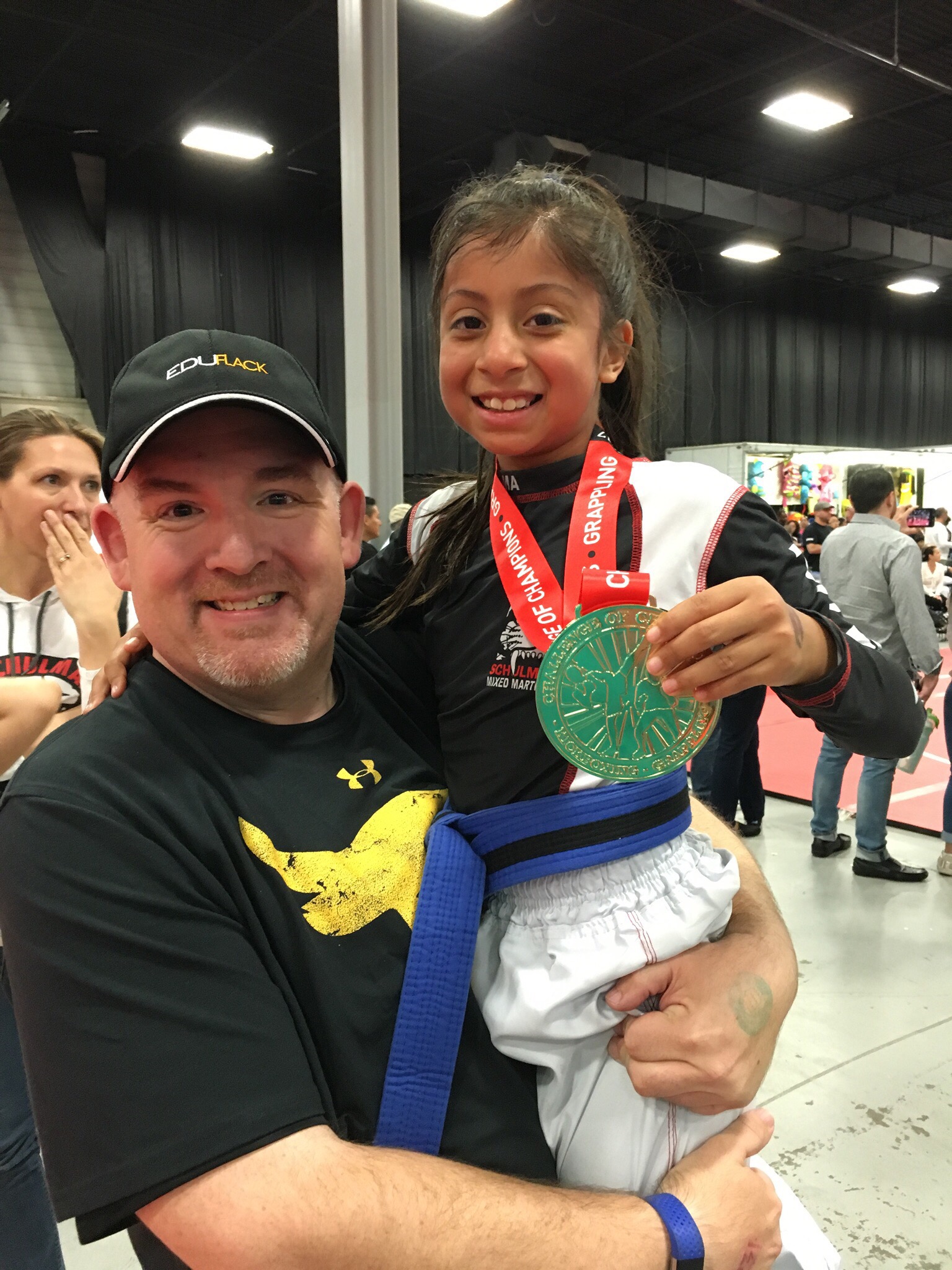
Instead, I spent my last Sunday at a civic center in Central New Jersey. I was there to cheer on my daughter, competing in her first “Challenge of Champions,” a regional grappling and kickboxing tournament sponsored by Tiger Schulmann’s MMA. My mini-me has been training with Tiger Schulmann’s for two years now. On Sunday, she earned a silver in grappling for 9-10-year old girls, and a gold for kickboxing.

But I was also there for me. I’ve been training a few months longer than my daughter. As a result, I spent my Sunday strapping on my gear to kickbox against the old, fat, and unskilled bracket (those over 40, more than 200 pounds, and with white, blue, or yellow belts). Unlike my daughter, I left with no celebratory hardware. Instead, I walked away from my bouts with two fractured ribs, bones broken 30 seconds into my first fight, and that remained broken throughout my entire second bout.

 
Which begs the question, why in the world is a guy like me spending his Sunday getting kicked and punched to the point of breaking? Why do I spend much of my free time sparring with men half my age and with (at least) twice the skills and athletic prowess? Why do I suffer from broken toes, fractured tibia, and more bruises than I care to count, and respond by thinking of how I can do better and how I can avoid suffering the same injuries in the future? I should be pedaling a stationary bike or strolling around the neighborhood. Instead, I worry about the quickness of my left cross and the strength of my roundkicks.

Why?

I do it because it forces me to do something that doesn’t come easy to me. Not everything should come naturally. Not everything is covered by our personal skill sets or lives in our personal wheel houses. When we are challenged to break those comfort zones, we learn who we truly are as individuals.

I do it because it eliminates the word quit from my vocabulary. Parents know how often kids want to stop doing something because it might be a little challenging. If I’m not traveling for work, then I’m on the mat training. I don’t come up with excuses to skip, and my kids (both of whom train) similarly can’t offer excuses. 

I do it to be healthier. Yes, kickboxing is an incredible workout. I’m a man who once weighed more than 400 pounds. Today, I am in the best physical shape of my life. I’m stronger. I have far greater physical stamina. More importantly, I am healthier so my kids see the importance of a healthy lifestyle and staying physically active. If dad (and mom) can do it, then the kiddos can definitely do it.

I do it to clear my mind. It may sound silly, but the hour on the mat is the one hour in a given day when I don’t think about work or family or finances or any of the other thousand and one things that weigh on me most days. I need to focus on the task at hand. If my mind drifts to a work issue, I’ll take a blow to the body (or worse, to the head). So I need to stay focused on me and my opponent. All of those professionals who embrace the philosophy of “deep thinking” or who bemoan the impact of multi-tasking fully understand the benefit.

I do it because it is a pure meritocracy. No one cares what one does for a living. It doesn’t matter how much money one earns, how big one’s house is, or what car one drives. What matters is commitment, focus, and skill. It’s about the color belt around one’s waist and the number of days one trains. As a result, my community is one that we strive for in the 21st century. It is male and female. It is black, white, brown, and yellow. It is Christian and Jewish, Muslim and atheist. It is young and old. At the end of training, we are all just brothers and sisters, working toward similar goals.

And I do it because it provides a sense of family. It may sound incredibly corny, but our little Princeton school does indeed become a family. I care for many of the other kids there as I do for my own, watching them train and develop. We have a tight group of families that train, with both parents and all kids working. It provides a sense of belonging that it harder and harder to find these days. We help each other through training issues, through work issues, through family issues, and through personal issues. And we do it because we choose to, not because of a sense of obligation.

I have no grand aspirations. I recognize that Dana White is never going to come knocking on my door, because he has been looking for someone just like me to join the UFC. I know that, no matter how much time I put in, my skills will never be great. Sure, I know they will improve over time, and I want them to improve, but few will ever look at me and use the words “skilled fighter” without adding a “not a” before it. I’ll continue to work through the bumps and bruises and breaks, using them as motivation instead of reason for surrender.

I do so because it makes me a better, more complete individual and because it makes us a stronger, more capable family. I’m reminded of that when I see a group of people cheering their hearts out for my daughter as she took home the gold. I’m reminded of that when I see those members of my Tiger family who waited until the very last fights of our friends were fought late on Sunday evening. And I’m reminded of that when I see the resiliency, commitment, and respect my young children demonstrate on a daily basis because of it all.

At the end of the day, I am a writer, a father, an advocate, an agitator, a strategist, an innovator, and a fighter. And through all of the ups and downs all of those identifiers bring me in both my personal and professional lives, I wouldn’t want it any other way.

(Eduflack is a high blue belt training at Tiger Schulmann’s MMA in Princeton, NJ. A version of this piece also appeared on LinkedIn Pulse.)

Learning to Learn Better: The Interview

Dear ol’ Eduflack has been spending a great deal of time recently focused on the subject of cognitive science. Dating back to my time helping lead the National Reading Panel, I’ve been fascinated with learning about how people learn. And I’ve been even more fascinated by those that, despite the incredible growth in cognitive learning research in recent years, continue to believe that learning is an art, with little room for hard science.

So when I heard about the new book, Learn Better: Mastering the Skills for Success in Life, Business, and Schools, or How to Become an Expert in Just About Anything, I was sold. The book itself is terrific, weaving a tight narrative of instruction, storytelling, and inspiration. And it applies to concepts of learning, and learning better, in areas many of us may never have thought of.

That’s why I just had to reach out to Ulrich Boser, the author of this terrific book, to get some answers to the questions I was begging to ask. Most know Boser as a senior fellow at the Center for American Progress. My first interactions with him date back to when he was an editor at US News & World Report. As author of Learn Better, Boser has made an important contribution to the discussion of how we improve learning and how we ensure our educators, our institutions, and our learners are prepared for what the future of learning might bring.

Huge thanks to Boser for indulging me and stepping up on the five most important questions his book left me with. 

EDUFLACK: What was the most surprising story on learning you heard as part of your research? 

BOSER: For me at least, the story of Roger Craig was definitely the most surprising. To explain, Roger Craig thought that he might have an edge at Jeopardy after reading about an approach to learning known as spacing. The idea behind spacing is pretty simple. Since we all forget, learning should be spread out—or spaced—in order increase the amount of learning.  

So Craig began to study Jeopardy! trivia using a spaced approach, and with the help of a bit of software, he would revisit every weird Jeopardy detail in a highly distributed—or spaced—way.

Armed with this bit of the science of learning, Craig dominated Jeopardy. He first appeared on the game show in the fall of 2010 and eventually set a record for the most amount of money won in a single game.

Craig’s success at the game show tells two bigger stories, I think. First, learning often leaves as soon as it arrives, and to account for this fact, people should revisit whatever they’ve learned at regular intervals.

Second, people can use the science of learning to develop much richer skills. 

EDUFLACK: Learn Better seems to champion competency-based education, the ability of a student to both learn and be able to do/demonstrate. Is that a fair assessment?

BOSER: Absolutely. Indeed, I find the debate over competency-based education a little narrow minded, to be honest. More specifically, does anyone really argue that we should not measure competency? To me at least, it seems obvious that if students learn something, they should be able to–you know– do it.

In my mind, the more important question is: How do we measure competency? What programs and policies do we need to figure out if students can really demonstrate their learning?

From my conversations with researchers, it seems that robust learning is the ability to think in a certain field. So if someone wants to be a competent engineer, they should be able to think like a engineer. If someone wants to be a competent a car mechanic, they need to think like a car mechanic.

This isn’t as complicated as it seems, and according to a growing number of experts, this sort of thinking—and learning—often comes down to analogies. In other words, we can learn a lot by seeing the relationships within a field, by seeing how things fit together.

For me, the problem is that our education system is not aligned with the research. Standards, curriculum, tests, they often push in different directions on the issue of competency, and we need better tests and instructional tools to promote—and measure— analogical thinking within an area of expertise. 

EDUFLACK: In recent years, there has been a drumbeat that every student can and should benefit from a liberal arts college education. But as you emphasize finding value in one’s learning, is “all can benefit” the approach we should be looking to?

BOSER: I think a liberal arts education is deeply important. To engage in the world, we need a broad base of knowledge, from knowing Mozart to understanding the Battle of Mogadishu. What’s more, a liberal arts-oriented education can help us learn new things. Background knowledge helps learning, and the most reliable indicator of what you can learn is what you know.

At the same, we expect way too much of schools. In K-12 at least, schools are supposed to teach everything from reading to coding, social skills to citizenship, tuba to Picasso, plus win an occasional sports championship. That’s simply too much, and it keeps schools from focusing on effective teaching and learning. 

EDUFLACK: The thesis of Learn Better seems to place a great deal of responsibility on the learner to own his or her own education. What should teachers today be doing, or doing differently, to ensure better learning in their classrooms?

BOSER: Great question. First, I’d point out that students need to learn responsibility in the same way that they learn geometry or Spanish, and we need to give young people more opportunities to develop ownership skills in meaningful ways.

This can be difficult, to be sure. I have little kids, and as we are rushing out the door each morning—a mess of untied shoes and missing water bottles—it’s hard to imagine giving my kids any more responsibility. But giving kids some ownership is crucial. It gives them an opportunity to practice responsibility.

Second, we have to realize that people need to find their own meaning. This is key to learning, and people have to find their own meaning in a subject in order to be driven to learn that subject.

This means that just sprinkling some pop culture facts on a topic isn’t going to make it interesting. Alas, just mentioning the Kardashians during math class isn’t going to promote any robust forms of motivation.

Instead, educators should encourage students to find their own value in a topic, to figure out how the students might uncover their own relevance in a field of expertise.

Chris Hulleman at the University of Virginia puts this idea well. Motivation “is about making that connection between what people are learning and what’s going on in their lives,” he told me. “Value is the mechanism. For people, the question is, ‘Can I see why this is valuable to me?’” 

EDUFLACK: In talking about the need to shift from rote memorization to deeper thinking, I read it as a need to move learners from being generalists — or jacks of all trades — to being specialists or expert in those things that really drive them. Are we headed toward such a future?

BOSER: Yes, and in many ways, this future is already here. After all, the history of the modern world is the history of specialization, and our economy runs on people developing pretty narrow areas of expertise.

Adam Smith wrote about the power of specialization centuries ago in his book Wealth of Nations, and at its core, it’s about dividing up labor. What’s more, technology is putting a version of this trend into hyperspeed by automating more and more tasks, which requires more and more specialization.

That said, we don’t always need to become experts. Mastery isn’t always necessary. But we should stay away from rote learning. It’s simply not effective.

Let’s take changing a tire on a car, for instance. I don’t need to become expert in the skill of tire changing. My tires don’t break down that often. But I do want to go beyond a rote understanding of tire changing.

Because if I have a rote understanding, I will not be able to change a tire on any other car besides my current car. That doesn’t help me that much, especially if my friend’s car has a flat tire or if I get a new car.  

So when it comes to changing a tire, I would want to learn how to change a tire well enough that I understand some of the basic principles (like lift) and enough of the mechanics (like unscrewing bolts) that I can change the tires on different cars.

To answer your question, then, we want people to specialize–and learn some topics very well. But some generalization remains necessary, at least if you don’t want to be stranded by the side of the road with a flat tire.

Just Say No to Political Pottymouths

If you haven’t noticed yet (and it is near impossible not to notice), the 2016 elections have led us into a 2017 political discourse where the name of the game is vulgarity. The language that was once used in political backrooms is now being used front and center in public meetings, speeches, and in social media. Things most people wouldn’t say to their mothers are now being said before cheering crowds of thousands.

Over on Medium, I look at the rise of cuss words as substitute for political voice. As with any name calling, it fills the space because we simply can’t think of anything substantive to put in its place.

As dear ol’ Eduflack writes: “it is fascinating that a generation of parents who regularly preach to their kids, ‘use your words,’ to express their frustrations now throw in the towel when it comes to doing the same themselves.”

Give the full piece a read. You won’t f*%!in’ believe it!

Acknowledging that Career and Technical Ed Still Matters

Career and technical education (CTE) remains one of those important topics in public education that we just don’t talk enough about. When it became politically incorrect to call it “vocational education,” we renamed it to CTE. But even in today’s environment – one where we claim to prioritize science, technology, engineering, and all of those skills once termed “21st century,” we still don’t give CTE its due.

Last month, the Trump Administration made much hay of its push to make and buy American when it comes to manufacturing. As we focus on how we protect American jobs while growing the American economy, we can’t expect to have a meaningful discussion on the topic unless we are talking the skills and knowledge necessary to ensure those manufacturing jobs both today and tomorrow. That means serious conversations — and policies — around career and technical education.

Over on BAM! Radio Network, Eduflack explores this important topic, hoping that CTE can finally get its due in both education and the economy. Give it a listen here. You won’t be disappointed. 

Is Free College Really a Good Thing?

Last week, New York Gov. Andrew Cuomo, joined by U.S. Sen. Bernie Sanders, announced a plan to provide “free” college to all New Yorkers with a family income under $125,000. This isn’t the first time politicians have announced plans for free college, and it likely won’t be the last.

In making the announcement, Governor Cuomo noted that postsecondary education is a necessity in the current global, information economy and that many NYers graduate with “$30,000” in debt to secure a degree. “That is not fair. That is not right,” the New York Post quoted the Empire State governor as saying.

Yes, Cuomo is absolutely right that a postsecondary education is a must for all these days. And while we can get into the discussion on whether such programs end up throwing shade on community colleges and lead more individuals to pursue four-year degrees that don’t open many doors in that information economy, I’ll leave the fight over what “postsecondary education” means for a future post.

Instead, dear ol’ Eduflack wants to take issue with the notion that it isn’t right or fair that individuals take on student debt obtaining a four-year degree. According to the Institute for College Access and Success, the average graduate of a four-year college (excluding the for-profits) leaves school with $30,100 in debt.  That works out to student loan payments of about $300 a month for the average college graduate.

That’s less than the monthly payment on an average car loan the recent graduate is likely paying. It is likely less than the average rent. And unlike the car and the rent, it is an asset that the graduate will carry with them throughout his or her life.

We can often forget that when we make things “free,” particularly things that one used to pay for, we reduce the perceived value of the item. When it is free, we don’t see to care as much about what we received. It was free, after all, so it is no biggie if we lose it, forget about it, or fail to use it.

When we pay for something, we see value. With a college education, we are forced to make choices. What postsecondary path is of most interest to us. What areas do we have the most skill. Where do we see potential careers. Are we willing to do the work necessary to turn our investment into a tangible product (our degree)?

When we take out loans, take on jobs, or even have families who can pay the tuition, we are less likely to seek that degree in underwater basketweaving and instead choose paths that are aligned with our interests, talents, and future goals. And that is a good thing.

Instead of free college, why not instead focus on college affordability? Why not ask if so many of those universities need the ever-growing endowments they have? Why not ask how colleges and universities are reducing costs to their students, and not just their operating costs? Why not ask when a two-year degree may make far more sense than a four-year degree? Why not ask whether it makes sense for that “free” college to essentially go to pay for remediation? Why not ask how we ensure it takes students four years, and not six or seven, to earn a four-year degree? Why not ask how we ensure college focuses on the student, and not the institution? Why not ask how we ensure a college education is about what is learned, and not just what is taught? Why not?

After World War II, about 5 percent of Americans held a college degree. Today, we are up to about 40 percent. Are those millions and millions of Americans chumps for personally sacrificing, taking on debt, and gaining college degrees when they could have just waited around for someone to give it to them for free?

I don’t mean to be the skunk at the garden party, but if we think free college is the answer to all that ails us, we are going to be severely disappointed. Not only does free college diminish the value of a postsecondary degree, but it also begins to draw further distinctions between where one earned that degree. How long before employers begin asking whether that free degree from the state college is as valuable as the paid-for degree from the private college up on the hill?

Efforts to bring equity to postsecondary education through free college could end up bringing a whole new era of inequity to the discussion.


The Quest for More Engaging History Instruction

Ultimately, fostering each student’s curiosity and sense of agency leads to habits of mind that support lifelong learning and civic engagement—and it is never a bad outcome when mastering required curriculum is exciting and fun. Teachers are also happily about the ease with which games can be tied into curriculum and standards and used to enliven content delivery and assessments while maintaining academic rigor. They are also committed to taking the lesson back to their colleagues—teachers teaching teachers, to make learning more dynamic throughout their schools.

– The Woodrow Wilson Foundation’s Stephanie J. Hull, writing about the importance of gaming in social studies instruction in The “Great Game” of Teaching History for GettingSmart.

A Family Engagement Advocate for EdSec!

Last week, Education Week published an interesting look ahead at what could be when a new Education Secretary is selected. In her piece, the always terrific Alyson Klein asks what might be if Hillary Clinton bucked tradition and selected, as her next U.S. secretary of education, an individual coming from the higher education side of the realm.

Historically, we are used to EdSecs coming from the K-12 perspective. That’s definitely true of the past four, with Rod Paige, Margaret Spellings, Arne Duncan, and the current EdSec John King all cutting their teeth on the mean streets of K-12. Before that, we had governors like Dick Riley and Lamar Alexander, who brought a policy perspective but whose educational lens — due to the nature of a state chief exec — was far more primary/secondary ed than higher education.

Sure, it is fun to throw out names and rank this state chief over that urban superintendent over this university president over that former governor or congressman, to talk about who the unions will give an approval to versus who some of the big money reform donors can live with. It can even be interesting to envision what an EdSec with a higher ed focus might bring to the bully pulpit when it comes to topics like student loans, for-profit education, and even the threatened reauthorization of the Higher Education Act.

But what if maybe, just maybe, we went in a different direction? What if instead of looking at the two sides of the coin — P-12 and higher ed — we instead looked at the ridged edge that brings the heads and tails together? What if we took the cabinet search in a completely different direction, and instead looked for a parent voice, a family engagement advocate who could talk with some authority on the full continuum, from early childhood education through adult professional learning and all points in between?

Imagine a family engagement voice who could lead on the value of high-quality early childhood and the linkages between health and education …

Imagine a family engagement voice who could lead on K-12 issues well beyond “the test” and instead key in on what students should know and be able to do to succeed and how families can be a part of the learning process along with educators …

Imagine a family engagement voice who could lead on higher education issues, bringing real-life experiences to fights over student loans, free college, and gainful employment …

Imagine a family engagement voice who could lead on the role continuing education plays after finishing formal P-16 pathways, or about the importance of career and technical education, or about how education and labor can work together to address workforce readiness issues …

There is a reason groups like the National Assessment Governing Board insist of having specific parent voices on their boards. Parent and family advocates bring a particular focus to a range of education policy issues. They can be the link between practitioner and policymaker. And they can ensure the work focuses on both the inputs and the outcomes, with every action focused on how it impacts the learner.

Sure, we’ve had discreet projects like the Parent Information Resource Centers (PIRCs) that sought to give voice to such parents. And sure, a new EdSec could always appoint a special advisor for family engagement. But such an appointment can be empty. Without a formal voice, and without a formal budget, those special advisors can be hamstrung from bringing the best of ideas into practice.

So let’s forget this East Coast/West Coast style battle of K-12 and higher ed. Instead, let’s look to place the first honest-to-goodness parent advocate in the biggest chair on 400 Maryland Avenue. Let’s give the rostrum to a family voice who can work with teacher and policymaker alike, one who can see that P, K-12, and higher ed are deeply connected and should never be separated.

And if we can’t have such an EdSec, and we have to fall back on tradition, can that new EdSec at least create a new Assistant Secretary for Family Engagement position? Please? Pretty please?


We Need Your Help: Letters for Latino Students

Today, I am want to give a shout out to a new initiative that Eduflack has recently launched. As loyal readers know, I am incredibly proud of my family and the story of how we became a story. As chronicled in my award-winning book, Dadprovement, both of my kiddos were adopted from Guatemala. They are full birth siblings. And we are all incredibly proud of their heritage.

Next week, the entire family is headed out to Missouri as part of a national gathering of families who have adopted from Guatemala. MoGuat provides families like ours a sense of community and of belonging. And it helps our children, in particular, to see that they are not alone.

It’s no secret that now is not the ideal time to be young and brown in America. Talk of walls and sending families “back to their own countries” sends the wrong message to kids. It can also be very difficult for young people to understand, as they feel they aren’t wanted. That is why I launched Letters to Latino Students. I want to begin a national movement that shows what a bright future our young people have ahead of them. The first phase of this is seeking encouraging words from leaders across the country — Latino or not — on what is ahead. The call for these letters is below. I ask all Eduflack readers to please share this post with any and all who can contribute. All notes will be posted to the Letters to Latino Students website and will be shared as part of a broader effort.

Instead of walls, let’s build some bridges. We need those letters, folks.

You understand how important it is for children to have quality role models. But in the U.S. today, millions of Latino students hear far too often that they are part of the problem and that their dreams count less than those of many of their classmates. I am writing to you not seeking money but simply asking for your inspiration for those students who need to hear that they can be successful and that they are as important as their more privileged counterparts.

Through Letters to Latino Students, we are seeking motivational works for so many of today’s young people. So I write to ask you for a favor. Can you share with us some motivational words for today’s students? Can you offer a story from your own childhood that inspired you to finish school, go to college, or seek your passions? Can you share those quotes or movies or songs or books that gave you the inspiration to become the success you are now today?

Too much of today’s media communicates – intentionally or otherwise – that brown children are somehow at fault for many of our nation’s ails. They are told we need walls to keep them away and that they should “go back to where they came from.” And while they will soon represent the single largest group of students in our public schools, Hispanic students are too often made to feel inferior.

Let me be honest with you, this is a very personal subject to me. As the father of two Latino children, I have heard, seen, or experienced what can be said or done to kids that look like my beloved children. I know how brown students can be seen as a burden in the public schools, having heard from my own elected officials that we need to “do less” in our public schools to make them less attractive to “those families.” And while I know that my children can achieve anything, many others don’t share that view.

Letters to Latino Students seeks to share with all Hispanic students that anything is possible. It hopes to show today’s young people that there are generations before them that have succeeded, embracing and proud of where they come from and who they are. We hope to ensure that all Latino students can be inspired to persevere, regardless of the options placed before them.

I hope that you will take a few moments to write some inspirational words that can be shared with today’s Hispanic young people. All responses will be shared on our website, and all will be heavily promoted through social media. You can send your letters or thoughts to letters@letterstolatinostudents.org.

My kids, and the millions of children like them, look forward to your response.

Learning (and Winning) By Losing

Today, I write as a matter of personal privilege. Yes, this post isn’t like most of my others. But bear with me, I promise I’ll try to bring it back to the edu-thinking you come to expect.

About a year and a half ago, I took my first kickboxing class. To this day, I couldn’t quite tell you why I did it. But I did. I enjoyed it There was something about hitting a heavy bag that was so much more satisfying than driving a golf ball.

I quickly learned that my time on the mat was the one hour in a day when my mind was completely clear. For 60 minutes, I couldn’t think of work or family or the writer’s block my latest book had triggered. I could only focus on the task at hand. For someone who spent the first 42 years of his life engaged entirely in rhetorical sparring (and spent 40 of those years staying as far away from physical activity as possible), it was a big change.

About six months after I started, the edu-daughter decided to give it a go. This week, she earned her blue belt, inspiring her to now want to “be more serious” about it. Her older brother began earlier this year. And even the edu-wife is giving it a go.

This past weekend, I participated in the Challenge of Champions. Yes, participated as in competed. I strapped on my gloves, stepped onto the mat, and gave it my all. I even have the video to prove it.

Yes, I got hit. But I also landed some of my own. Yes, I got knocked down. But I got back up. Yes, I lost. But I hung in there the whole fight.

And yes, I was fighting an opponent who was about a foot taller and a good 30 pounds heavier than I was, but I didn’t use it as an excuse. Sure, it completely threw my gameplan out the window. But it also helped me see what I need to work on and how I need to improve.

Those who know Eduflack professionally will likely be quite surprised by the video. Surprised to know that I even think of doing such a thing in my limited free time. But what might be a surprise is an incredible learning experience as well.

Each day, I watch the very definition of personalized learning at its best. On the mat, Sensei Billings is able to teach a wide range of students with a wider range of skills and knowledge. Sensei is able to know, on a daily basis, which students need positive reinforcement and which need tough love. And he knows how to get the most out of each and every student.

On the mat, one sees knowing and being able to do and apply what you know are two very different things. It’s one thing to practice the repetition of a single move on a heavy bag. It is very different to throw combinations as a classmate is holding the pads. It is far different to put it all together and spar with your brothers in the school. And even more different to put it all together as you go against a complete stranger with the single goal of beating you on the mat.

As MMA is now a family affair, the experience also provided an ideal moment of teaching by doing. After watching my fights, my kids can no longer say that something is too hard for them to do. They know it would have been very easy for me not to show up this weekend, or to use an injured foot as an excuse, or to avoid engagement once I saw my opponent. I did none of that. Instead, I just brought it. And both the kiddos know that’s what I expect from them. I don’t care if they win or lose. I don’t care what grade they get. All I care about is whether they did their best and worked as hard as they could.

But the most surprising lesson I learned from all of this, and one I should have known from all my years of education advocacy, is the importance of family and community. I’m incredibly fortunate to train at Tiger Schulmann’s in Princeton. With all sincerity, I can say it isn’t a gym and it isn’t a school; it is a family. We are all of different races, ethnicities, and religions. We all come from different backgrounds and different career paths. But at TSMMA Princeton, we are all one family.

At the CoC, I was cheering as hard for classmates and their children as I would for my own wife and kiddos. And i received similar enthusiastic support and encouragement from my mates. Those I spar with are now my brothers and sisters, pushing me harder as I hopefully push them. And I wouldn’t want it any other way.

After my fights this weekend, I was originally down. I had lost. Watching the videos afterward, I felt a little better about the situation. I had hung in there and fought good fights. But it was my brothers and sisters at TSMMA in Princeton who truly helped me see all that I accomplished. And it is their words that already have me thinking of what I need to work on and how I need to strategize before I compete in the next CoC.

I get that MMA isn’t for everyone. But the lessons I have learned from Tiger Schulmann’s, particularly in my most recent defeat, are incredibly important to me. They are important not only to what I might do on the mat, but they are important to both my professional and my family lives. Osu!