
Excellent Teachers, Equitable Distribution, Real Results

Last week, the New York Times’ Eduardo Porter had an interesting commentary looking at whether educators are really the ones who should be tasked with fixing all that ails our society. In tackling the discussion of whether American students are really lagging or whether, when we adjust for all sorts of outside factors, they are doing just fine, Porter concludes by noting, “Teachers are paid poorly, compared to those working in other occupations. And the best of them are not deployed to the most challenging schools.”

That last point, one of how we get our best teachers in front of the classrooms and the kids who need them the most, is one of the most pressing issues facing public education today. Earlier this year, the U.S. Department of Education requested a report from each of the state departments of education, explaining how they were addressing the equitable distribution of effective teachers. But those reports still doing get exemplary teachers where they are most needed.

In response to Porter’s piece, Stephanie Hull, EVP and COO of the Woodrow Wilson Foundation, offered some valuable insights. On the pages of the NYT, Dr. Hull wrote:

Getting excellent teachers into all classrooms is a national imperative. To meet this challenge, we must also improve teacher education, producing more and better prepared teachers, especially in shortage areas like STEM and special education. This is the only way to ensure a strong pipeline of teachers who know how to meet the needs of all students.

In states like Georgia, Indiana and New Jersey, we are seeing how programs specifically intended to recruit, prepare and support exemplary teachers for high-need classrooms can have a positive effect on the community and on the student.

She knows of what she writes. The work she mentions in places like GA, IN, and NJ is exactly what she is doing through the Woodrow Wilson Teaching Fellowship. And when you find a way to recruit, prepare, and support exemplary beginning educators to teach STEM in high-need schools, and you get those teachers to stay in those schools and classrooms well beyond their obligations, you must be doing something right.

Is Woodrow Wilson Teaching Fellowship THE answer to the equity problem? Of course not. There is no one way to solve the issue or to improve access to great teachers for all kids. But programs like WWTF are definitely a part of the solution. It’s one of the reasons I’m so committed to helping that program, and others like it to succeed. Instead of just talking about what it can do or making promises of what is possible, programs like Teaching Fellowship are actually building pipelines of STEM teachers committed to careers in the schools that need them the most. How novel …
#Edtech and E-Learning Influencers

This seems to be the time of year for rankings and lists in the edu-space. In addition to Education Next’s annual list of the Top education folks on social media, Onalytica this week released a fascinating read, Edtech and Elearning: Top 100 Influencers and Brands.

In teeing off their study, Onalytica notes:

Blended with traditional teaching is the use of advancing technology to support learning. Institutions are behaving more like brands, looking to spur innovation in the same way that businesses can, utilising entrepreneurial and startup practices to improve learning. Being ahead of the game in the field edtech and elearning is one of the best ways to make yourself more attractive to prospective students and increase your reputation.

I’ll let you read the full report. The mapping out of the networks is particularly interesting. But let’s jump right to the rankings. First up are the influencers. For this list, Onalytica looked at normalized page ranks. And like Education Next, they are using Twitter feeds as the base.

Sylvia Duckworth (@sylviaduckworth) comes in first, with the top 10 being rounded out by David Anderson (@elearning), Alice Keeler (@alicekeeler), Jeffrey Bradbury (@TeacherCast), Scott McLeod (@mcleod), Monica Burns (@ClassTechTips), Tom Murray (@thomascmurray), Vicki Davis (@coolcatteacher), Mark Anderson (@ICTEvangelist), and Kasey Bell (@ShakeUpLearning). Yours truly, @Eduflack, comes in at number 46 (somewhat remarkable as I don’t focus on edtech the way most on the list do, thought I do favor it).

And what of the brands? We see a top 10 that includes: EdSurge, EdTech K-12 Magazine, eLearning Industry, Mindshift, Education Week, ISTE, EdTech Higher Ed, Edutopia, jisc, and Edudemic.

The role of education technology and e-learning in discussions, policies, actions, and outcomes in education is only going to continue to grow. As we all try to navigate this world, the primer offered by Onalytica is a great place to start. So many of these influencers and brands are on my go-to Twitter read list. And now I have a few more to add.

Moving from #STEM to STEEM?

Earlier this week, Eduflack was in a meeting talking about what could be. As is typical in such discussions, the conversation often shifts to STEM–or science, technology, engineering, and math–education. Sure, we often struggle with what technology and engineering look like in a K-12 setting, and some ask whether STEM is more important than great literature, but there is no denying that STEM literacy is important for virtually every student, whether they intend to be a rocket scientist or an artist.

One of the big trends lately has been asking whether it should be “STEAM” instead, with an A added for the study of the arts. But after some of the visits I’ve made to schools and educators in places like Indiana and Wisconsin, I’ve become an advocate for STEAM, only with the A standing for agriculture.

Today, though, something crossed my desk that has me wondering is perhaps we should be thinking of it as STEEM. There is no doubt that second E has a lot of attention and the focus on this current generation of students (and their parents, I would guess). The big question, though, is how one effectively teaches the environment and ecology in today’s K-12 universe (unless you want to be a true stickler and claim that such studies should fit under science, but another story for another day).

So I was intrigued when I saw a new curriculum offered by the Think Earth Environmental Education Foundation designed to help K-2 teachers instruct their little learners in the finer points of environmental education. The curriculum is being offered free of charge to schools, and focuses on subjects such as natural resource conservation, waste reduction, and the minimalization of pollution. Think Earth is even rolling out a third-grade curriculum for this coming 2015-16 school year, with plans to add fourth through eighth grade in the coming year. And to be environmentally conscious, it’ll all be available online.

According to its creators, the curriculum has already been used by more than 60,000 educators. And if we believe the small print, it is aligned with Common Core State Standards, Next Generation Science Standards, and the McREL Standards Compendium.

As I write this, I can already here the edu-wife laughing at me, wondering what liberal tsetse fly bit me overnight, resulting in me writing an environmentally conscious blog post. Yes, I’m that guy that complains about recycling (even though I seem to be the one hauling our sorted trash to the curb each week). And I have been known to say the Earth should toughen up a little, and it is awfully pompous of us to believe that a few decades of human consumption is going to ruin a planet millions of years in the making.

But I also think of my own kids, one who exited second grade two years ago and one who just finished her tenure in the second stanza this past spring. Both learned about the environment. Both came home preaching about my waste and our need to protect the environment. And neither really knowing what it all meant and definitely not seeing how it fit into what they were learning in class on a daily basis.

So if this curriculum and the work of Think Earth can help move us a little closer to relevance, while helping the youngest learners begin to collect the knowledge that will be useful when they are tested on science in years to come, I’m all for it. Added bonus if it means I don’t have to roll my eyes when my kids just choose to preach environment every April, And triple word score if maybe, just maybe, it means I’m not the only one in the house having to do the work because the rest of my family unit is worried about the environment.

Because #STEM Matters

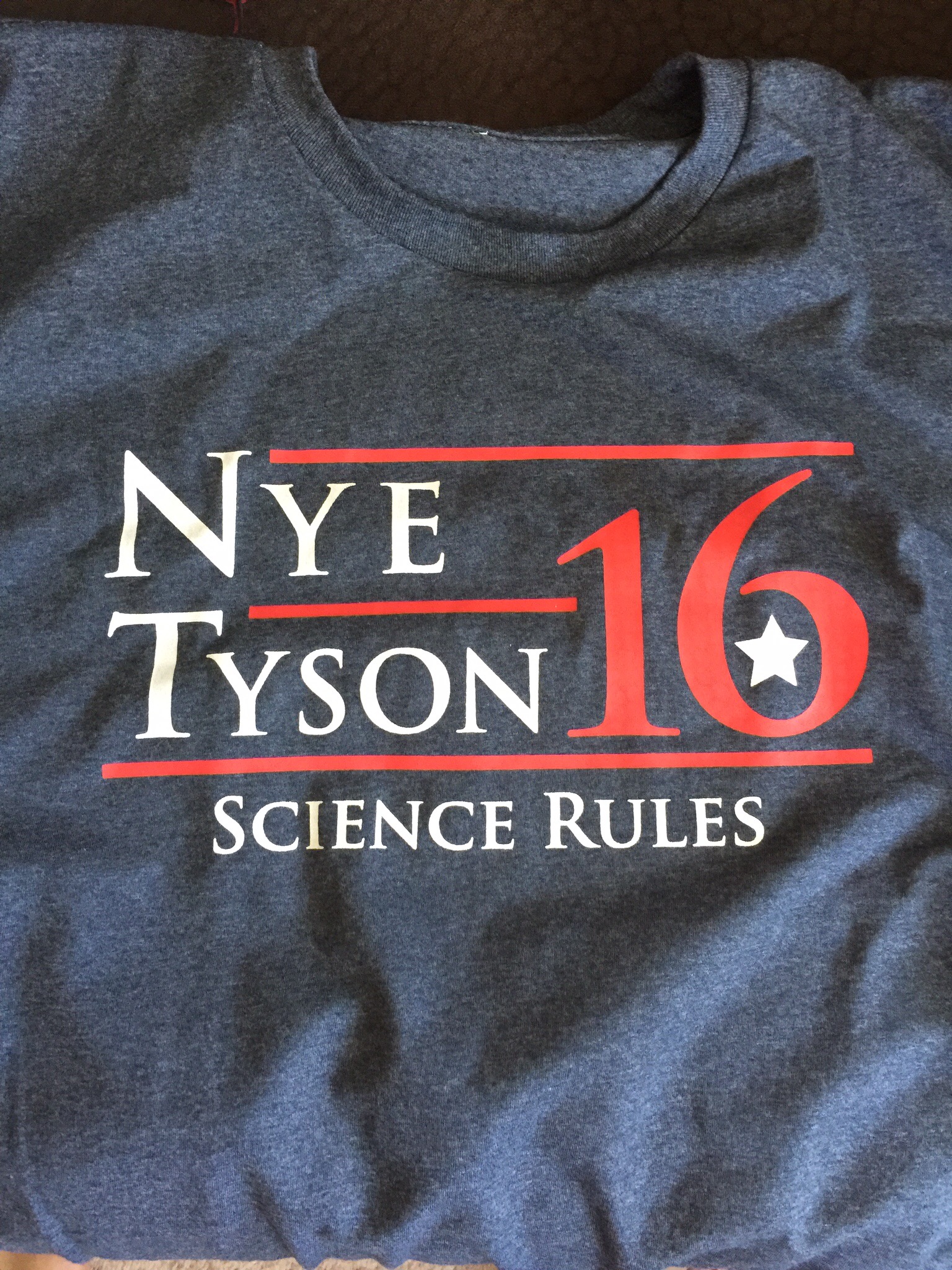
I wore this shirt over the weekend, while I was out running errands. Got lots of confused looks. None seemed to really appreciate it. One asked if Mike Tyson was really running for president. 

Was it too soon? Should I have waited until after we got photos back from Pluto?


A Real STEM-winder

On a fairly regular basis, Eduflack reads some voice on social media lamenting that we are spending far too much time, as an education community, focused on discussions of science, technology, engineering, and math (or STEM) education). What about the humanities? What about passion? What about love? What about what about?

But we can’t overlook the importance of STEM education in our global, digital economy. Even the most romanticized of today’s poets need some STEM skills to remain relevant. One doesn’t need to be a rocket scientist or a surgeon to know that STEM literacy is just as important these days as literacy itself.

Over at US News & World Report, there is a new STEM Index for our reading, review, and reflection. Developed in partnership with Raytheon, the USNWR STEM Index “measures science, technology, engineering and mathematics activity in the United States relative to the year 2000.”

  • Additionally, USNWR offers a wealth of analyses and opinions of what the numbers tell us. Some of the more noteworthy facts include:
  • While the number of STEM bachelor’s degrees earned by Black college students increased 60 percent since 2000, the share actually shrunk compared to the overall number of bachelor’s degrees earned by Black students;
  • STEM degrees earned by white students increased 10 percent, compared to overall bachelor’s degrees;
  • Women still lag behind men in number of STEM degrees earned, exam scores, and general interest in STEM; and
  • White and Asian students and college graduates overwhelmingly outperformed Black, Hispanic, and American Indian students in STEM degrees earned, exam scores, and general interest in STEM.

You can read more about the trends here.

The portfolio of STEM info from USNWR is definitely worth the read. And it is a further reminder of why STEM literacy is so important, whether one wants to be a physicist or a playwright.

STEM Priorities, STEM Teacher Ed Investments

Earlier this week, President Obama celebrated the White House Science Fair. As part of an event celebrating all things science, he recognized recent investments in his administration’s STEM initiative, talking about jobs and the impact on the economy.

In its coverage, Tech News World went a little deeper than most, exploring recent STEM progress and where it is headed. In his story, Jack Germain endulged Eduflack, as I pushed a topic near and dear — STEM teacher education.

There is no question that STEM is important to our economic and societal success. But STEM success doesn’t come without a real investment in STEM education. And high-quality STEM education only comes when we have truly excellent STEM teachers leading our classrooms, particularly those classes in high-need schools.

As Germain wrote:

 The United States has experienced a shift from a national analog industrial economy to a global digital information economy.

U.S. social institutions — including education, finance, government, media and health — were created for the former, observed Patrick R. Riccards, director of the Woodrow Wilson National Fellowship Foundation. That’s a problem, because Americans live in the latter, in a society that demands we transition from the models of the past to those needed today.

“This is particularly true in education,” he told TechNewsWorld.

“As a sector, we have been reluctant to embrace change, whether in the form of research findings, shifting demographics, technological advances, or similar triggers that demand change in other fields. Even as our methods of old work less and less well than they did previously, we have too often resisted the necessary transitions,” Riccards explained.

“Slowly, though, we are seeing a transformation in public education. This has been particularly true in the ways we prepare children with the science, technology, engineering, and math skills they will need to be college and career ready,” he pointed out.

If we truly see STEM as our future, the focus must be on developing a generation of excellent STEM educators for our schools — particularly our high-need schools, Riccards urged.

All the love in the world for STEM is meaningless, he said, if schools are staffed by ineffective teachers who are not truly versed in the STEM disciplines.

Couldn’t have said it better. The full article is definitely worth a read.

In Search of STEM Teachers

STEM. STEM. STEM. STEAM. STEM. STEM. STEM. STEM. STEAM. STEM. STEM.

If one spends his or her time in education, it is impossible to avoid the topic of STEM. For a decade now, ever since “21st century skills” jumped the shark, we have been focused on a STEM-literate society. Sometimes, we look to add the arts to STEM, making it STEAM. (Though in one ingenious school district I visited in Wisconsin, they had STEAM, but the A was for agriculture, not the arts.) But we can’t get away from that STEM focus.

Last month, ACT released a survey of its test takers on a range of topics, one of which was STEM. ACT found that nearly half of those looking to take the ACT test demonstrated an interest in STEM subjects. That’s almost a million aspiring college students giving at least a look to the STEM areas.

But that interest in the content isn’t translating into an interest in teaching the content. Surveying those same students, of the nearly 1 million interested in STEM, only 5,500 are thinking about a future where they are teaching a STEM subject.

Over at Education World, I delve a little deeper into this disturbing revelation, looking at both why we need to do a better job or recruiting STEM teachers and how we can do it.

The teacher is the single-most impactful influence on the learning of the child. If we want today’s students to have an interest in STEM and to want to pursue careers in STEM teaching, we need to provide them with well-prepared teachers who make STEM real in their classrooms. We need excellent educators who inspire the next generation of STEM teachers. We need classroom teachers who can inspire an interest in the STEM subjects, encourage high-ability students to consider teaching careers, and show them how best to prepare the next generation of learners.

It’s an important read. Give it a look.

Boosting Excellent Men — and Women — in Teaching

Over the weekend, The New York Times’ Motoko Rich wrote about the dilemma of how to get more men into the teaching profession. As one would imagine, the news analysis discussed the need to raise salaries, increase respect for the profession as a whole, and other such ideas.

While those are important, the education community also needs to drill down a little further. If we are serious about getting excellent teachers, be they men or women, into high-need schools, we need to dramatically improve our teacher education programs. If we want higher outcomes, we need improved inputs. It is that simple.

In response to Rich’s call to action asking why more men don’t teach, the Woodrow Wilson National Fellowship Foundation reflected on what it has learned constructing rigorous STEM teacher prep programs in states like Georgia, Indiana, Michigan, New Jersey, and Ohio. From the Foundation:

Motoko Rich is absolutely right. We need the best candidates to go into the teaching profession. Collectively, we need to do everything we can to ensure our schools, particularly those that are high need, have excellent teachers leading all classrooms.


To achieve this, we must recognize the importance of high-quality teacher preparation programs that ensure teachers to be have the pedagogy, clinical experiences, and mentoring and support necessary to achieve. We must redesign our approach to teacher education, requiring greater rigor and stronger relevance to where instruction is headed, both in the near and long term.


An example of this new path is the Woodrow Wilson Teaching Fellows program. Our innovative program is helping develop the next generation of STEM teachers in states like Georgia, Indiana, and New Jersey. We are partnering with 28 universities in five states to improve teacher education and, in the process, prepare excellent teachers for the 21st century classroom.


This focus on rigor and impact directly addresses the concerns Rich and others raise. This year, 45 percent of our Teaching Fellows in Indiana are male. In Ohio, 49 percent are men. And in New Jersey, the majority of our Teaching Fellows, 52 percent, are male.


What does this tell us? A high-quality, rigorous teacher education program attracts our best future educators, both male and female.


This should not be an issue of men versus women. Instead, we should be focusing on how to improve our teacher education programs in general. The Woodrow Wilson Teaching Fellowship offers a proven solution, and the results speak for themselves. We know what a difference well-prepared teachers, male or female, make when it comes to both student learning and achievement outcomes. And we are working to get more of those teachers in our high-need schools.

An interesting observation. And an incredibly important point. First and foremost, we must be focused on excellent teachers. Doesn’t matter gender or race or socioeconomic background. We need to do a better job of getting great teachers in the classroom. And that starts with offering great teacher education.


(Disclosure: Eduflack calls the Woodrow Wilson Foundation home.)

Rising to the Teacher Challenge in Georgia

When we talk about the teacher pipeline, we often hear folks voicing their frustrations about how the old teacher education pathways just aren’t sufficient when it comes to getting truly excellent teachers into high-need schools. This is particularly true when we talk about placing math and science teachers in historically disadvantaged schools.

Seven years ago, the Woodrow Wilson National Fellowship Foundation (a place I like to call home) launched an effort redesign teacher preparation to meet the needs of 21st century schools. The Woodrow Wilson Teaching Fellowship program now “recruits and prepares the nation’s best and brightest recent graduates and career changers with STEM backgrounds to teach in middle and high school science and math classrooms. It also works with university partners to change the way these top teacher candidates are prepared, focusing on an intensive full-year experience in local classrooms and rigorous academic work.”

The program is operating in five states — Georgia, Indiana, Michigan, New Jersey, and Ohio. In places like Indiana, Woodrow Wilson is finding that its Teaching Fellows are exceeding expectations, with student achievement in measured math and science classes led by Teaching Fellows exceeding performance in peer classrooms.

Interesting what makes the program tick and how it does what it does?  You are in luck. Woodrow Wilson President Arthur Levine and EVP/CEO Stephanie Hull are hosting a Shindig discussion this week to talk about the Georgia program and ow the Woodrow Wilson model is getting the job done when it comes to preparing excellent STEM teachers for high-need schools.  

The discussion is open to all. Just register today for the Wednesday, September 10th online conversation. I promise you won’t be disappointed (and you’ll get to experience a terrific new online collaborative platform in Shindig).