
Parents, School Choice, and More Data Points

Parents and school choice. School choice and parents. As the public discussions on charter schools specifically and school choice in general continue to plow forward, there is more and more focus on the role of parents in the process.

This week, the Center on Reinventing Public Education released a new report, How Parents Experience School Choice, that surveyed parents in Baltimore, Cleveland, Denver, Detroit, Indianapolis, New Orleans, Philadelphia, and Washington DC. Families in these strong charter cities were queried on their experiences in exercising parental choice when it came to their kids’ schools.

So what, exactly, did CRPE find? Among the toplines from 4,000 parent interviews:

  • In seven of the eight communities, half or more parents chose a non-neighborhood-based schools. In New Orleans, that number rose to 87 percent. In Indy, it dropped to 35 percent.
  • Parental views on the public schools differed greatly, with 60 percent of Denver parents saying they had good public school options available to them, while only 40 percent of Philly parents had the same perspective.
  • In Denver, NoLa, and DC, where choice is growing, more than half of parents said their cities’ schools were getting better. The high-water mark was in DC, where 65 percent of parents reported improvement.
  • While we often hear parents choose charters first and foremost because they are safer, 80 percent of DC parents and 79 percent of New Orleans parents said they chose a school because of academics, choosing over safety or location.
  • Choice isn’t easy. The survey found parents with less education, minority parents, and parents of children with special needs are more likely to have difficulty navigating choice. In DC, African-American and Latino parents were less optimistic about options than their white counterparts. In Baltimore, special ed families were far more likely to report problems finding the proper school than those without special needs.
  • And what does all this tell us? Out of the shoot, we can see this is a far more complicated issue than we may think it is. Even in cities with a history of strong choice and a number of school options, there is no clear path. For every parent choosing academics, there is likely one choosing safety and convenience. For every city saying choice is needed, there may also be a view that traditional public schools are improving.

And for all of the marketing that has gone into selling choice as the magic elixir that heals all in urban public education, parent perception hasn’t caught up to the sales pitch. There may be long wait lists for charters, but the reasons for such lists aren’t as crystal clear as some would like us to believe.

In battles over school choice and charters, proponents often try to make this a fight of statistics, believing they have the facts and figures to demonstrate that school choice is the only choice. But in reading between the lines of this data, we can also see that there is a whole lot of heart in this issue. Parents make choices for very emotional reasons. And those reasons may not be quantified on an Excel sheet or in a sales brochure.

Regardless, we need more data like this from CRPE. Data that forces us to look longer, examine deeper, and question more often.
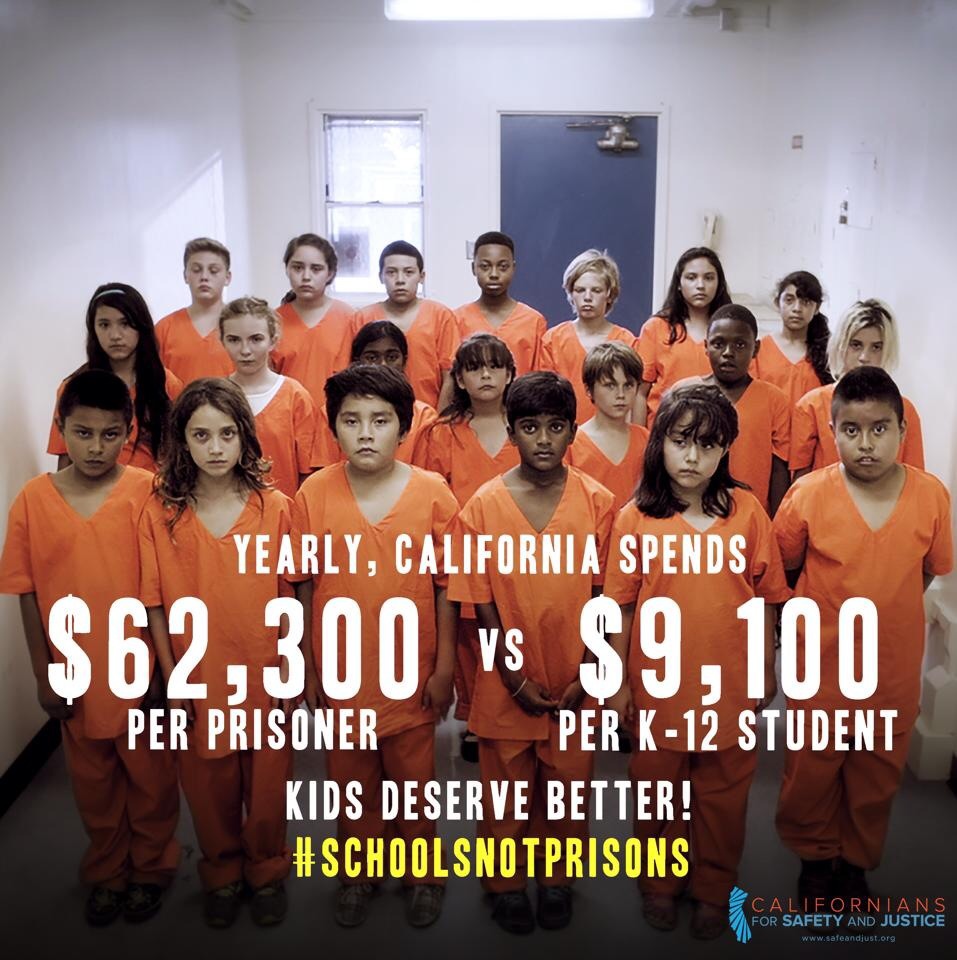
The True Costs of Education

Since I’ve been involved in education reform issues, I’ve heard a lot about the costs of education. The haves and have nots. Money following the child. Merit pay for teachers and students. What gets sacrificed during lean budget years.

But we still talk to little about the costs when we don’t provide all kids with a great public education or what happens when we allow race, family income, or zip code determine how good a “good” public education really is.

When I saw this from Californians for Safety and Justice, it helps bring it all into perspective. Yes, we need to make sure that tax dollars are spent wisely. But can we really argue about where our priorities should be?

IMG_1241.JPG

Seeking Collaboration Between Reformers, Educators

For too long, we have heard of the battles between the education reform community and educators. From the way these debates have been framed, one would think the two sides couldn’t agree that the sky was blue or that water was wet.

Truth be told, reformers and educators agree on far more than they disagree. and both sides of the school improvement coin are necessary if we are to be successful in efforts to improve student learning and achievement.

Or so Eduflack writes in this week’s Education Week. In a commentary entitled, “It’s Time for Reformers, Educators to Work Together,” I note:

The time has come to turn away from the divisive, us-vs.-them approaches of past policy fights. Instead, we must work together with educators to improve our public schools. We must focus on options and opportunities that can have real impact on all our children, not just a select few. And we must do so in a way that improves teaching and learning for all.

Otherwise, we are merely tinkering around the edges, seeking to set the next boundaries for the next fight. Our kids, our communities, and our nation deserve far better than such rhetorical posturing.

As we start another school year, we can’t afford another year of sniping, motive questioning, and hyperbole. Hopefully, this piece gives all sides something to consider.

A Texas-Sized Step Back on Edu-Thinking

Earlier this month, the Texas Young Republicans passed a resolution adopting a two-page platform and recommending the Republican Party of Texas endorse it whole cloth in 2016. Why is this important? Well, the two-page platform included some specific language regarding education policy (in the non-Common Core-adopting Texas).

The Texas Young GOPers stated:

We believe that all children should have access to quality education. Parents have the primary right and responsibility to educate their children, and we support their right to choose public, private, charter, or home education. We support the distribution of educational funds in a manner that they follow the student to any school, whether public, private, charter or home school. We reject federal imposition of educational standards and the tying of federal education funding to adopting federally mandated standards.

Reads like the flag and apple pie, huh? Setting aside the problem of using the Oxford comma at the beginning, and then forgetting the serial comma in the second set of school descriptors, let’s take a look at the statement.

Sentence one, I’m with ya. Every child should have access to quality education. I’ll do you one better, Young Texans, every child should have access to quality public education. And high-quality public education at that.

I’m also with you on parents having the right and responsibility to educate their kids. I didn’t realize that such parental rights were under siege. If anything, the main issue seems to be what we do when parents do not exercise said right, and their kids’ education is then solely the responsibility of teachers. We should be focusing more on getting parents more involved in what happens in our schools.

Then we shift into the “money follows the child” philosophy, with an added wrinkle. Not only are we calling for equal funds to go to charters (school choice) and privates (vouchers, or school choice on steroids, depending on your perspective), but we are now saying that money should follow the home schooler? Are we suggesting that each parent who decided to home school is now entitled to a $10k or $20k tax rebate (per child), for keeping them out of the public schools altogether?

And we finally get the horcrux that continues to dog just about every education discussion. The notion that the evils of everything public education lies embedded in Common Core State Standards. Forget that Texas had no issue rejecting the “imposition of federal standards” in the first place. Forget that most states who put the standards in place didn’t get a federal dime to do so (while they may have hoped to, there were far more Race to the Top losers than there were winners). Yes, now is the time to take a strong stand on a policy decision that was made four years ago (in terms of initial adoption of the standards and tying $$ to them).

At some point, we — and that includes those young Republican Texans writing political platforms — just need to acknowledge that the vast majority of states have adopted CCSS. They decided, for a range of reasons, that these standards were better than the hodgepodge of crappy standards each individual state had developed and adjusted and weakened over the years. They did so by their own free will, and did so (presumably) because they saw it as a positive step for their state, public schools, and communities. We need to see it isn’t a bad thing that many students will be held to higher standards than their older siblings, and we should embrace it.

Most importantly, we need to see it is imprudent to try and undo a policy decision that was made eons ago (politically) and that, instead, we should focus our attentions and energies on ensuring that said standards are implemented well and done so with fidelity. That we focus on the best in terms of instructional materials and PD. That we move forward with efforts to improve those standards and make them stronger and better over time (particularly with regard to early childhood and the math). That we use this as a foundation to build a stronger public education system for ALL students, and not as a “last stand” for those looking to reopen the battles of the past.

I yield the soapbox, and suspect I won’t be asked to speak at the Texas GOP convention in 2016 …

“Our School,” Our Community

When we talk about education and school improvement, we can often forget there are real schools involved in the equation. In our quest for reform, we can slip into thinking in abstraction, thinking about public education as if it were a laboratory and our changes have little, if any, impact on the educators and students who spend the majority of their time in those very buildings.

While some of my reformer friends may say this is an unfair or downright untrue statement, it is rooted in fact. The reform movement, of late, is largely about changing systems and processes. It is about administrative changes and oversights and accountability. The rest can come later, after we change how these schools “operate.”
It is because of this that we need to be reminded of the human factor in our schools, both those that excel and those that struggle. That we highlight that there are no educators or students who seek to fail or not make the grade. That we all want to see success, even if we define it differently or can’t determine how to chart the best path to get there.
That’s why we need to refocus on our schools as a community. Good or bad. Success or no. We are a community, and we are in this together.
This spring, author Sam Chaltain reminds us of this important point in his new book, Our School. Published through Teachers College Press, Our School chronicles the search “for community in the era of choice,” as Chaltain weaves a powerful narrative that looks at the experiences in real schools. He reminds us why so many of us do what we do, and why this work can be much harder than so many people seem to think.
How? The impact of this book is best captured in the words of Sir Ken Robinson, a guy who knows a thing or two about school reform and improvement and who pens Our School‘s foreword.
Our School is an important book. It brings to life, in the most vivid way, many of the issues about American education that in political debates are too often treated as abstractions. In place of the conventional rhetoric about what’s right or wrong in the nation’s schools, Sam Chaltain offers a close-up, beautifully observed account of a year in the life of just two of them. In many respects, these schools couldn’t be more different. Both are in Washington, D.C., physically close to the epicenter of American power, though in most other respects a world away from it. One is a startup charter in new premises, still working to define its identity and to catch its beat. The other is a long-established neighborhood school, filled with the memories of generations, a school where many former pupils now send their own children or grandchildren.
On these pages, Eduflack has often written about the importance of conversing, engaging, and collaborating with those that offer a differing perspective. For many years now, Sam has been one of those folks in my life. Sam and I agree on much, and strongly disagree on some. And while I may not agree with all of the conclusions he offers up in his latest book, I’m damned glad to have taken the time to read it. We all must be reminded that community, far more than policy or oversight, is what is responsible for a school’s ultimate success or failure.

“A Day of Action”

Yesterday, educators across the country participated in “A Day of Action,” a series of events across the country that, according to Valerie Strauss at The Washington Post, “sponsors hope will draw national attention to the problems of corporate-influenced school reform and to build a national movement to change the public education conversation and to increase funding for schools.”

We can set aside the fact that organizers were hoping to accomplish an incredible number of goals from a series of public demonstrations.  And we will forget what Eduflack has written here previously, that too many people are fighting a false battle against the “privatization” of our public schools, when no one is actually looking to flip public schools private.
And I’m even willing to save for another day the important discussion on school funding.  Yes, I agree wholeheartedly that we need to look at our funding models for our public schools, ensuring that all schools are equitably funded.  But we also must look at how we are spending those dollars, and admit that our priorities are off when some of our lowest-performing schools are also those with some of the highest per-pupil expenditures in the nation.
Instead, today Eduflack turns your attention to the guiding “principles” behind “A Day of Action.”  Organizers are absolutely right in needing a call to action, a basis that all participants can latch on to and believe in.  So for this week’s festivities, seven principles were offered in an effort to “reclaim the promise of public education.”
They include:
* Public schools are public institutions.
* Our voices matter.
* Strong public schools create strong communities.
* Assessments should be used to improve instruction.
* Quality teaching must be delivered by committed, respected and supported educators.
* Schools must be welcoming and respectful places for all.
* Our schools must be fully funded for success and equity.
All noble goals.  All well meaning.  And all principles that EVERYONE should be able to get behind.  I recognize the importance of trying to win over hearts and minds.  But these same principles (maybe with an edit to the final one) are principles that any education reformer worth his or her salt could get behind.  
Just think of the following:
* Public schools, including our public charter schools, are public institutions.
* Our voices (not just those of the unions or veteran educators) matter.
* Strong public schools create strong communities.  Just ask those whose lives and neighborhoods have been transformed by an institution like Democracy Prep.
* Assessments should be used to improve instruction, with test scores utilized to ensure our schools, our teachers, and our students are achieving. 
* Quality teaching must be delivered by committed, respected and supported educators. It isn’t what ed school you attended or that you received the proper pedagogy in your prep, it is about what you do in the classroom.
* Schools must be welcoming and respectful places for all.  That includes parents and community members who seek improvement or choice.
* Our schools must be fully funded for success and equity.  That begins by ensuring all public schools, including charters, in the same city are spending the same per pupil.
There is no question we are in need of a day, a week, a month, a year of action to improve our public schools.  And while I still maintain that sides agree on far more than they disagree when it comes to school improvement, can’t we have a real, respectful conversation about the areas of disagreement instead of trying to “own” some basic platitudes on which we all should agree?

Is Anyone Pro-Privatization? Anyone?

Earlier this week, MSNBC posted a new video on its website.  It is from the Melissa Harris-Perry Show, with special guest Diane Ravitch touting her latest book (which in fairness, Eduflack hasn’t read).

While I don’t usually stop for such video segments, I was taken by the headline that MSNBC (the Lean Forward network) was putting on the segment.  The piece led with the screamer, “The Case Against School Privatization.”
Those who know Eduflack know that I’ve spent a fair amount of time in the education reform movement.  During that time, I got pretty immune to what folks would say about me or about reformers in general.  And over time, the repeated accusations of “privatization and profiteering” started to sound like the adults in a Charlie Brown cartoon to me.
But I paused when I saw it on a supposed unbiased news network.  And it leads to a very important question.
Is anyone out there actually advocating for the privatization of our public schools?
I offer this as a serious question.  Who is pro-privatization?  At least more privatization than we already have.  We have already privatized transportation (bus service) and school lunches and textbooks and professional development.  And last I checked utilities and such are still provided by private companies (many of whom actually draw a profit from it as well).
But is there anyone out there looking to turn public schools into private ones?
And please, don’t give me the charter school argument.  Whether one wants to accept it or not, charter schools are public schools.  Yes, they are an alternative to our traditional public schools.  But they are still public schools.  
So where are they?  Who are these horrible beasts that are looking to take our well-meaning public schools and turn them into private schools?  Who is seeking to take a neighborhood school and turn it into a home for J. Crew and the country club set?  Who is actually out there converting all of these public schools?  Who are these privatizers we should be so fearful of and who we are creating all of these supposed white knights to slay the privatization beasts? 
Truth be told, the only thing we have seen in recent years is private schools going public.  Look to our nation’s capital.  After the U.S. Congress pulled the plug on voucher funding, many of the Catholic schools that were serving the vast majority of voucher kids decided to convert from parochial institutions into public charter schools.  These Center City schools saw the need to continue their service to the community and to the kids they were educating, and publicized (if that is the right word) themselves.
While there is plenty in public education that we can debate and argue about, do we really need to throw privatization in the mix?  It is a cheap rhetorical trick meant to win over an uneducated population.  No one is rushing to convert public schools private.  Practically no one (at least no well-meaning reformers) are even talking about it. So why frame what should be an intelligent, well-meaning debate that way?
We need to spend more time engaging in meaningful dialogues about our schools and what we can do together to improve them.  Ad hominem attacks, fake arguments, and phony straw men works against that goal.  it may sell some books, but it does very little to help ensure that all our students receive a high-quality, meaningful public education.
 

Dream School, Seriously?

“Pregnant, neglected or bullied; the students all have one thing in common — each had a life experience that caused them to take an unexpected left turn.  Dream School’s celebrity teachers will have one mission — to excite these young minds, reignite their passions, and get them to graduate from a real, accredited high school.”
And so begins the introduction to Dream School, the latest television spectacle from the Sundance Channel, a subsidiary of the AMC Networks.  Based on the website, the show has been on for at least a month and a half (if we do the math from the six episodes up for viewing on the site now.  But dear ol’ Eduflack (a self-confessed television junkie) honestly hadn’t heard about it until this week.
The premise is fairly simple.  A team of “celebrities” decide to play teacher as they seek to change the lives of young adults in need of life changing.  For the enormity of the challenge, Sundance has turned to successful educators such as 50 Cent, David Arquette, Oliver Stone, and Jesse Jackson.  They are supported by a superintendent from California and three teachers (all from California charter schools, interestingly).
So it begs an important question.  Where is the public outrage on Dream School?  
For all of those who grow short of breath ranting about Teach for America and its lack of proper teacher preparation, where is the outrage of placing inexperienced and untrained celebrities in classrooms with the very definition of at-risk students?
For all of those who get red in the face questioning the value of charter schools, where is the outrage of only using teacher coaches who come from public charter schools?
For all of those who argue good teachers cannot overcome poverty and family situations, where is the outrage that a celebrity can step in and do the job that entire school system was supposedly unable to do?
For those who talk of overcrowded classrooms, where is the outrage that Dream School is essentially a one-to-one intervention?
For those who fear the “profiteering” on our public schools, where is the outrage over where all of the ad revenue for this new show is going?
And how can we pass up responding to a gem like, “But how will they perform as teachers to some of America’s toughest high school dropouts?”
Yes, our schools shouldn’t be test tubes.  But they also shouldn’t be the settings for reality television experiments.  Some of these students seem to have real problems.  They need knowledgeable, experienced educators who can provide them the support and attention they need.  Somehow, “no, I’m not a teacher, but I play one on TV” doesn’t quite seem to be the full answer these at-risk students need.

Parent Survey (or Statistics are Dangerous)

We began the week reflecting on an AP poll on parent sentiments about public education.  As we roll into hump day, we now have the 2013 edition of the Gallup/PDK poll of “what Americans said about the public schools.

This year’s Gallup/PDK highlights:
* As we’ve heard for decades, most Americans give the public schools a “C” grade, but give their own schools an “A” or “B”
* 62 percent of parents have never heard of Common Core State Standards
* 36 percent believe increased testing has hurt school performance, 22 percent say it has helped, and 41 percent said it makes no diff at all
* 58 percent oppose using standardized test scores in teacher evals, up from 47 percent in last year’s survey
* 52 percent said teachers have a right to strike (yes, that really is a question PDK asked)
* 88 percent say their child is safe when they are in school
* 66 percent favor educating children whose parents are in the United States illegally
* Only 29 percent favor sending kids to private schools at public school expense
Overall, the survey results aren’t that big a surprise.  They seem to jive with what PDK reports annually in this survey, and they aren’t too big a deviation from what AP released earlier in the week.
What’s disappointing is how PDK decided to present this year.  One would think that a semi-intelligent human being could take a look at polling toplines and understand that when only 22 percent say high stakes testing helps school performance, the majority doesn’t believe it to be so.  Unfortunately, PDK dumbed it down a step further, putting out a “highlights” document that makes sweeping statements without providing any statistical backup,  While one can track down the supports, it is definitely a dangerous document in the hands of the wrong folks.
Some of these self-proclaimed “highlights include:
  • Common Core – “Most Americans don’t know about the Common Core and those who do don’t understand it.”
  • Standardized Tests – “The significant increase in testing in the past decade has either hurt or made no difference in improving schools.”
  • Charter Schools – “Charter schools probably offer a better education than traditional schools.”
  • Online Learning – “High school students should be able to earn college credits via the Internet while attending high school.”
  • Biggest Problem – “Lack of financial support continues to be the biggest problem facing public schools.”
Let’s just take the last item.  Per-pupil public school funding is at its highest rates ever in the history of United States public education.  Do we honestly believe that is the biggest problem facing the schools?  More so than the obscene achievement gap?  More so than a third of all fourth graders unable to read on grade level?  More so than our inability to address the needs of a growing ELL population in our classrooms?  More so than ensuring that good teachers remain in the classroom and get the support and respect they need?
They again, sometimes poll results are just poll results.  But looking at the latest PDK release, Eduflack is left with two thoughts.
“A little information is a dangerous thing.” Albert Einstein
“There are three kinds of lies: lies, damn lies, and statistics.” Mark Twain

Vote for Somebody!

Election Day is two weeks away.  The debates are now over.  TV commercials are on heavy rotation.  Game on.

Regardless of which candidate or which party one prefers, we can all agree how important is is to vote.  That’s why it is so terrific to see the video that is taking the nation by storm.  The citizen-scholars at Democracy Prep’s Harlem school have put the importance of voting on November 6 to music, offering a terrific remake of Call Me Maybe … Vote for Somebody.
Give it a look.  It is a terrific piece, and it is a reminder of the power of kids and the importance of great schools for all.
Happy viewing!