
Does Accountability “Eradicate Goodness?”

As a nation, No Child Left Behind has been the law for more than 13 years now. Good, bad, and ugly (and with the occasional waiver from any of the three), NCLB governs K-12 education in the United States.

Listen to any of those who were responsible for bringing it into law, or those who were responsible for implementing the law, and you’ll hear one of the most important components was “accountability.” NCLB was designed to hold states, districts, schools, teachers, and students themselves for learning. Test scores determined if adequate progress was being made. If it wasn’t, then federal dollars were at risk and great public shame could come to those put on the “list” for failing to make AYP.

We all recognize that, at some point in the near future, NCLB will be replaced with some variation of the current “Every Child Achieves” bill that is currently working its way through Congress. A great many legislators, organizations, individuals, advocates, agitators, and the like are all look to make the changes that help them the most or reflect their own dreams and desires for federal K-12 governance.

And we will see change. We likely will see a number of changes. We will likely see changes that aren’t even warranted (or may not be demanded). But one thing should be clear. We aren’t going to see federal law do away with accountability.

I understand there are a great number of people who want to accountability go the way of the dodo. Those that want to see all the sticks replaced with carrots and federal law governed by the philosophy that we are all a success and we’ve earned trophies just for participating in the schooling process.

But results count. There are clear benchmarks of what students should know and be able to do at the conclusion of each grade. There are clear expectations of what it means to finish the fourth grade or to graduate from high school. And when students enter fourth grade unable to read at grade level or head into 12th grade functionally illiterate, someone needs to be held accountable. The state. The district. The school. And the student himself.

So it a cryin’ shame when we see folks who should know better thinking that a redo of the ESEA law can and should mean the total elimination of any and all accountability. Particularly when they frame it as, “Doing anything punitive in nature eradicates what goodness is going to come out of this bill.”

For those keeping track, those are the words of Sheila Cohen, the president of the Connecticut Education Association. They were spoken, as captured by the Connecticut Mirror, in response to U.S. Sen. Chris Murphy siding with civil rights groups who want to see accountability provisions remain in the federal law, including the NAACP.

“The principle of accountability is not negotiable to us,” said Leslie Proll, director of the Washington office of the NAACP Legal Defense and Educational Fund. “This was the raison d’etre of the original act. Educational systems must be held responsible for narrowing and eliminating gaps in opportunity and achievement for students of color.”

Proll is right on point here. Educational systems must be held responsible. They must be responsible for both the inputs and the outcomes. They must both admit there are serious concerns when it comes to achievement and opportunity gaps AND that we need to everything possible to close those gaps. And no, simply blaming “poverty” is not going to get us there.

There cannot be accountability without some sort of punitive action. Otherwise, there simply is no accountability. Are we to simply say, borrowing from the old Robin Williams routine, “improve the schools, or we’ll ask you to improve them again?” Decades have shown us it just doesn’t work that way.

Instead of believing that something punitive eradicates all that is good in nature, perhaps we should borrow a little from Newton’s third law of physics. For every act of accountability, there is an equal and opposite act of achievement. That the possibility of a negative impact will actually lead our schools to make the requisite change to close those persistent gaps that need to be closed.
A Real STEM-winder

On a fairly regular basis, Eduflack reads some voice on social media lamenting that we are spending far too much time, as an education community, focused on discussions of science, technology, engineering, and math (or STEM) education). What about the humanities? What about passion? What about love? What about what about?

But we can’t overlook the importance of STEM education in our global, digital economy. Even the most romanticized of today’s poets need some STEM skills to remain relevant. One doesn’t need to be a rocket scientist or a surgeon to know that STEM literacy is just as important these days as literacy itself.

Over at US News & World Report, there is a new STEM Index for our reading, review, and reflection. Developed in partnership with Raytheon, the USNWR STEM Index “measures science, technology, engineering and mathematics activity in the United States relative to the year 2000.”

  • Additionally, USNWR offers a wealth of analyses and opinions of what the numbers tell us. Some of the more noteworthy facts include:
  • While the number of STEM bachelor’s degrees earned by Black college students increased 60 percent since 2000, the share actually shrunk compared to the overall number of bachelor’s degrees earned by Black students;
  • STEM degrees earned by white students increased 10 percent, compared to overall bachelor’s degrees;
  • Women still lag behind men in number of STEM degrees earned, exam scores, and general interest in STEM; and
  • White and Asian students and college graduates overwhelmingly outperformed Black, Hispanic, and American Indian students in STEM degrees earned, exam scores, and general interest in STEM.

You can read more about the trends here.

The portfolio of STEM info from USNWR is definitely worth the read. And it is a further reminder of why STEM literacy is so important, whether one wants to be a physicist or a playwright.

Good Teaching Trumps All

It is impossible to seriously improve student achievement without focusing on how we prepare teachers for the classroom. Over at the American Youth Policy a Forum blog, I recently talked to AYPF about the new for effective teacher prep and the impact it can have on student achievement, particularly in high-need schools. 

“If you have a good teacher in charge of a classroom to do what is necessary to educate the kids, the kids learn. There’s no getting around that,” said Riccards. “As policies change, as instructional approaches change, we know that good teaching trumps all.”

Give it a read. You won’t be disappointed. 

Do We Need a “New Approach to Accountability?”

In public education, the term “accountability” often brings out the best and the worst in folks. Some see it as a necessary measure to understanding if teachers are teaching, students are learning, and districts are doing what districts need to do. Others see it as a “mandate” that measures the wrong things and places one-time student performance over the learning process as a whole.

Yesterday, the Council of Chief State School Officers and the Council of Great City Schools issued their statement on testing, offering another voice opposed to “high-stakes testing” and calling for assessments that are meaningful and less stress inducing. President Barack Obama and EdSec Arne Duncan quickly backed the CCSSO/CGCS opinion (though I still maintain it is the path that Duncan has been largely advocating for nearly six years now).

Today, we have some new thinking that gets factored into the equation. The Stanford Center for Opportunity Policy in Education (SCOPE) released Accountability for College and Career Readiness: Developing a New Paradigm. Written by Linda Darling-Hammond, Gene Wilhoit, and Linda Pittenger, the manifesto outlines for changes that need to be addressed in the accountability debate, while offering some fresh thinking on accountability 2.0 (or is it 8.0?).

What changes are needed? Put simply:

  • More sophisticated assessments that get at a deeper understanding of content, critical and creative thinking, problem solving, and the like;
  • More equitable and adequate resources with regard to teaching, materials, and technology;
  • Greater capacity among schools and educators to reach more challenging content; and
  • A more effective model for change and improvement that moves schools from the current industrial model to “innovative learning systems for the future.”

To get us there, the authors point to a new accountability model that focuses on four key components: 1) meaningful learning; 2) professional accountability; 3) resource accountability; and 4) continuous improvement.

And what of those dreaded assessments that seem to block any meaningful discussion on true accountability? The good folks at SCOPE call for a model that looks to both standardized tests and performance-based assessments and portfolios. Standardized tests would inform the performance-based assessments, and results from the latter would be used to improve and enrich the former (while also informing teaching as a whole).

It’s hard to argue with what Darling-Hammond et al put forward, for it is really common sense. We need better assessments, tests that inform instruction and focus on student learning. We need to do a better job of delivering resources to all classrooms, particularly those that would be labeled historically disadvantaged. We need to push the envelope with regard to teaching more challenging content (which I would argue is why CCSS is an important floor to start with).

And we definitely need to move beyond the misguided notion that a single test, taken on a single day defines the success of a school, a teacher, or a kid.

But how does such a frame fit with the anti-testing zealots (or advocates, depending on your view) out there? Can we accept there is a meaningful role for standardized tests in the learning process? Can we use such tests, along with performance-based assessments, without cries of drilling, killing, and death by bubble sheet?

Even more importantly, can we all agree there are significant achievement, learning, and opportunity gaps in our public education tapestry and that we need a strong accountability model to bridge those gaps? Can we agree all is not roses, lollipops, and rainbows in our schools, and we have a need to improve and thus need to chart the best course to get there?

The ideas moved forward by SCOPE help us see where we need to go. The notion of moving from our current industrial model to a more innovative, future-focused one is particularly valuable. But the devil is always in the details. Can we use these sorts of ideas to move the discussion forward? Or are we destined for another round of “testing bad, accountability badder?” I hope for the former, but fear the latter.

Why Do Teachers Leave the Classroom?


When it comes to teacher attrition, we all have our ideas as to why teachers are leaving the classroom. For decades, we guessed it was because salaries were just too low. In recent years, we’ve opined that teachers are leaving education in droves because of high-stakes testing, high-stakes accountability, and most recently, because of the Common Core.

Over at Education Week, Jordan Moeny relays data points from a recent Albert Shanker Institute/American Federation of Teachers panel discussion. The topic of the panel was the lack of qualified staff in high-need schools. The panelists included UPENN researcher Richard Engersoll and Duke researcher Helen Ladd.

What did they relay with regard to why teachers, at least those in high-need schools, are deciding to no longer be teachers?

The top source of teacher dissatisfaction is too little prep time. It is closely followed by “teaching load is too heavy” and “class size is too large.” Poor salary and benefits comes in fourth.

The rest of the list of concerns for teachers at high-need schools include: student behavioral problems, lack of faculty influence, too little parent support, no opportunities for parent advancement, and too little collaboration time.

Imagine that … the top nine things that frustrate teachers in high-need schools the most, and not a mention of the dreaded Common Core. Not a whisper high-stakes testing. Not a glance at the post-NCLB corporate education industrial complex.

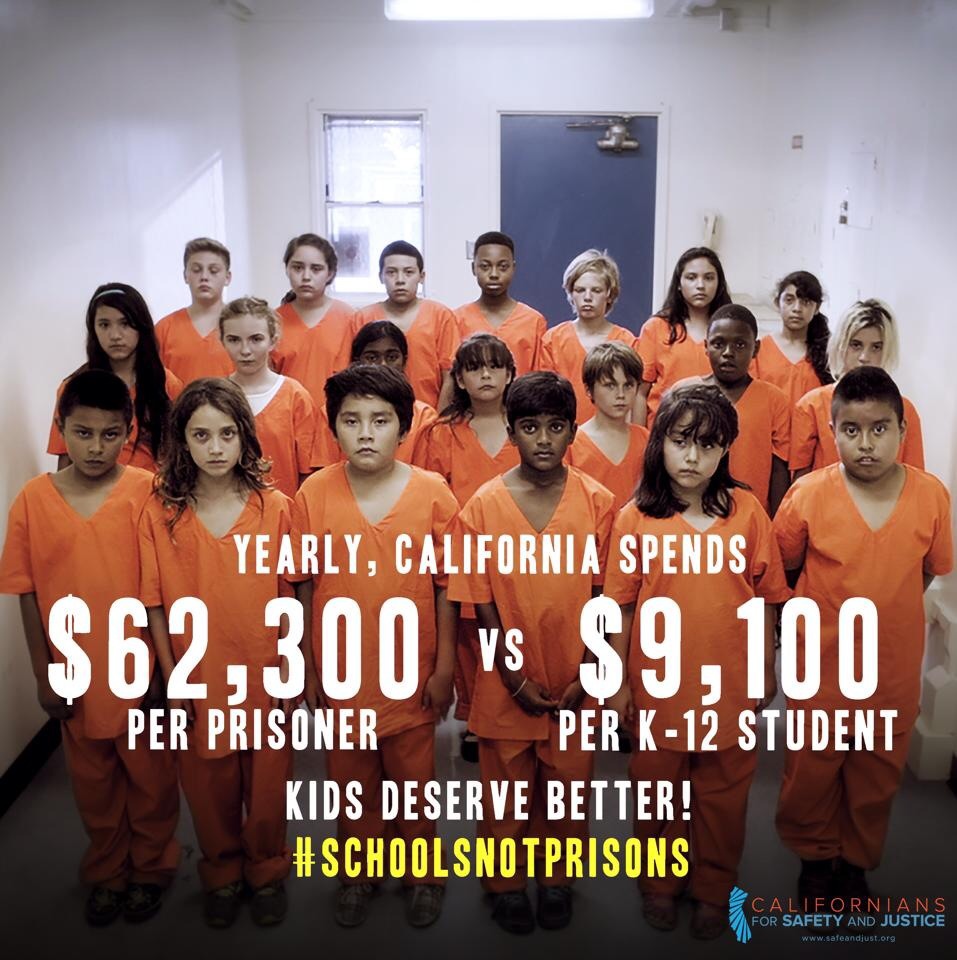
The True Costs of Education

Since I’ve been involved in education reform issues, I’ve heard a lot about the costs of education. The haves and have nots. Money following the child. Merit pay for teachers and students. What gets sacrificed during lean budget years.

But we still talk to little about the costs when we don’t provide all kids with a great public education or what happens when we allow race, family income, or zip code determine how good a “good” public education really is.

When I saw this from Californians for Safety and Justice, it helps bring it all into perspective. Yes, we need to make sure that tax dollars are spent wisely. But can we really argue about where our priorities should be?

IMG_1241.JPG

Seeking Collaboration Between Reformers, Educators

For too long, we have heard of the battles between the education reform community and educators. From the way these debates have been framed, one would think the two sides couldn’t agree that the sky was blue or that water was wet.

Truth be told, reformers and educators agree on far more than they disagree. and both sides of the school improvement coin are necessary if we are to be successful in efforts to improve student learning and achievement.

Or so Eduflack writes in this week’s Education Week. In a commentary entitled, “It’s Time for Reformers, Educators to Work Together,” I note:

The time has come to turn away from the divisive, us-vs.-them approaches of past policy fights. Instead, we must work together with educators to improve our public schools. We must focus on options and opportunities that can have real impact on all our children, not just a select few. And we must do so in a way that improves teaching and learning for all.

Otherwise, we are merely tinkering around the edges, seeking to set the next boundaries for the next fight. Our kids, our communities, and our nation deserve far better than such rhetorical posturing.

As we start another school year, we can’t afford another year of sniping, motive questioning, and hyperbole. Hopefully, this piece gives all sides something to consider.

School Leadership and Business School Training

Last week, Eduflack was fortunate to visit America’s heartland in pursuit of a better way to prepare tomorrow’s school principals and district leaders today. We’ve all seen the research. After classroom teachers themselves, we know that school leaders have the second-greatest impact on learning. Some research even says a school principal accounts for 25 percent of a school’s total impact on student achievement. Yet the preparation of said leaders seems to get short shrift in today’s debates on school quality.

As a result, too many of our current education leadership programs are focused on quantity and how many graduates they can provide administrator’s credentials to in the shortest period of time. It isn’t necessarily about quality. It isn’t necessarily about ensuring tomorrow’s principals have the skill sets to lead tomorrow’s schools. And it rarely is about who those future leaders can lead by example in their quests to improve student achievement, serving as the instructional leaders they truly are.

So it was heartwarming to see efforts in two states that break the leader prep mold and focus on how best to prepare tomorrow’s school administrators. In both Indiana and Wisconsin, efforts are underway to create a more rigorous terminal degree to prepare school leaders. In each state, business schools are taking the lead, offering MBA courses given through an education lens, combined with clinical instruction and meaningful partnerships with local k-12 school districts.

The expected result? A new generation of education leaders who are equipped with the knowledge, skills, and tools to help close the achievement gaps in the schools they will soon lead. And we are talking about closing the dual achievement gaps we currently face, the gaps we see within and between states here in the United States and the gaps we unfortunately see with our nation’s highest performing schools and their peer institutions internationally.

Chalkbeat Indiana’s Hayleigh Colombo has the story on how a generous gift from the Lilly Endowment is expanding the Woodrow Wilson MBA Fellows program in Indiana. And Erin Richards at the Milwaukee Journal-Sentinel has the story on how Wisconsin is blending school leadership and business acumen.

Both pieces are well worth the read. If we are serious about getting excellent administrators into our schools and districts, we need to examine new ways to prepare those leaders, providing them more than just traditional pedagogy. Programs like those in Indiana and Milwaukee are working to do just that.