
Of Vocational Schools, Career Tech, and Learners

Years ago, I worked for an education entrepreneur who drilled in me the notion that American high schools were fundamentally broken, built for an era that was long gone. Today, we know that postsecondary education – in some form – is a non-negotiable. For one to have a successful career, to be able to take care of a family and keep a roof over their heads, a high school degree alone was no longer sufficient. High schools needed to become passageways to the successful pursuit of postsecondary education.

It wasn’t always this way. One can look back to the post-World War II era and see a time when only a third of high schoolers went on to college. A third of students graduated from high school to directly enter the workforce or pursue military service. And yes, a third would fail to earn a high school diploma, but still were able to obtain and keep employment.

Recently, President Donald J. Trump spoke longingly on those good ol’ days, noting how America’s future economic success may very well lie with a return to vocational schools. And while most do not use the term anymore, he may indeed be correct. It’s tough to deny that career and technical education is more important than ever. But it is careerteched that is vastly different than the shop class that President Trump may remember from high schools of decades past and is calling for. And it is at a time when we now look to community colleges to provide much of what those good ol’ voke ed schools used to offer.

It’s career and technical education that today is largely delivered by community colleges, either to recent high school graduates seeking that non-negotiable postsecondary education or to career changers needing to update their skills and knowledge to compete in a digital, information economy. It’s for those who recognize that the future economy demands a strong blend of all of the educational buzzwords we’ve heard over the past decade or two, whether it be STEM, 21st century skills, or the like.

It is also a reminder that the education offered and the students pursuing it are not nearly as homogenous as we’d like to believe. Sure, we all have this picture of the “typical” college student pursuing a “typical” liberal arts education at a “typical” four-year college. But there is nothing typical about students today, their aspirations, or the pathways one takes to get there. Nothing typical about the K-12 experience, and certainly nothing typical about the postsecondary experience.

I was reminded of this, yet again, this morning when watching Good Morning America. As a transition, Robin Roberts spoke briefly with student representatives from the Family, Career, and Community Leaders of America, or FCCLA. It was an organization that the edu-wife, the product of a private high school in New England, was completely unfamiliar with. And she works in education.

But as the product of Jefferson (County Consolidated) High School in Shenandoah Junction, West Virginia, I knew the organization well. Or rather I knew the organization as it once was known, the Future Homemakers of America. In my high school, FHA was a more popular student group than the Future Business Leaders of America. It was almost as strong a student organization as our Future Farmers of America contingent, which spent every fall missing classes to make apple butter out in the high school parking lot.

In my day, our county high school had about 1,200 students in total. About a third of our high school graduates went on to college. We weren’t a large enough school district to have a fully functioning vocational high school or career/technical education program. At the time, we didn’t even have a community college in our part of West Virginia (my father, when he was president of Shepherd University, actually created the community college that is now the state’s largest and most successful, to meet the growing demands).

So career and technical education was largely supported by clubs like FFA, FHA, and FBLA. Such organizations supplemented what was learned in the classroom. They provided much of the “vocational” training that President Trump now seeks, and did so largely because of teachers who were willing to give their time and knowledge to do so.

In the nearly three decades since I graduated from Jefferson High, those organizations have adjusted their approach and their services to their members. They’ve continued to serve as a gateway for so many seeking postsecondary career and technical education. And they’ve turned out generations of individuals with the skills, knowledge, and passions to pursue a wide range of careers.

When we debate the successes or failures of K-12 education, it is easy to get bogged down in test scores and growth measures. It is easy to focus on those learners who beat the odds to get accepted into a dozen Ivy League schools. And its easy to point out how much that used to fall to K-12, from remediation to career and technical ed, has now been pushed onto our local community colleges.

It is far harder for us to recognize, acknowledge, and celebrate the ways communities do come together to provide for their students. It harder to see the value in the student who will soon run his family’s farm also knowing how to code (and knowing the comedies and tragedies of Shakespeare).

Preparing for a strong economic future does not mean needing to return to the bricks-and-mortar good ol’ days of voke ed. Instead, it means recognizing the importance of instilling a wide range of skills, knowledge, and ability with today’s learners, and recognizing that such lessons can – and should – be taught beyond the traditional classroom in the little red schoolhouse. And it means seeing how community colleges and clubs and OST programs can contribute.

(A version of this post also appeared on LinkedIn Pulse.)
Investing in the Future of #TeacherEd

As a community, we spend so much time thinking and talking about what the schools, classrooms, and students of tomorrow may look like, but we often overlook an essential component to the equation. What will the teacher education of the future look like, the educator prep necessary to ensure we have the classroom leaders for such future K-12 environments.

For the past four years, dear ol’ Eduflack has been privileged to be part of the development of the Woodrow Wilson Academy of Teaching and Learning, and initiative of the Woodrow Wilson National Fellowship Foundation and MIT to completely reinvent teacher preparation and education schools in general.

Last week, the good folks over at the Chan Zuckerberg Initiative announced their significant support for the WW Academy and its efforts. Benjamin Herold over at Education Week referenced it as CZI investing in “personalized learning for the whole educator.” Caitlin Reilly noted that “teaching K-12 is brutally hard” and this was one of the ways CZI was “offering support.”

No matter how one cuts it, I’m incredibly honored to be a very small piece of the initiative and to have the support of innovators like those at CZI. Chan Zuckerberg joins with notables such as the Bezos Family Foundation, Bill & Melinda Gates Foundation, Carnegie Corporation, Amgen Foundation, Simons Foundation, and Nellie Mae Education Foundation in believing in the WW Academy’s mission of transforming the preparation of the nation’s teachers and school leaders.


I say it far too often, but change is hard. Changing systems is even harder. These organizations, and the many other partners who have joined with the WW Foundation and MIT in this effort, see that as an opportunity, not an obstacle.

The future of teacher education is now!


Can We Make America Great With Education?

Standing before Congress and the nation last week, President Donald J. Trump delivered his first State of the Union address. Depending on your perspective, it was either one of the greatest policy addresses ever delivered or a dumpster fire. Like everything else, it’s all in the eye of the beholder.

Yes, the President spent a great deal of time talking about the future of our nation, the quest to Make America Great Again, and his intended focus on the economy and the jobs that drive it. But one important thing was missing from the story. Education.

Over on the BAM! Radio Network, we explore the absence of education from the 2018 SOTU, and how the lofty goals expressed in the speech can never be fulfilled if we don’t get serious about the future of school and education here in the good ol’ U.S. of A. Give it a listen. It is one of the ways we can make education radio great again.


From CAP, How to Leverage #ESSA to Elevate Teaching Profession

For much of the past year, the education community (yours truly included) has opined on how proposed federal budgets and actions coming from our nation’s capital pose a clear and present danger to teaching and teacher preparation. After all, when you essentially look to zero out all Title II moneys for teachers and their continued support, what is one supposed to think?

All hope may not be lost, though. The good folks at the Center for American Progress lifted the curtain on an important project in which it has been engaged. The first is a new interactive tool developed to spotlight specific efforts to elevate the teaching profession. On the site, users can click on a given state and choose a particular focus (compensation, career pathways, licensure, recruitment, retention, and the like) to see how individual states are innovating and meeting the specific needs of educators in its jurisdiction.

The second is a white paper that takes a deep dive into what specific states are doing to use ESSA and its Title II provisions to modernize and elevate the teaching profession. There, CAP explores hot-button issues such as recruitment and diversity, teacher prep and new teacher supports, licensure and certification, compensation and loan forgiveness, data support, and pipeline-spanning initiatives.

What’s particularly terrific about that issue brief is it spotlights the work in states that often don’t get the shout-outs when it comes to innovation and teacher supports, but are states that are really doing tremendous work. All serve as examples of what can be done and what should be done in an environment where we believe that change and innovation really isn’t possible, based on legislative restrictions.

Give both a gander. You won’t be disappointed.

Ed Tech is Not the Enemy!

Yes, there are a great many in the education community that look to attack and tear down just about everything that EdSec Betsy DeVos says. So when she starts off 2018 singing the praises of personalized learning, it should be no surprise that the resistance immediately lobbed charges of wanting to turn our schools over to the machines.

This tends to be a common misperception about personalized learning. We’ve bastardized the phase, wanting to believe it means simply plugging every child into a computer and letting the tech do the teaching. And while that might be how some personalized learning is indeed done today, it certainly isn’t what was intended and it certainly doesn’t represent the best of what personalized learning does and can offer, both to the learner and the educator.

At the same time, technology need not be the enemy to learning. Effective personalized instruction isn’t about putting the tablets in charge. At its heart, it is about providing educators with a tool that can be used to effectively reach some of their students. In the hands of a great teacher, technology can be empowering, not limiting. And yes, it can improve the learning process.

Over at BAM! Radio Network, I explore the topic, praising personalized learning and asking us to cut ed tech a break when it comes to the classroom. Give it a listen.

And for those who say personalized learning is just a tool of the technology companies and doesn’t actually work, give a look over to special education programs and IEPs. An IEP is just personalized learning in a different wrapper, folks.

Trump’s Higher Ed State of the Union

Yeah, yeah, yeah. We all know that the President of the United States rarely uses the State of the Union to focus on education issues. For every year that George W. Bush sought to ensure No Child Left Behind or Barack Obama looked for a Race to the Top, we’ve heard far more addresses where education is a passing mention at best.

A recent Politico poll found that 46 percent of Americans believe it is “very important” POTUS address education issues in tomorrow night’s address to Congress, while another 29 percent said was somewhat important. And while voters tend not to vote in national elections based on education issues, it is a good sign that Americans seem to want to elevate the rhetoric on topics of the classroom.

Over at BAM! Radio Network, dear ol’ Eduflack explored what a Trumpian address on K-12 education issues could look like. Highlighting the power of education to make America great again and expressing ire over other nations beating the U.S. of A on key international benchmarks, it isn’t a stretch to see how President Donald J. Trump could focus on elementary and secondary education issues.

But what could a focus on higher education look like? As rare as P-12 education is in the State of the Union, postsecondary education discussions are far rarer. By now, we all realize that Trump is hardly a politician of convention. So maybe it isn’t too late to drop this proposed section of “Trump-speak” into the address currently being finalized.

My election in 2016 was a sign that the American people were deeply concerned with their jobs, pocketbooks, and families. Voters rallied around the notion of ‘making America great again,’ recognizing that the strongest way we can make America great is by ensuring all of her people have well-paying jobs, both today and tomorrow.

Recently passes tax cuts are already having a direct impact on American works, as companies like Walmart and Disney and our leading banks are providing bonuses, incentives, and even college tuition assistance to their workers. So many of those businesses that are already rewarding their workers have one key thing in common. As companies, they have made the necessary adjustment to meet the needs of tomorrow. They have reimagined their businesses for the digital, Information Age in which we now all operate. These employees recognize the importance of workers with the knowledge and kills to do both the jobs of today AND of tomorrow. As a result, they will have huge successes under the new tax code.

It is time to bring that vision and that innovation to education, particularly to our colleges and universities. For the past year, Betsy DeVos and her team have been grappling with issues such as growing college tuition and the financial operating structures of individual universities. In communities across the country, colleges are shutting down because they lack the students and the impact they once had. All of this demonstrates a higher education system that is largely broken.

Unlike our businesses, higher education is still largely focused on process, not on outcomes. It rewards based on past achievement, not on future success. It prioritizes the needs and preferences of the provider, not the learner or customer.

That is why tonight I am directing my Education Department to chart a new course for postsecondary education in the United States, a course that takes us to our next destination, not our previous stops. We need to build them schools of tomorrow, preparing the workers of tomorrow with the skills of tomorrow for the jobs of tomorrow.

What does that mean?

First, we need to incentivize, not discourage, innovation in higher education. Just because a program or a school is doing things in a way that has never been done does not mean it should be prevented from doing so. That means empowering regulators and accreditors to encourage new models of thinking and instruction.

Second, we need to better understand the students of today – and tomorrow – while ensuring our institutions of higher learning are meeting their needs. The demographics of college students today are vastly different than those from a generation ago. How we teach those learners must also be different.

That requires a more personalized approach to college education. It is time to throw out the lecture halls and blue books. Instead, we look to advances like artificial intelligence, simulations, and virtual reality to help students learn in the ways that make the most sense to them. And we look for what students know and what they are able to do with that knowledge.

And finally, we need to ensure that classroom instruction meets real-world needs. That requires equipping every young learner today with the STEM skills needed to succeed in the jobs of tomorrow. And that requires forward-thinking classroom teachers able to teach those STEM skills in ways that are both relevant and interesting to today’s kids.

Across this great country, families are seeking a better life for their kids. In the 1950s, hardworking Americans sought the same, determining that sending their kids to college was the best path to that better life. In recent years, we have lost that sense of trust, seeing higher education instead as a playground for dilettantes and those without life direction. No more.

My Administration is committed to restoring American higher education to a position of greatness around the work. That is only done through innovation and an embrace of what is possible. It is done by breaking the restraints of over-regulation. And it is done by recognizing the future direction of higher education belongs not to the learner, not just to the provider. Only then can our colleges and universities become great again.

Imagine some applause lines like that in the 2018 SOTU.

Really!?! You’re Going to Make Me Defend PARCC Again?

I really didn’t want to spend this week defending PARCC tests, but the universe is working against dear ol’ Eduflack. Yet again, I’m forced to take up rhetorical arms against those who either fail to understand, or choose to prey on, concerns regarding the Common Core and the assessments used to measure student progress against those standards.

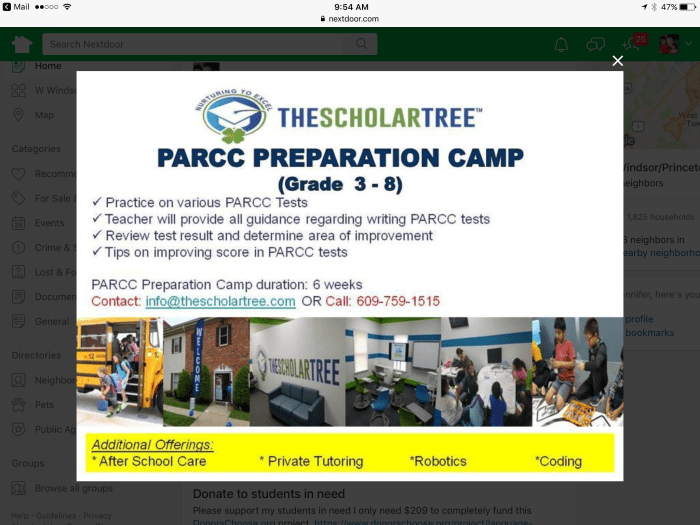
This week, an Eduflack reader shared a screen shot of a recent web page. The below was created for parents in a highly resourced, high-performing school district. It was shared as one would share promotional materials for the latest summer camp or child social activity. And it preys on the helicopter parents’ worst fears.

IMG_0420

Yep, its time to send your little ones to “PARCC Preparation Camp.” Over the course of a month and a half, your child can spend their summer days in test prep, preparing for an assessment that one is not supposed to do test prep for. You can drill and be told those areas where you need to purchase additional tutoring because the schools clearly aren’t cutting it. And I’m not even sure what you are getting when your 12-year old will receive “all guidance regarding writing PARCC tests,” but clearly that is important (it is the second selling point in a list of just four!).

And one enhances the offerings by highlighting to a STEM-obsessed parent community that additional tutoring in robotics and coding is also available. That makes it a downright party!

This is why we just can’t have nice things in the education community.

One would be hard pressed to find a parent who wouldn’t seek to give his or her child every possible help available when it comes to school. We are constantly inundated with television ads for the latest tutoring services, as for-profit companies pledge to turn the most struggling of learners into a future Nobel laureate. We purchase the latest technology, buy the latest software and apps, all in the name of giving our kids a leg up. As parents, one of our jobs is to ensure our kids are getting the best educations possible. We use the resources we have to do the best we can at that job.

But when companies are taking advantage of that parental concern — and playing up community concerns around a specific test or particular instructional content — it just makes the blood boil.

And it is should come as no surprise that such ads are populating parents’ social media at a time when the local community started to learn that the PARCC test is being used to determine whether middle schoolers get into the gifted math classes sought by so many parents. Now, if your kid doesn’t get into the math class necessary to create the next Google or Bitcoin, it is your fault as a parent for not sending them to PARCC camp when you could. (And don’t even get me started on the PARCC test prep books that are now available. I can even find them that are specific to the “New Jersey PARCC.”)

As parents, we need to do a far better job of educating ourselves on teaching and learning. Assessments like PARCC are not tests that one should be doing test prep for. They are tests meant to serve as a milestone for how the student is doing. Is my kid at a proficient level, compared with other fifth graders across the country? If not, I need to be talking to the teachers and the schools to understand where the deficiencies may be and address them appropriately and in partnership with the teacher. It isn’t a time to enroll my kid in PARCC boot camp or have them take the walk of PARCC shame.

Sadly, a great number of parents will likely sign up for this camp, and others like it across the country. They will believe these strip-mall tutors will have the cryptex necessary to crack the PARCC code, win the game, get into the Ivy League, and become the smartest, most successful person in the history of persons. Even more sad, parents will credit PARCC gains to test prep and their foresight, not to the hard work of the teacher throughout the academic year.

Or they could just have their kids do some independent reading over the summer. And play outside. And identify, develop, and pursue some of their passions during the summer months.

P.T. Barnum allegedly claimed there was a sucker born every minute. Imagine what he would have said seeing test prep outfits take advantage of parent concerns over testing and the school achievement of their kids.

What We Have Here Is a Failure in Parent Communication

Last week, when announcing his incoming secretary of education, new New Jersey Gov. Phil Murphy noted his intentions to “stop using PARCC tests.” The statement was hardly controversial. Across the Garden State, parents have spent the past three years voicing frustrations with the student assessment, reading from the talking points of Common Core and testing opponents.

So when the then governor-elect joined with parent advocates and the teachers unions in calling for the state to “create new, more effective and less class time-intrusive means for measuring student assessment,” it was no surprise that social media lit up in celebration.

Outside of Princeton, in my little Mayberry RFD, parents rejoiced. For days, Facebook has lit up with messages of parents bidding the state test adieu. They celebrated the end of PARCC. They applauded that their kids wouldn’t have to take the weeks-long tests this winter. They cheered going back to the good ol’ days. They thanked the incoming governor for finally taking action. And in doing so, their premature jubilation reveals our failures to adequately engage parents in the policy process and communicate with them on important issues.

So dear ol’ Eduflack spent the weekend being the proverbial skunk at the garden party. Pointing out that the governor’s works have to be translated into legislative action by the New Jersey state legislature. Noting that New Jersey must still administer annual assessments on almost all of its K-12 students, and that PARCC has to be replaced with something else. Highlighting that if the state doesn’t use PARCC or Smarter Balanced, then it would need to pay to develop a similar test that would have to be approved by the federal government. And making clear that, even if such actions were taken this spring, it would be years before our kids would be free from PARCC assessments in the classroom.

Yes, parents across the state and throughout the country are well intended. Yes, they are paying enough attention to the issues that they are able to share anti-testing talking points like the length of tests, the use of technology, and the absence of early childhood experts in test development. But we are doing a great disservice when we only share part of the process – and part of the solution – with families.

One can’t throw a rock in education policy discussions without hitting someone speaking of the importance of family involvement and parental voice in the discussion. Just as we like to declare the Simpson-eque, “what about the children?” in such discussion, so too do we ask where the parents are in the debate.

But too many are selective in how they want that parent voice present. We don’t want them involved in curricular discussions because that is the purview of the educators. We don’t want them to have too much power with regard to school choice, for that should be a decision of policymakers. We don’t want them involved in teacher evaluation, for they are unaware of the challenges and nuances of what happens in a school and classroom.

So we largely welcome parents twice a year to short parent-teacher conferences, we applaud when they show up for PTA meetings and school concerts, and we hope we won’t need to see them otherwise for disciplinary actions. We certainly don’t want them showing up on the school doorstep with their concerns regarding what is happening behind those doors.

Years ago, I was fortunate to collaborate with a group of tremendous researchers, scientists, educators, and parents on the book, Why Kids Can’t Read: Continuing to Challenge the Status Quo in Education. The book was designed to serve as a primer for parents to get involved in improving reading instruction in their kids’ classrooms. By focusing on what the research tells us, what is working in schools, what other parents have dealt with, and what tools can make a successful parent advocate, Why Kids Can’t Read was written to empower parents in their quest for a world-class education for their kids, for all kids.

In writing it, and since in dealing with my own struggles as a special education parent, it is clear we largely don’t want empowered parents in the schools. If we look back through history, there are only a handful of moments where education policy truly changed because of the power of parents. Instead, we prefer to keep parents at arm’s length, giving only the illusion of involvement.

If we are serious about parents as partners in the learning process, we need to figure out how to truly educate them on it. It is insufficient to equip them solely with the talking points found on social media, and then expect them to be active partners in improvement. Better, stronger educational opportunities for our children can only come when parents are better educated on the processes and policies themselves.

Otherwise, parents are simply the proverbial dog chasing the squirrel, reacting to the latest buzzwords and urban legends shared on social media with the same buzzwords and urban legends they heard the week or month before. And that’s no way to improve teaching and learning for our children.

Truth Should Not Be Subjective

In an era of “alternative facts” and opinion masquerading as media, the truth can be a hard thing to find. Over at LinkedIn Pulse, dear ol’ Eduflack writes on how New England Patriots QB Tom Brady’s claims that “everyone has different truths” and the recent analysis that President Donald Trump has made more than 2,000 false or misleading claims since assuming office is incredibly dangerous, particularly for the communications profession.

As I write:

No, truth is no longer evident; truth lies in the eye of the beholder. And that should be unacceptable, particularly for communications professionals. For those of us who deal in information, it becomes essential that we prize truth as our most coveted commodity. We should defend our positions and our organizations with all of the zealousness that our positions allow. But we must do so recognizing we can never, ever lie. There may be elasticity in advocacy or in flacking, but there is none in the base truths on which communications and public engagement is based.

Give it a read. I swear it is all true!


Let’s Resolve to Improve Edu-Communications in 2018

Speaking at the University of Baltimore’s commencement last month, Education Secretary Betsy DeVos reflected that, “we will do well to first listen, study, ponder, then speak genuinely to engage those with whom we disagree.” She continued, “voices that are quiet at first, grow in strength while those who rush to shout are humbled.”

The start of a new year is often viewed a a time to reset and to offer resolutions that result in improvement. Yes, we can spend our time ranting about what was — or was not done — under the first year of DeVos’ leadership at the U.S. Department of Education, but instead we should take this time to reflect on how we can improve public education. We should use this opportunity to highlight the big ideas that we can speak genuinely about, the ideas that, while they may face fierce disagreement, are ideas that could have real impact.

So instead about mocking the threat of bears or wringing hands over the perceived belief that we continue to privatize and profiteer from public education, let’s put forward some educational resolutions in 2018.

Let us resolve to recognize that learning — and learners — are not homogeneous. There is no one-size-fits-all approach to student learning and achievement. All students come to the classroom with varied skills, knowledge, perspectives, and life experiences. They enter the learning process at different points with different abilities and challenges. Because of this, teaching and learning must be personalized. In 2018, we need to seek out far more ways to ensure that learning is matching the needs of the student, and that teachers are empowered to tailor their teaching to meet the needs of the classroom. To do this, and in recognizing it all can’t be done via technology, we must ensure that all teachers are provided the pre-service and in-service education to deliver such differentiated instruction.

Let us also resolve that the learning environment itself is no long homogeneous. The days of the little red schoolhouse are over. Learning today is a 24-7 environment. Just as we must ensure that our traditional schools are properly resourced and supported, so too must we acknowledge the need to support out-of-school-time learning. Be it in a museum, a community center, a place of worship, or an online environment, what happens outside of school is just as important to the academic development of today’s learner as what happens in the traditional classroom.

Let us resolve to transform pre-service teacher education to meet the needs and opportunities of the classrooms of tomorrow. With each passing year, we ask more and more of our teachers. We look to them to educate, guide, assess, and support. We place greater and greater emphasis on the outcomes of their practice. That means ensuring pathways to preparation that emphasize what they will experience in the classroom, that focus on outcomes and demonstrating that they can apply all that they are taught, and that give them every opportunity to succeed as a teacher from day one. We can’t shortchange teacher education, nor can we expect that the preparation pathways of decades past will still meet the needs of classrooms in 2018.

Let us resolve that school choice is not the magic elixir that will solve all that ails k-12 education. Yes, options are important for families. But we cannot overlook that the vast majority of school-aged kids today attend traditional public schools and will continue to attend them. Our attentions and resources – both financial and human – should be directed proportionally, based on where kids are today.

Let us resolve that a college degree in the liberal arts is not the solution for every child. Yes, postsecondary education is a non-negotiable today. But that education can be found at community colleges. It can be discovered in career and technical education programs. It can be found in STEM and computer science. College is just as much about equipping learners with career skills and opportunities as it is helping them become lifelong learners. We mustn’t let our focus linger on the latter, to the detriment of the former.

And most importantly, in the words of Secretary DeVos, we must resolve to engage those with whom we disagree. As we look to 2018, there are many big ideas on which we can and should be focused. Building the schools and classrooms of tomorrow. Personalizing learning for all, based on both learner interests and needs, and doing so beyond just the computer screen. Expanding our worldview of assessment beyond the summative. Strengthening our educational systems to best serve special education and ELL students. Enhancing career/technical education and STEM offerings to keep up with the ever-changing reality of our digital, Information Age. Real investment in these areas only happens when we are able to break down the walls, and engage in tough yet meaningful dialogues on what our schools, our educators, and our learners need to succeed in the future.

Such dialogue on these essential issues is required if we are to look to the bigger, bolder, dream issues that education can face. How do we empower educators to design the right learning opportunities for all those they are teaching? How do we effectively use assisted and augmented reality offerings to improve the learning process? How do we demonstrate that learning is about mastery and doing, and not just about ticking off items on a prescribed checklist? How do we bring educators and parents together as partners in the learning process? How do we enlighten all those in the process to see the value in high-quality assessments? How do we embrace the notion that standards — whether for teachers or learners — are intended to be floors and not ceilings?

When it comes to education, the new year is one chock full of both challenges and opportunities. Yes, we can muddle through another year, making some incremental gains or slippages, based on the perspective. Or we can acknowledge that we, as a community, agree on far more than we disagree with. Even the most hardened status quoer and the most indignant reformer can and should agree on 75 percent of all that faces education today. It is in that remaining 25 percent that we have our most robust discussions and disagreements.

In that 25 percent, we must heed the advice of the EdSec and speak genuinely and engage on those important topics. No, we won’t agree. We probably shouldn’t agree. But we if disagree in a respectful and thoughtful manner, and continue to have those dialogues over the areas of disagreement, we can move toward a better teachers, better learners, and a stronger educational tapestry for virtually all.

It may seem awfully simplistic, but our big idea for education in 2018 should be improved communication. Our resolutions for the new year should focus on how we improve the substance and depth of our conversations. And our engagements should reflect active listening, where we actually hear those we may disagree with, rather than think about what our next dazzling talking point should be. If we are serious about improving education, the simplicity of communication may be our most effective tool.

(A version of this post appeared on LinkedIn Pulse.)